
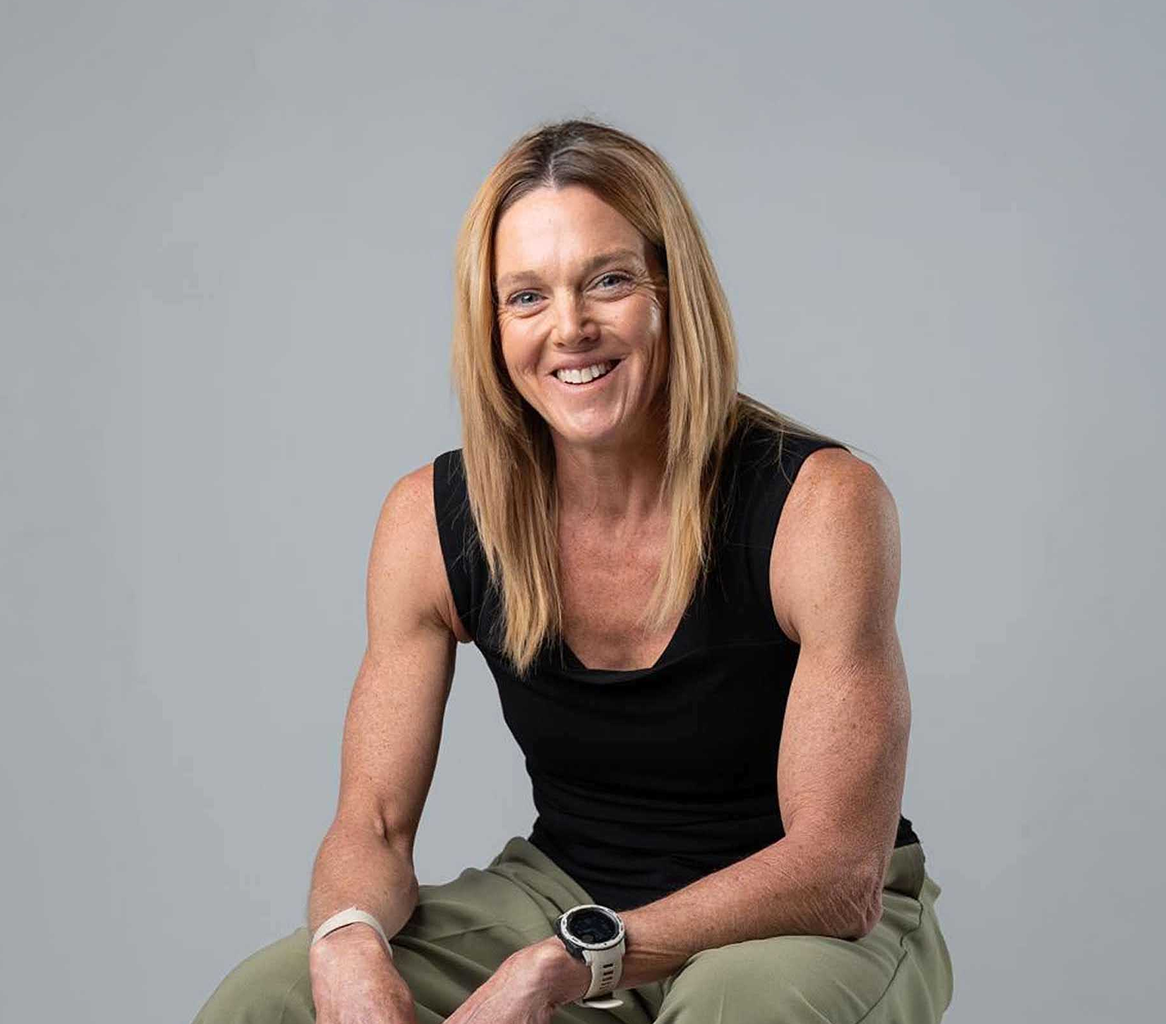
Stacy Sims wants to race bikes against her friends when she is 107. This is not a metaphor. Her great-grandmother lived to 105, her grandmother to 106, her other grandmother to 97, and all three kept their own houses and their own minds; walk into the great-grandmother’s place and you’d be told, “We’re playing cards.” Sims is a former professional cyclist and Ironman triathlete, an exercise physiologist and nutrition scientist who has run research programs at Stanford, AUT University, and the University of Waikato, and the author of ROAR and Next Level. She lives at the beach in Mount Maunganui, New Zealand, with her Kiwi husband and their daughter, and she has spent 25 years saying the same four words to anyone who will listen: women are not small men.
The line came out of a real problem. When she was racing in the late ’90s and early 2000s, the training plans handed to the women’s peloton were written for men, with no account of mood or menstrual cycle or anything else she was reading about in her own PhD work. The research backed up what the riders were feeling: a 2021 audit of six major sport and exercise science journals found that only 6 percent of studies were done on women alone. Now, she says, the same gap is reopening in the fastest-growing field in health. “Maybe one percent of the longevity research is done on active women, if that.” Her worry is that AI will cement it, because a chatbot trained on male data gives everyone male answers.
So she is building the other data set. Collective X Health, which she co-founded and where she is chief research officer, came out of stealth this month with $3.2 million to fund female-specific research and give coaches, researchers, and active women a search tool that only surfaces evidence actually about women. A book on healthspan for active women is due next year. And on November 7 she flies in from New Zealand to captain Stacy Sims’ Canyon Ranch SuperAgers at the Super Age Games in New York, where the biomarker she’s most nervous about is cognition, mostly because of the jet lag. Her own week is three heavy lifting sessions, one true high-intensity session, and two or three bike rides in nature she calls soul food. Her advice to most women over 40 is not to do more. It’s to do less, harder, and then go outside.
Let’s talk about exercise physiology. What’s actually different between men and women?
“It starts in utero. By the nature of being XX, girls into women are born with more of the proteins and mitochondria for being able to use fatty acids. We see differences in bone density, bone structure. XY men have more hemoglobin and red cell and iron counts. Women have smaller hearts, smaller lungs. But if we look at exercise, nutrition, sport, it’s all just been generalized from a male model.”
“When we’re thinking about artificial intelligence, it’s learning from the data sets that are there, and all those are already male biased. So when we’re getting recommendations from AI, it’s still perpetuating that gender data gap.”
I’m a 65-year-old guy. How should your exercise profile look different than mine?
“Women don’t age in a linear fashion like men do. Around 60, 65, there’s a decrease in lean mass, bone density, changes in lipid levels. That’s a male model. In women, because of perimenopause, there’s a discernible demarcation around the mid-40s. A drop in lean mass, an increase in body fat, specifically that deep abdominal visceral fat, changes in mood, cognition, gut microbiome. All of these things are compacted in perimenopause, whereas men have a longer time for all these changes to happen.”
“So we have to look at an external stress that’s going to create an adaptive response the way our hormones used to. Instead of the typical pink dumbbell, two sets of 30 reps, which you could get away with in your 20s, when you’re in your 40s it doesn’t work. It’s a metabolic stress that doesn’t create lean mass, nor does it increase strength and power. We have to look at power-based training, because that’s a central nervous system response: really heavy loads, low reps, one or two left before complete failure. Now the nerves are saying, hey, wait a second, we need to recruit more fibers, we need faster nerve conduction, and by the way, we need to build more lean mass.”
“If a man was in his 40s, he could get away with hypertrophy-type work to failure, 20 to 30 reps, and still gain lean mass. For women in their perimenopausal years, it’s not a strong enough stress to invoke change.”

Sign Up for the AGEIST newsletter
And zone 2? Everyone’s been told to live there.
“By the nature of being XX, women are already metabolically flexible. They already burn fat. The zone 2 data is all about improving metabolic flexibility and fat burning, and women are already there. So we don’t need to spend time there. What we need to do is polarize, to keep our fast-twitch fibers, to keep producing lactate, because the brain needs lactate for the gray matter.”
“I get pushback from the ultrarunners who want their long run or their long ride. I’m not saying don’t do it. I’m saying go do your soul food. Go for your hike with your friends, go for a group ride. But don’t make that the bread and butter. Two to three really good high-intensity sessions a week. It’s not about how often or how long. It’s about the quality of the work.”
Put some numbers on high intensity for me.
“The boot camp classes are not true high intensity. True high-intensity interval training might be 40 to 45 minutes total with a good warm-up and cool-down, and the work is one to four minutes at 80 to 85 percent with variable recovery. At the end you’ve spent 18 to 20 minutes in that zone, but you could hold it because you weren’t trying to hold it for 20 straight.”
“Sprint interval training is 30 seconds or less, as hard as you possibly can go, with two to five minutes recovery. On the assault bike: go as hard as you can for 30 seconds, fully recover, then chase those meters and beat them. Everyone loves it. It’s horrible. But that’s a complete system response telling the body we don’t need to store visceral fat and we need to increase insulin sensitivity.”
“If you can’t hit the actual intensities, you fall into moderate intensity, and this is the problem so many women end up in. Moderate intensity just creates more sympathetic drive, and you don’t get any of the changes to muscle quality or body composition because your body is in the stressed state. This is where I get women in their 40s going, ‘I’m doing all this stuff and it’s not working.’ We pull people back to two really specific workouts a week, and they understand: if I try to do four, I just hit moderate intensity.”
Her own lifting sessions run about 25 minutes: front squats and hip thrusts, five reps every two minutes, five or six sets, full recovery, no supersets. Monday squat, Wednesday push-pull, Thursday posterior chain, a couple of those days capped with battle ropes or kettlebell swings for the sprint work.
My trainers have me on four sets of 10, 90 seconds rest, an hour and a half a day.
“What are you doing with four sets of 10? Are you trying to get fatigue? Are you trying to get hypertrophy? When people do a lot of metabolic stress, the higher reps and lower loads, it invokes more stress. If you’re doing the heavier loads and fewer reps, you leave feeling worked but not exhausted. And that feeds forward to a better parasympathetic drive later.”
Sign Up for the AGEIST newsletter
I make it a point never to be prescriptive about food. What are your thoughts on nutrition?
“I always bring it back to the gut microbiome. One of the huge driving factors of poor body composition is a very poor gut microbiome. So get as much fruit and veg and whole grains as you can, really garner that fiber, and make that the base of everything. High protein, but it doesn’t matter if it’s animal or plant, have a mix. And it’s the 80/20 rule. Eighty percent of the time you’re nailing it. Twenty percent is life. If someone brings you a really nice bottle of wine or whiskey, you don’t want to say, ‘I can’t have that because it doesn’t work with my ethos at the moment.’ Enjoy it. Life’s too short.”
People hear they need 170 grams of protein a day and panic.
“The recommended daily allowance is based on the least amount you should have to prevent malnutrition. If you’re very active, going to the gym, doing cardio, you’re trying to get 2 to 2.3 grams per kilo a day, around 1 to 1.1 grams per pound. But when you start looking at all the things that have protein in them, you’d be surprised: green peas, edamame, nuts, seeds, spelt, amaranth, bulgur, even Brussels sprouts. When I do a schematic for a vegan, chia seeds and oatmeal with nut butter for breakfast, veggies and grains for lunch, tofu curry for dinner, all of a sudden there’s 150 grams in there and they’re like, ‘Whoa, how did I do that?’”
How do you counsel people to fuel through the day around these workouts?
“There’s definitely a sex difference. Women should not do any kind of fasted training. Some protein and carb before a first-thing-in-the-morning workout, then a real breakfast. Smaller regular meals through the day. If you’re trying to lose weight but still train hard, take maybe 150 calories away from dinner, usually a glass of wine or a slightly smaller plate, not enough to create a calorie-restrictive response in the brain. We take it from dinner because less food at night means you sleep better.”
“Men are more resistant to negative outcomes. You can do fasted training. It’s not necessarily ideal, but you can get away with it. Men can have a big bolus of protein and that’s fine. Women need to break it up.”
Which brings me to time-restricted eating.
“Buzzwords, right? For women, we really need to eat within half an hour of waking up to counter that cortisol peak, because if we don’t, the hypothalamus is like, we’re in a bit of a fight-or-flight situation, so the first thing I’m going to do is start catabolizing lean mass. For women, time-restricted eating is just normal eating: breakfast, dinner, no snacks after dinner, stop eating two to three hours before bed, wake up, eat within half an hour. For men there’s a little more leeway. But circadian rhythms are set with daylight and food, so if you’re trying to get even energy, train hard, and sleep well, you probably shouldn’t be holding a really long fasting window either.”
“We’ve done a few studies with continuous glucose monitors and sleep studies, and a lot of people who wake up a lot are hypoglycemic because they haven’t eaten enough in the day.”
You’ve said empathy belongs in the conversation about stress. Take us there.
“Over the past few years I’ve seen a significant loss of empathy and support networks. Human beings are social by nature, but the friendships aren’t real. People are looking at friendships through likes and swiping, and there’s no real connection. And people are so angry. As we get older we really want to foster empathy and understand where another person is coming from instead of jumping to a reaction, because we need those social connections. If you have empathy and you can respond in kindness, then people will take a step back and do the same.”
So lack of empathy means anger and stress, and you never get into a parasympathetic state. You never recover.
“Absolutely. If you’re a figure on social media and someone leaves negative comments, most of us know not to read them, but sometimes it comes through and you have the significant negative reaction, and it stays with you for weeks. It damages the ability to recover and relax. So if one comment can do that to one person, all the rhetoric that goes around is creating this massive mental distress and lack of ability to relax and sleep well and enjoy life.”
Editor’s Note: Answers have been condensed and edited for clarity.
Connect with Dr. Stacy Sims: Website & Courses / Instagram (@drstacysims) / Collective X Health
Books: ROAR & Next Level
Join Stacy Sims’ Canyon Ranch SuperAgers at the Super Age Games, November 7, New York City: games.superage.com
Don’t Miss