
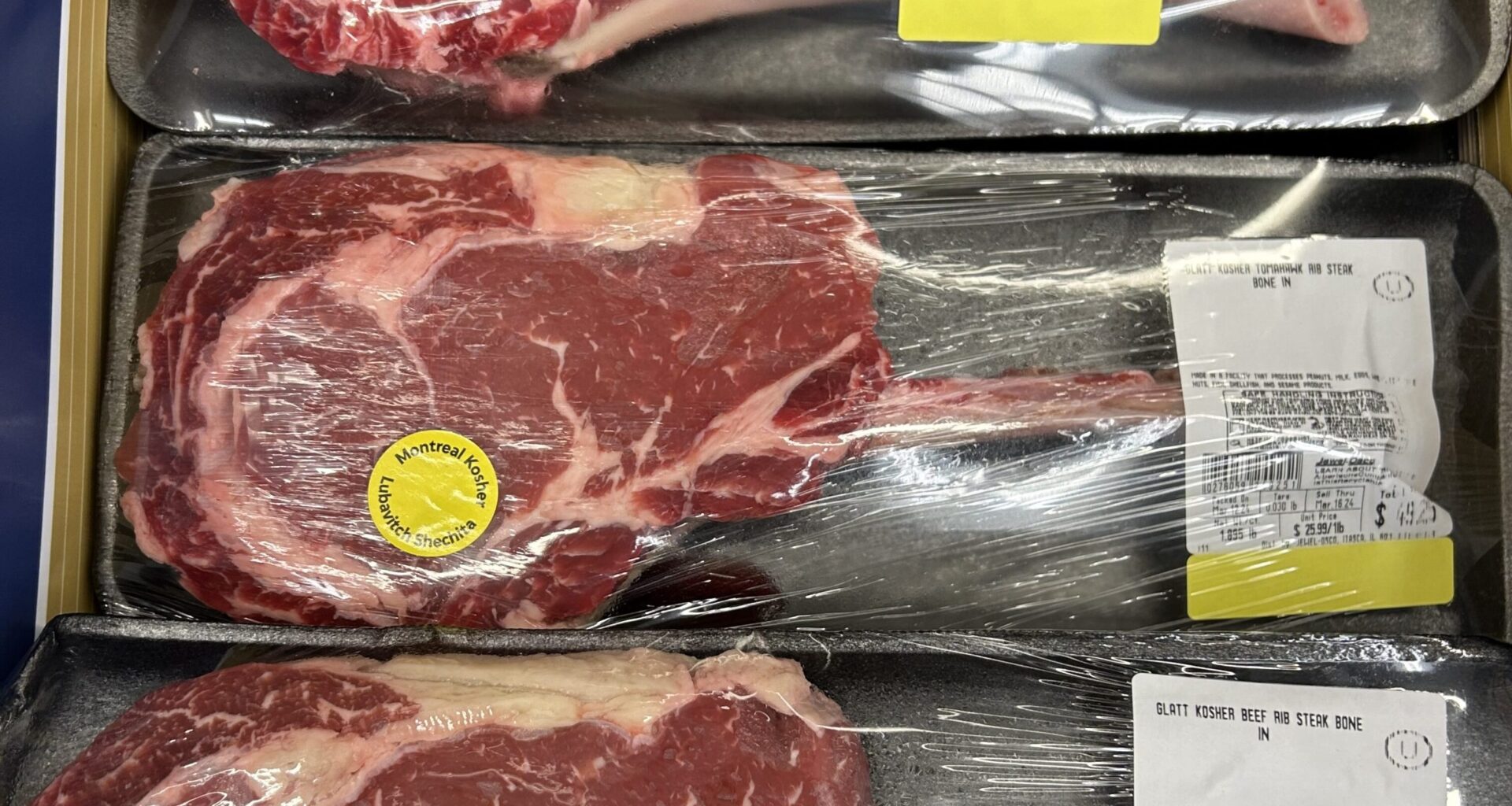
Ottawa is spending $40 million over six years “to support the resilience and productivity” of Canada’s kosher and halal red meat (beef and veal) sector, helping address unique challenges of kosher and halal slaughter under Jewish and Islamic dietary laws.
The funding was a small mention on page 273, in a table in the federal Budget 2025 under “Health, Immigration, Culture and Communities expenditures: Supports for Kosher and Halal practices in Red Meat Production” via Agriculture and Agri-Food Canada (AAFC) and the Canadian Food Inspection Agency (CFIA).
That includes new and existing funding commitments to AAFC and the CFIA through 2029-2030 to help licensed kosher and halal meat producers comply with the 2019 Safe Food for Canadians Regulations.
The CFIA will also receive new learning materials, digital tools, and guidance for staff and abattoirs, plus funding equivalent to six full-time employees overseeing kosher and halal slaughter inspection.
A total of $29 million is allocated to AAFC for the new Kosher and Halal Investment, AgriAssurance, and AgriMarketing programs. The largest portion, $25 million, supports slaughter establishments with quality assurance systems, efficiency improvements, new technology and equipment, and promotion of international trade in Canadian kosher and halal meat. Financing is offered over two fiscal years (2025–2027).
It’s unclear if the programs will have any real effect on Canada’s kosher meat supply, and while AAFC says it is finalizing funding agreements, only one project is approved to date: Beretta Farms Ltd. (This includes about $179,000 to introduce traditional halal slaughter techniques at its Alberta operations, along with enhanced stunning methods.)
The programs follow the CFIA’s 2019 regulations mandating specific tests to confirm animals were unconscious after ritual slaughter without pre-slaughter stunning, including absence of rhythmic breathing and corneal reflex. These rules increased costs, slowed production by several minutes per animal, and reduced efficiency to the point that some licence holders shuttered their kosher meat operations, including one large packer north of Montreal that processed more than 1,000 cattle weekly.
Canada’s largest kosher meat distributor, Mehadrin, together with Shefa Meats, the Kashruth Council of Canada (COR) and MK Kosher (MK), went to Federal Court to stop CFIA enforcement of the guidelines. They argued the rules had a devastating impact on Canada’s kosher meat supply, depriving Canadian Jews of an important religious precept, and were unreasonable or beyond CFIA authority, as well as discriminatory and infringing Charter rights.
Judge Guy Régimbald agreed, granting an injunction in July 2024 halting enforcement of certain unconsciousness indicators until final resolution of the issues. Other 2019 regulations remain enforceable, including requirements that animals be unconscious before hoisting in ritual and non-ritual slaughter
Sidney Nemes, whose family operated Montreal’s J & R Kosher Meat and Delicatessen for half a century before its closure in 2023, and who now advises industry players, told The CJN the market is constrained by large producers, with many abattoirs tied to bigger processors.
“Canada does not have a rich source of kosher producers,” he said, noting that fewer operators opt to include kosher slaughter. While he said the programs can help and he has worked with some companies considering grants, particularly in Ontario, “it doesn’t seem to have attracted wide interest.”
The CJN asked Montreal-based MK Kosher whether the programs were a community ask of government and if the grants were sufficient to help producers offset new costs but received no response. COR managing director Richard Rabkin told The CJN he was not familiar with any producers applying for the grants and did not know much about the program.
Asked about the new funding, Mount Royal MP Anthony Housefather said it stemmed from discussions last year, telling The CJN, “One solution was to help provide those slaughterhouses doing kosher slaughter adapt their facilities to remain profitable, even with the longer time frame required on each animal slaughtered, which meant more lines were needed. At least some of these monies are towards helping adapt facilities.”
Contributions are generally capped at $2 million, covering up to 50 per cent of project costs. The AgriMarketing program includes an additional $2 million to boost kosher and halal red meat export and market development, and AAFC will raise its maximum contribution to 70 per cent for projects targeting markets such as Bangladesh, Malaysia, Pakistan and Sri Lanka, or for businesses more than 50 per cent owned or led by an “underrepresented and marginalized group,” including Indigenous Peoples, women, 2SLGBTQI+, visible minorities, and persons with disabilities.
Montreal-based Mehadrin procures and distributes about three-quarters of the kosher meat from Canadian licenced slaughterhouses, with Toronto-based Shefa Meats picking up the balance. Court documents show Mehadrin also imports kosher beef from Mexico and Argentina and exports 30 to 40 per cent of its beef to the United States.
The CJN asked Mehadrin’s CEO, Chaim Moskovits, if they had occasion to access grants within the new program. “It only applies to those who are doing the physical slaughtering,” he said. “We think it may be a good idea and I know a few people trying to access the project, but it’s too early to know so we really can’t answer anything much yet.”
A similar view was expressed by Premier Kosher, known for its large kosher poultry business outside Hamilton, Ont. “We recently ramped up our red meat operations,” plant manager Sebastian Gedja told The CJN, though the company does not operate its own slaughtering facilities. On other aspects of the government programs and CFIA guidelines, he said, “we still need to do some more research on how this will affect producers as it’s difficult to adhere to all these regulatory requirements. So, while it’s definitely of interest, it’s too early to comment.”
Asked about the program, past and current lobbying efforts regarding the guidelines, the Centre for Israel and Jewish Affairs (CIJA) did not comment in time for publication.

Joel has spent his entire adult life scribbling. For two decades, he freelanced for more than a dozen North American and European trade publications, writing on home decor, HR, agriculture, defense technologies and more. Having lived at 14 addresses in and around Greater Montreal, for 17 years he worked as reporter for a local community newspaper, covering the education, political and municipal beats in seven cities and boroughs. He loves to bike, swim, watch NBA and kvetch about politics.