
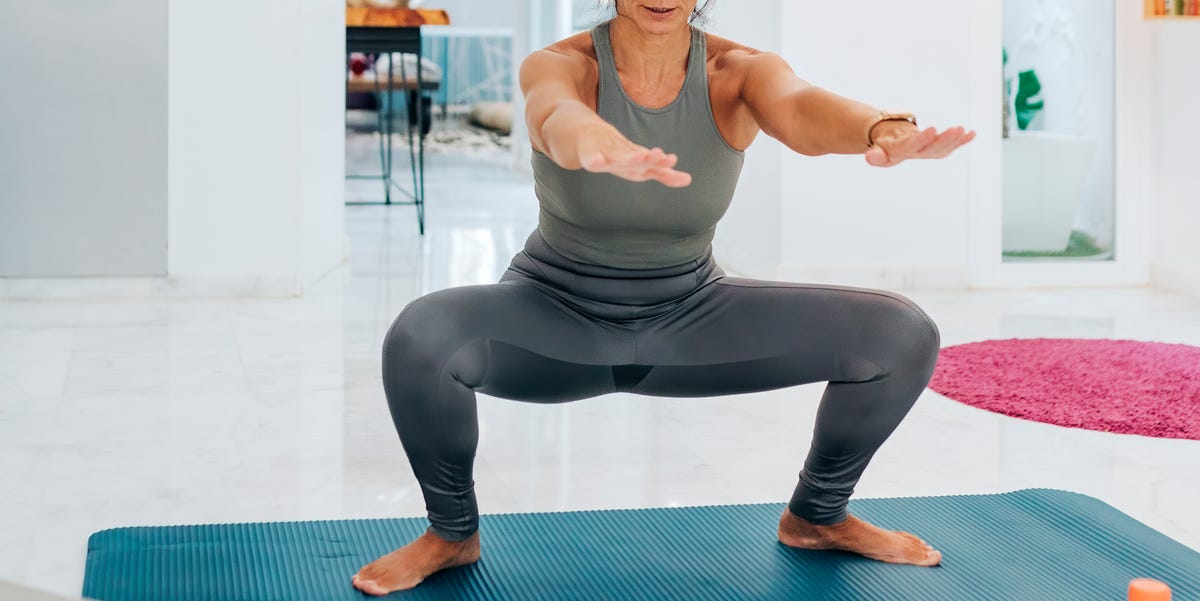
While strength and mobility naturally decline with age (a 47-year study recently revealed fitness and strength start dropping as early as 35), several small, simple moves have the power to counteract that decline. One such exercise? The horse stance.
Spotlighted by mobility expert Fabio Sparano, known as Fab Mobility online, in a recent video, the exercise – which can be done anywhere – builds ‘serious leg strength and stability that keeps you moving strong for years.’
Why is the horse stance effective?
The exercise supports longevity because it mirrors the strength required for everyday movements and activities. ‘Our thigh and back muscles work hard the whole time, and this strength helps you stand up from a chair, walk up stairs and stay steady on your feet every day,’ explains Sparano. ‘It also keeps your lower-back safe – your abdominal muscles have to work hard to keep your back straight, which protects your spine.’ This is particularly beneficial if you’re sitting at a desk all day and when you need to bend down to pick something up.
It’s also great for balance because in the position, ‘your ankles, knees and hips all work together to keep you from falling over, which teaches your body how to stay balanced and keeps you from falling as you get older,’ adds Sparano.
How to do the horse stance
‘Like a sumo wrestler, stand with your feet wider than your shoulders, pointing the toes out slightly. Now, sit down, drop your hips, and go until your thighs are in line with your knees at 90 degrees, or as low as you can go,’ says Sparano. ‘Put your weight on both feet equally – imagine roots growing from your feet to the ground, solid and stable. Hold this, starting with five seconds.’
Regressions
For an easier version of the horse stance, Sparano advises holding onto a chair to take some of the weight off your legs, and to let go of the chair for 10-second intervals once you feel more confident.
If that’s still too difficult, Sparano recommends performing a smaller movement, where you don’t go as low – ’you’re still building leg strength, working your balance and waking up the core [muscles] that protect your lower-back.’
Progressions
Once you can hold the horse stance for one minute, Sparano encourages trying some harder versions. Although you might also just choose to continue gradually building how long you can hold the position daily.
The kung fu flow
Hold the standard horse stance, but shift your weight from side to side, holding for three seconds each time. This ‘teaches your body to stay balanced while moving, which is exactly what you need when you walk on uneven ground,’ says Sparano.
The karate strength pulse
Sitting deeper than the standard horse stance and feeling the stretch in your hips, pulse up and down an inch or two, instructs Sparano. Once this feels relatively easy, you can add weight. This progression builds explosive leg strength.
Common mistakes to avoid
Before you start, Sparano highlights these common mistakes.
Knees caving in: Your knees need to point the same way as your toes, otherwise the movement won’t be effective and you risk knee injuries.
Leaning forward: Stand tall, with your chest up, otherwise you’ll put pressure on your lower-back.
Breath holding: Even when your legs start burning, resist holding your breath – ’deep breathing in through your nose and out through your mouth keeps you calm and gets oxygen to your muscles so they can keep working.’
Going too fast: Movements need to be smooth and controlled otherwise you’ll lose your balance and risk injury.
‘Speed doesn’t matter here. The horse stance builds your legs, protects your lower-back and gives you balance that keeps you moving confidently for decades to come.’
After years living with endometriosis and undergoing seven rounds of IVF, Radio 4 presenter Emma Barnett turned to training with PT Frankie Holah to rebuild strength and a more positive relationship with her body. Download the Women’s Health UK app to access Frankie’s full training plan.
 Related Stories
Hannah Bradfield is a Senior Health and Fitness Writer for Women’s Health UK. An NCTJ-accredited journalist, Hannah graduated from Loughborough University with a BA in English and Sport Science and an MA in Media and Cultural Analysis. She has been covering sports, health and fitness for the last five years and has created content for outlets including BBC Sport, BBC Sounds, Runner’s World and Stylist. She especially enjoys interviewing those working within the community to improve access to sport, exercise and wellness. Hannah is a 2024 John Schofield Trust Fellow and was also named a 2022 Rising Star in Journalism by The Printing Charity. A keen runner, Hannah was firmly a sprinter growing up (also dabbling in long jump) but has since transitioned to longer-distance running. While 10K is her favoured race distance, she loves running or volunteering at parkrun every Saturday, followed, of course, by pastries. She’s always looking for fun new runs and races to do and brunch spots to try.