
When observant Jews shop for food says Mendy Boyarsky, “they grab it and look for the heksher (kosher symbol). Most don’t care if it’s a KSR, an MK, COR or Star K.”
But increasingly, he says, it’s the “other” thing that gives them pause: the price, the owner of Montreal’s new Aleph Butcher shop told The CJN. “It’s completely out of control.”
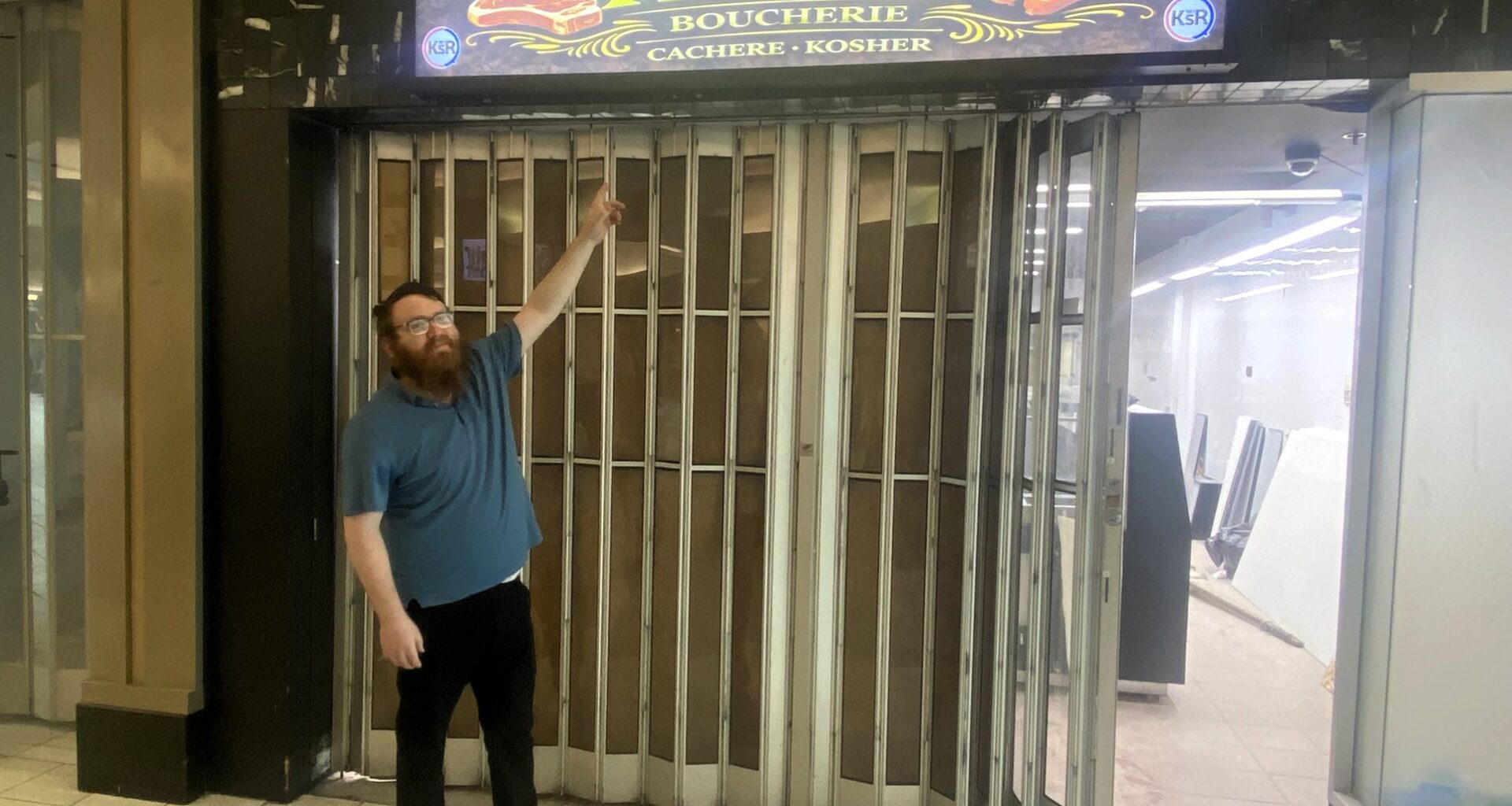
Boyarsky’s new store is opening in the west end, in the space where J & R Kosher Meat and Delicatessen operated for decades, in Côte Saint Luc’s Quartier Cavendish (Cavendish Mall). But Aleph isn’t your typical store, says Boyarsky. “I’m in it for one reason only,” he said a week before the grand opening. “Create competition and lower the cost of kosher food in Montreal. I’m on a mission.”
Ordinarily, a new store is no huge deal, but in Montreal, where ordinary food costs have become problematic, it’s even more so for Jewish families trying to observe kashrut.
“A meat store? Here? Such good news!” said Aline Malka, clapping her hands and repeating the refrain heard from dozens of people peering through the papered-over glass door fronting the store, as Boyarsky talks to a reporter about his plan.
“When can we come in?” asked her companion. “March 23, God-willing” his rote reply. “Will you have chicken feet and cows’ feet?” asked a young man in French, walking by with a young child in tow. As workers complete floor surfacing and equipment awaits installation, Boyarsky lets out a chuckle: “There’s definitely a reaction.”
His associate Sid Nemes is also busy, shuttling to and from Argentina to secure another container’s worth of kosher beef for the store in anticipation of the demand following next week’s soft opening. Nemes, whose family operated Montreal’s J & R for half a century before its closure in 2023, is overseeing operations for Boyarsky, telling The CJN a full container of beef is ready for opening day, “and we’ve already followed up with a second. We’re doubling the order.”
Aleph will be certified KSR, Montreal’s “younger” kosher certifying authority, launched in 1978 by Quebec’s Chief Sephardic Rabbi David Sabbah. Its heksher is found on most west-end kosher eateries and increasing – about three dozen to date – numbers of businesses and including many products from bread to honey. It’s growing in popularity and recognition in Montreal, just as the Jewish population itself evolves, with a growing Sephardi community.
Boyarsky’s vision is simple: reduce costs through low profit margins, direct sourcing of beef, and alternative certification. That’s the root of big savings said Boyarsky, adding, “KSR are doing it for the same reason. It was a mechayeh (a pleasure) working with them. They were very, very reasonable, very affordable, it was a no-brainer. It wasn’t even ‘let me counter-offer, let me negotiate.’ To put it bluntly, it’s as if KSR was doing it for free, because they want to serve Montreal. I think it means a lot to Rabbi Sabbah that people have kosher meat.”
Boyarsky made a point of explaining why he didn’t work with one of Canada’s largest certifiers – Montreal Kosher (MK), which has been in business for a century and dominates the market in Montreal, certifying more than 150 companies. “I wouldn’t even have considered working with MK. Not for a second.”
Harsh words, he agrees, but he actually faults Montreal’s oldest and most well-known authority for what he calls favouring dominant importers and producers, like Canada’s largest kosher meat distributor Mehadrin, which procures and distributes about three-quarters of the kosher output from Canadian slaughterhouses and imports from Mexico and Argentina.
That he says, makes it near impossible for smaller players to bring in new products, to the detriment of the Jewish community. “Because there’s no competition, Jewish families pay far more. It’s wrong and it has to stop.”
While he acknowledges MK is the hechsher of choice for many large food producers, he insists there’s far more to it. “So they certify Heinz ketchup? Lovely! It would be nice if people could afford a hot dog, or maybe some smoked meat between the bread and the condiment.”
“There’s a monopoly in Montreal and without competition the prices of meat rise faster in Montreal than the challah. People have been getting ripped off for 30 years and we haven’t seen any relief from anybody. I’m sure if they wanted to lower the prices, they could do so very quickly. In my opinion, MK should have went to the biggest producers and said, ‘Either the price goes down or we’re going to let other people come in and pressure the prices down immediately.’”
The CJN asked MK and Jewish Community Council (JCC) director Rabbi Saul Emanuel, about the issues raised, notably, if MK is making it too difficult for competition in Montreal, and what he thinks about Montreal families traveling out of the city to find kosher meat cheaper than in their own neighbourhoods. Rabbi Emanuel did not respond to The CJN’s queries.
KSR is no new kid on the block, but they are smaller than MK. “Yes, it’s true we are the smaller one in Montreal,” KSR’s Amram Sabbah told The CJN, “they are the first, but we are happy to be the second, the younger ones.”
Nemes said he told Rabbi Sabbah what they wanted “and he came back very quickly and said ‘Absolutely, we can do this’. We sourced the proper (kosher slaughterers) and went to Argentina with our team. We met everybody, created relationships, and Chief Rabbi David Sabbah went down to check it all out and authorized it.”
What has garnered the most attention about Boyarsky’s new venture, apart from the hype about opening the week before Passover, is his very assertive posture that Montreal needs a new model of retail and kosher certification to create competition. And he finds the reactions both amusing and disturbing.
“All of a sudden a few Ashkenazim are working with Sephardi heksherim (kosher certifiers) and people lose their minds,” he laughs, attributing the fuss to “some small groups that are racist towards the Sephardic community and don’t respect it. KSR is a perfectly valid certifier, in Chabad especially, that attitude has been completely thrown out. We respect it 100 per cent. Anybody who thinks KSR is inferior, it’s just outward racism towards the Sephardi community.”
Boyarsky said he was moved to act after seeing a woman wincing at the price of kosher food in a store case. “Her eyes nearly popped out of her head and she dropped the package and moved on. I don’t know if she bought meat that day or if she bought trayf (non-kosher).” A few days later, his own simple meat order for a small gathering ran above $800. “And for nothing special. It’s out of control and Montrealers have needed relief from these prices for years, but it’s never happened because there’s no competition.”
He says there will be regular savings. “I don’t need to lose money, we just need to do fair prices, particularly on products families need so they can stock up. And these are staples: ground beef, chicken, London broil. Everything will be significantly cheaper.” Simply put says Boyarsky, Jewish families need another alternative to not eating meat, eating non-kosher, or even hitting the road to New York or New Jersey to load up.
“It’s ridiculous. It’s easier for a family to head down to Monsey or Lakewood or Borough Park and load up whatever the limit is and bring it home.” And it’s often from the same large company that sells around the corner from their home, he says, “far cheaper.” (Mehadrin products for example, are not only ubiquitous in Montreal and across Canada, but available at U.S. stores including Trader Joe’s locations along the U.S. east coast.)
Even with travel and exchange, he says, significant savings are possible. Indeed, kosher meat in Montreal is typically 35-55 per cent more expensive than in the larger U.S. markets. A quick, recent comparison of advertised Montreal and New York grocery prices, shows a pound of kosher medium ground beef typically fetching about US$10 versus about US$15 (Cdn. $20.50) in Montreal, while whole kosher chicken can cost 50 per cent more in Montreal, with wide spreads in prices depending on location. The difference is more marked on items like brisket and rib steak.
“I’ve heard that and it’s embarrassing,” says Elie, a 45-year-old father from Côte des Neiges, bringing his children to the health clinic next door. “Some things should be beyond ‘cold, hard business.’ What this man is doing is wonderful.” The CJN asked another Orthodox shopper what he thought, the man waving off the question, saying, “let’s see the quality of kosher.” Asked to clarify, he replied, “it’s not all the same, but I wish him luck.”
Nemes says the new store has already changed the market in Montreal. “Take a look at some recent specials advertised in different stores – you can see already a few things dropping,” he laughs, “because of all the talk about competition coming.”
Aleph will employ about 10 people with three or four butchers on-site, with fully stocked meat cases and a selection of prepared meals, along with a full line of COR-certified Premier Kosher chicken from Toronto.
But Boyarsky’s vision goes beyond the 4,500-sq.-ft. store, and he wants Aleph meats in other stores, restaurants and institutions. “We’re working with some very big retailers to carry our products. One is confirmed, and a few others we’re working on, in Montreal and across Canada.” He’s mum on details but says “when people see our products in those stores, heads will spin.”
He says he has received some pushback in the form of calls or comments from “concerned people, in the business who are worried about losing their part of the market. I’m just being told ‘You better not do this, it can’t happen,’ but I couldn’t care less. It’s happening and nothing is stopping it.”
But he laughs it off, and says “the big winner will not be me, not KSR, not MK. The big winner will be Montreal consumers. There’s a million businesses I can go into. I don’t need to go into this to get screamed at, I’m doing this strictly to help the community. This is just my way of giving back.”
Indeed, Boyarsky and his family are better known for their real estate activity, particularly in the Snowdon neighbourhood surrounding the Décarie Expressway, their interests including hotels, and TAV College, which changed the game in Quebec for private college access, both for the Orthodox Jewish and wider Quebec communities.
The arrival of Aleph comes while kosher food availability and affordability in Canada is in flux. Last year, Ottawa announced $40 million to support companies doing kosher and halal operations, funding also meant to help producers comply with 2019 Safe Food for Canadians Regulations which increased costs, slowed production, and reduced efficiency to the point that some licence holders shuttered kosher production.
Mehadrin, together with Shefa Meats, the Kashruth Council of Canada (COR) and MK, went to Federal Court to stop enforcement of the guidelines and the court agreed, granting a July 2024 injunction halting enforcement of certain provisions until a final resolution.
It’s unclear if the federal cash will significantly affect Canada’s kosher meat supply, with only two projects approved to date: Beretta Farms Ltd., received approximately $179,000 to introduce halal slaughter at its Alberta operations with enhanced stunning methods; and P.E.I.-based Atlantic Beef Products Inc., about $2.2 million to recover more products from beef carcasses and improve halal packaging for retailers.

Joel has spent his entire adult life scribbling. For two decades, he freelanced for more than a dozen North American and European trade publications, writing on home decor, HR, agriculture, defense technologies and more. Having lived at 14 addresses in and around Greater Montreal, for 17 years he worked as reporter for a local community newspaper, covering the education, political and municipal beats in seven cities and boroughs. He loves to bike, swim, watch NBA and kvetch about politics.