
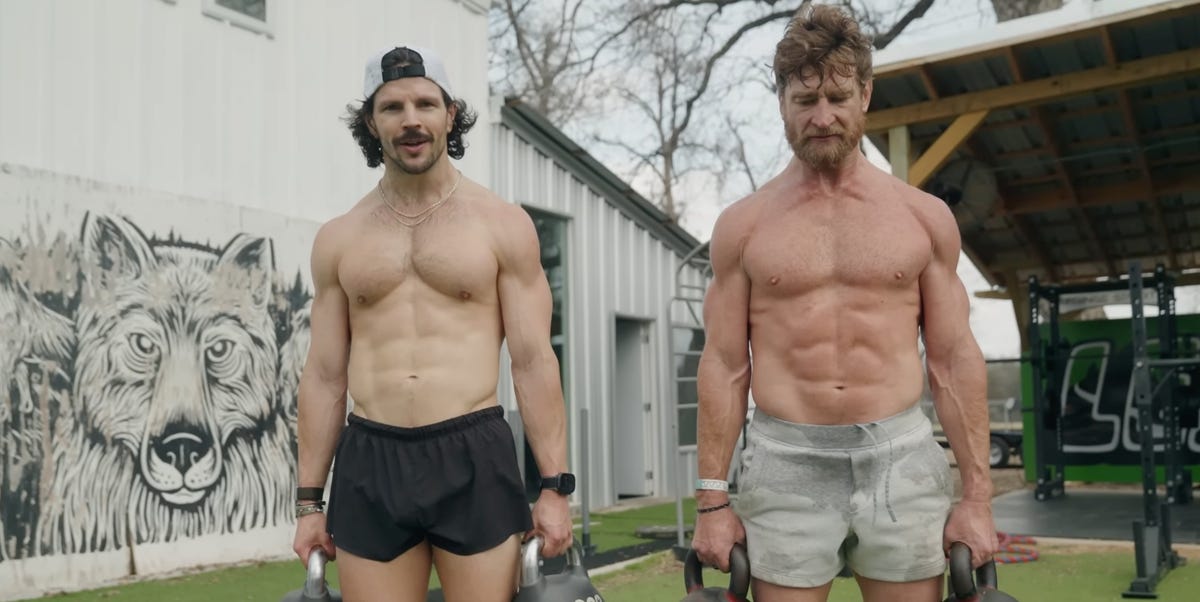
Intense training blocks often focus on short-term goals or a specific event. But Eric Hinman, 45, who has completed five Ironman races, believes your training should be built for decades of performance – not just the next few weeks or months.
In a recent video, YouTuber Dan Churchill trains alongside Hinman, breaking down the key movements that help combat age-related decline while improving athletic performance. The focus spans speed, strength, power and muscular endurance, alongside one often overlooked factor: recovery.
‘As you get older, your body starts losing the exact things that make you feel athletic,’ Churchill says. ‘V02 max declines, power drops, and muscle mass shrinks. Today, I’m going head-to-head with five-time Ironman Eric Hinman. He’s 45 years old and still one of the fittest hybrid athletes in the world.
‘We’re breaking down specific exercises designed to make you a stronger hybrid athlete while boosting your longevity. By the end of this video, you’ll know exactly how elite athletes train to stay fast and strong for decades, not just for the race season.’
1. Speed
VO2 max – which measures the maximum amount of oxygen your body can utilise during intense exercise – reflects how efficiently your heart, lungs and muscles work together. Improving it is one of the most effective ways to maintain both speed and long-term health.
To build it, Hinman and Churchill recommend interval running:
8 x 1km reps, with 90 seconds rest
Why it Helps
VO2 max naturally declines with age, dropping by around 10% after 30. Incorporating regular speed work can help slow that decline. Research published in JAMA Network shows higher cardiorespiratory fitness is strongly linked to lower long-term mortality, with no apparent upper limit to its benefits.
2. Strength
Strength training is a cornerstone of healthy ageing. Building and maintaining muscle supports everything from movement quality to injury prevention.
Hinman recommends a simple but demanding squat complex, performed every three minutes:
A1. Front Squat x 4 sets of 4 reps
A2. Back Squat x 4 sets of 8 reps
Why it Helps
A growing body of evidence links strength training to improved longevity. One paper in the British Journal of Sports Medicine suggests building muscle should be a lifelong pursuit, helping to ‘add life to years’. Other research shows resistance training can reduce all-cause mortality by up to 15%, with benefits peaking at around 60 minutes per week.
Don’t Skip Unilateral Work
Single-leg movements are key for balance, coordination and injury prevention.
‘Reverse lunge is a very functional movement,’ says Hinman. ‘It engages muscles and stabilisers you use throughout your life. This is not a movement to be missed.’
A. Alternating Reverse Lunge x 4–5 sets of 6 reps per leg
Build your grip strength
Grip strength is a powerful marker of overall health. Data from the UK Biobank shows weaker grip strength is linked to a higher risk of death from all causes.
Farmer’s carries, plate holds and loaded carries are simple ways to improve it.
3. Power
While strength is important, power – the ability to move quickly and explosively – becomes increasingly critical as you age.
‘Explosive movement is very neurological and is also really important,’ Churchill says. ‘It’s not just strength, but the speed at which you can move a heavy weight.’
To train it, he suggests a high-intensity Metcon:
A1. Push Press x 5 rounds of 12 reps
A2. Lateral Burpee x 5 rounds of 16 reps
A3. Alternating Dumbbell Snatch x 5 rounds of 16 reps
Why it Helps
This style of training combines strength and conditioning while placing a high demand on VO2 max. Research suggests relative muscle power may be an even stronger predictor of mortality than strength alone.
Fast-twitch muscle fibres decline rapidly with age if not trained – making power work a clear case of use it or lose it.
4. Muscular Endurance
Muscular endurance helps you sustain effort over time, particularly under fatigue. Hinman highlights Nordic curls as a key movement for building it.
‘If you are a runner and not doing Nordic curls, you are sleeping on a performance gain,’ he says. ‘Great for posture, great for posterior chain, and great for running.’
Why it Helps
Research shows Nordic curls are highly effective for strengthening the hamstrings, particularly during the eccentric phase. This is often an overlooked movement pattern, especially among runners. Studies also suggest they can reduce hamstring injury risk by up to 51%.
Better resilience means less time injured – and more time training.
5. Sleep
Above all, Churchill stresses the importance of sleep. Without adequate recovery, even the best training programme will fall short.
Sleep is where adaptation happens – helping repair muscle, regulate hormones and support long-term health.
Research published in the journal Sleep found that consistently getting fewer than six hours per night increases the risk of premature death by 12% over 25 years. Those sleeping fewer than five hours faced even greater risk.
Related Stories
Ryan is a Senior Writer at Men’s Health UK with a passion for storytelling, health and fitness. Having graduated from Cardiff University in 2020, and later obtaining his NCTJ qualification, Ryan started his career as a Trainee News Writer for sports titles Golf Monthly, Cycling Weekly and Rugby World before progressing to Staff Writer and subsequently Senior Writer with football magazine FourFourTwo.
During his two-and-a-half years there he wrote news stories for the website and features for the magazine, while he also interviewed names such as Les Ferdinand, Ally McCoist, Jamie Redknapp and Antonio Rudiger, among many others. His standout memory, though, came when getting the opportunity to speak to then-Plymouth Argyle manager Steven Schumacher as the club won League One in 2023.
Having grown up a keen footballer and playing for his boyhood side until the age of 16, Ryan got the opportunity to represent Northern Ireland national futsal team eight times, scoring three goals against England, Scotland and Gibraltar. Now past his peak, Ryan prefers to mix weightlifting with running – he achieved a marathon PB of 3:31:49 at Manchester in April 2025, but credits the heat for failing to get below the coveted 3:30 mark…
You can follow Ryan on Instagram @ryan.dabbs or on X @ryandabbs_