

When personal trainer and strength coach Lauren Pak, cofounder of Theory of Motion, tells runners to train their core “like an athlete, not an influencer,” she gets the irony. As someone with a fitness app, nearly 200,000 YouTube subscribers, and 1.4 million followers on Instagram, she does her fair share of influencing. The difference is views and likes don’t dictate her workouts. Function does.
“With influencers, or just social media in general, it tends to be more about what you look like, or what the exercise looks like, or what you’re going to look like after you do this exercise,” Pak says.
The problem is that the flashier exercises aren’t always the most effective or especially relevant to runners who value performance over aesthetics. Rather than demonstrating scroll-stopping moves or routines that promise to “torch your abs” or “snatch your waist,” Pak promotes a more holistic approach informed by the core’s main role in running.
What Your Core Does When You Run
Your core isn’t just your abs, Pak explains. “We’re talking about everything in your trunk,” she says, citing the obliques (side of the torso), spinal erectors (which support the spine), transverse abdominis (muscles that wrap around you like a corset), diaphragm (the important breathing muscle), pelvic floor muscles, glutes, hip flexors, and the rectus abdominis (what we think of as the six-pack).
Together, these muscles transfer force between the upper and lower body. When you run, they work together to support and stabilize the spine while facilitating the movement patterns and qualities integral to running and movement in general.
These movement patterns include:
Rotation: twisting at the trunkFlexion: bending forward or rounding the back and torsoExtension: bending backward to straighten the torso or arch the backLateral flexion: side bending at the waist
In addition to performing these movement patterns, your core must also control and resist them so that you don’t waste energy, introduce inefficiency, or put the spine in an unstable position. “Not only do you use rotation for the running pattern, but we also have to resist [too much] rotation because we don’t want to be just flopping all over the place,” Pak says.
Similarly, excessive rounding or arching of the trunk can negatively affect posture, form, and running mechanics, as can too much side-bending at the waist.
The benefits of a strong core are twofold, Pak says. “It’s helping to prevent or at least minimize risk of injury, and then it’s also going to help you to be a more powerful and a stronger runner,” she says.
How to Train Movement Patterns, Not Muscles
When programming a core workout, Pak thinks in terms of movement qualities, not body parts.
“There’s kind of this holistic approach that we take, where we’re using one exercise where it might be producing rotation, and then another one that works on resisting rotation. So an example of that might be a kettlebell halo or a kettlebell chop for producing rotation, and then a Pallof press for resisting it,” she explains. “Instead of thinking about specific muscles as we’re training the core, we’re thinking about the function overall.”
Sometimes the exercises she prescribes don’t look like typical core moves. A deadlift, for example, is a classic lift that strengthens the hamstrings and glutes, but it also demands enough core strength to resist flexion.
Recognizing these qualities in functional exercises can make it easier to integrate core training into your strength routine; if you’re lifting in ways that naturally engage the core across various movement patterns, you may not need to add as many dedicated core exercises.
That said, if you don’t have an established strength-training practice, adding a couple of exercises (like the ones below) to your running warmups can offer benefits, as the exercises not only build core strength over time, but they also prime running-specific movement patterns for your upcoming workout. “I think that getting a little bit of core stability work in before your run can help to actually have that translate into better running mechanics when you go out there,” Pak says.
8 Essential Core Moves
Each of the exercises below requires the core to move according to one of the primary movement patterns, or resist it.
You can use them to program a total core workout, or pepper them into your existing strength-training sessions or prerun warmups. For holistic, well-rounded core strength, try to hit each pattern throughout your training week. (Remember that functional movements that aren’t typical core exercises, like the deadlift and the front squat, count too.)
1. Rotation: Woodchop Stand with feet hip-width apart, knees slightly bent, and hold a dumbbell with both hands below left hip. Keep arms straight as you swing the dumbbell across body and overhead to the right side, straightening legs and pivoting on the ball of left foot. Swing the dumbbell back to below left hip, bending knees slightly.Repeat for 8-10 reps.Then switch sides. 2. Anti-Rotation: Pallof PressStart standing, feet hip-width apart, the right side of body facing a pole, rig, or other sturdy structure. Loop one end of a large resistance band around the pole at chest height and hold the other end of the band with both hands. Make sure you’re far enough from the pole so that there’s tension on the band. Keeping shoulders and rib cage stacked over hips, engage core and push hands out in front of chest until arms are fully extended. Pause, then slowly draw hands back into chest. Repeat for 8-10 reps.Then switch sides. 3. Flexion: Alternating Leg Lift Lie faceup, legs extended, arms at sides. Keeping legs straight and together, engage core to lift right foot toward the ceiling until legs form a right angle with torso. With control, lower leg until it’s a couple of inches from the ground.Repeat on left side.Continue alternating for 8-10 reps per side.
Make it harder: Lift and lower both legs together.
4. Anti-Flexion: Farmer’s CarryStand between two kettlebells or dumbbells with feet hip-width apart, knees slightly bent. With a flat back, hinge at hips, push butt back, and bend down to grab both weights. Drive through feet to stand up. Pull shoulders back and down, engage core, and keep shoulders and ribs stacked over hips. Slowly walk forward carrying the weights. Once you’ve gone as far as you can, turn around and walk back. 5. Extension: SupermanLie facedown with legs straight and arms extended in front of you. Keeping neck neutral, use back and deep core muscles to lift arms and legs several inches off the ground. Think about making body long (rather than arching back). Hold for a few seconds, then lower back down to the starting position. Repeat for 8-10 reps. 6. Anti-Extension: Dead Bug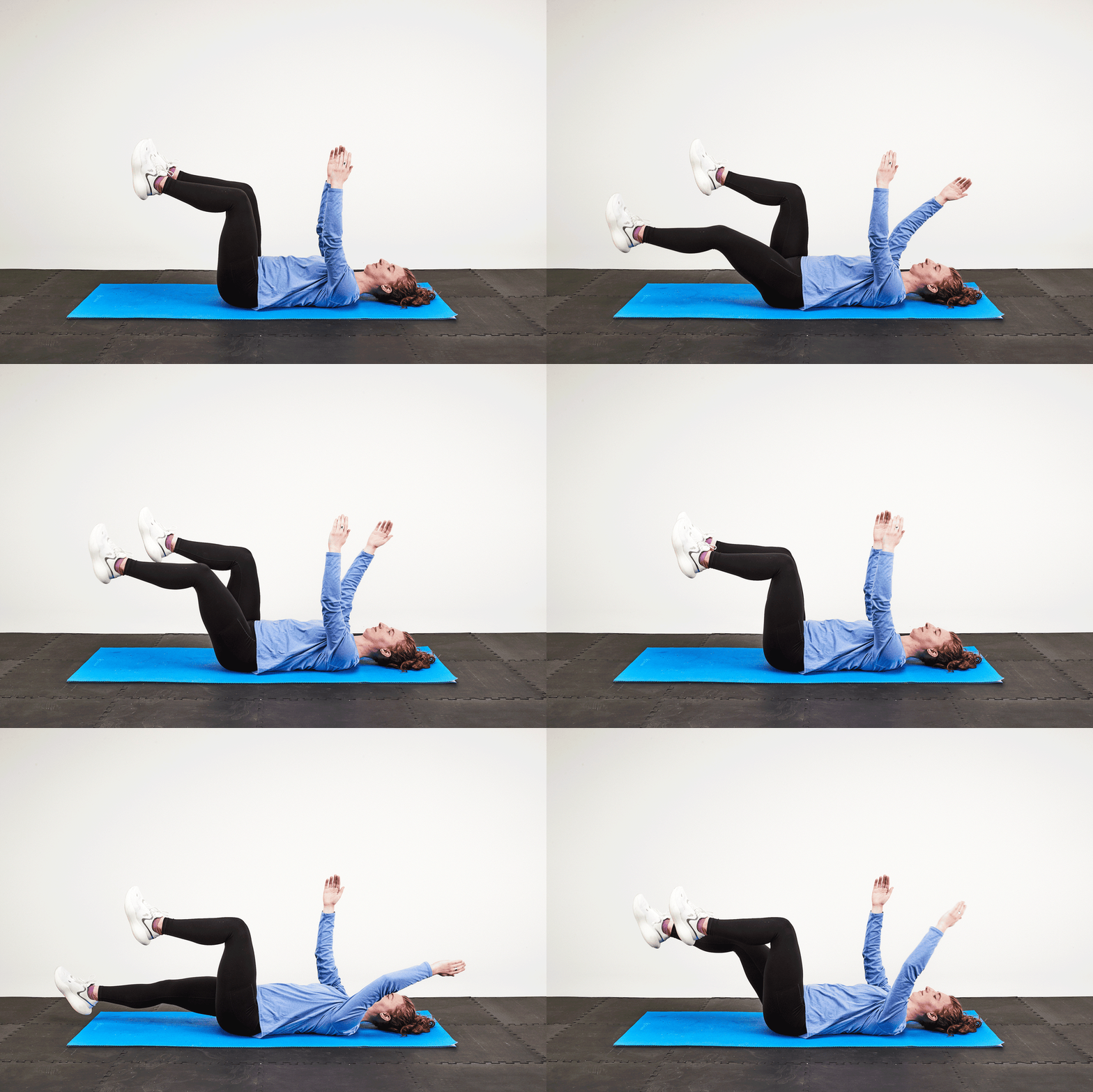
Trevor Raab
Lie faceup, arms raised over your shoulders, elbows straight, and legs lifted with knees bent 90 degrees. Engage core with slight pelvic tilt toward the ceiling. Think about pulling rib cage down, rather than allowing the ribs to flare out. This is the starting position. Lower right arm behind you until it’s a few inches from the floor. Simultaneously straighten and lower the left leg. Pause, then draw both arm and leg back to starting position. Repeat with the left arm and right leg. Continue alternating for 8-10 reps per side. 7. Lateral Flexion: Side Plank DipLie on right side with knees straight. Stack legs or stagger one foot in front of the other. Place right forearm on the ground parallel to body and lift hips up into a side plank. Make sure shoulder is stable (don’t allow upper body to sink into arm). Body should form a straight line from head to heels. Slowly lower right hip toward the floor, then lift back up into side plank. Repeat for 8-10 reps. Then switch sides. 8. Anti-Lateral Flexion: Side Plank Hold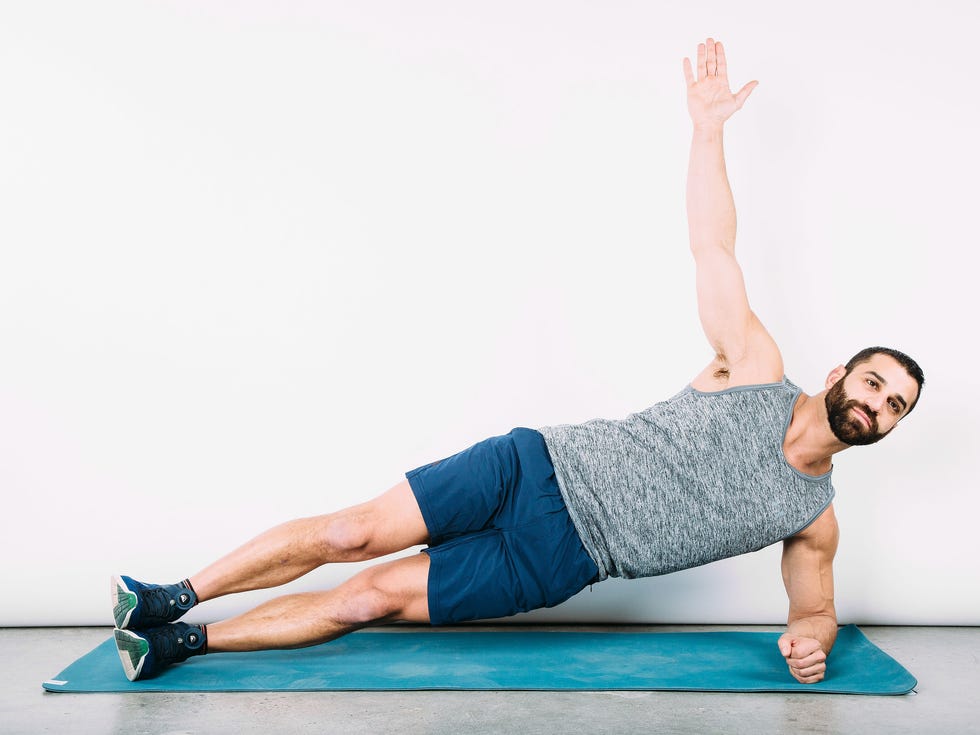
Julia Hembree Smith
Lie on right side with knees straight. Stack legs or stagger one foot in front of the other. Place right forearm on the ground parallel to body and lift up into a side plank. Make sure shoulder is stable (don’t allow upper body to sink into arm). Body should form a straight line from head to heels. Hold this position for 30 to 60 seconds.Then switch sides.