
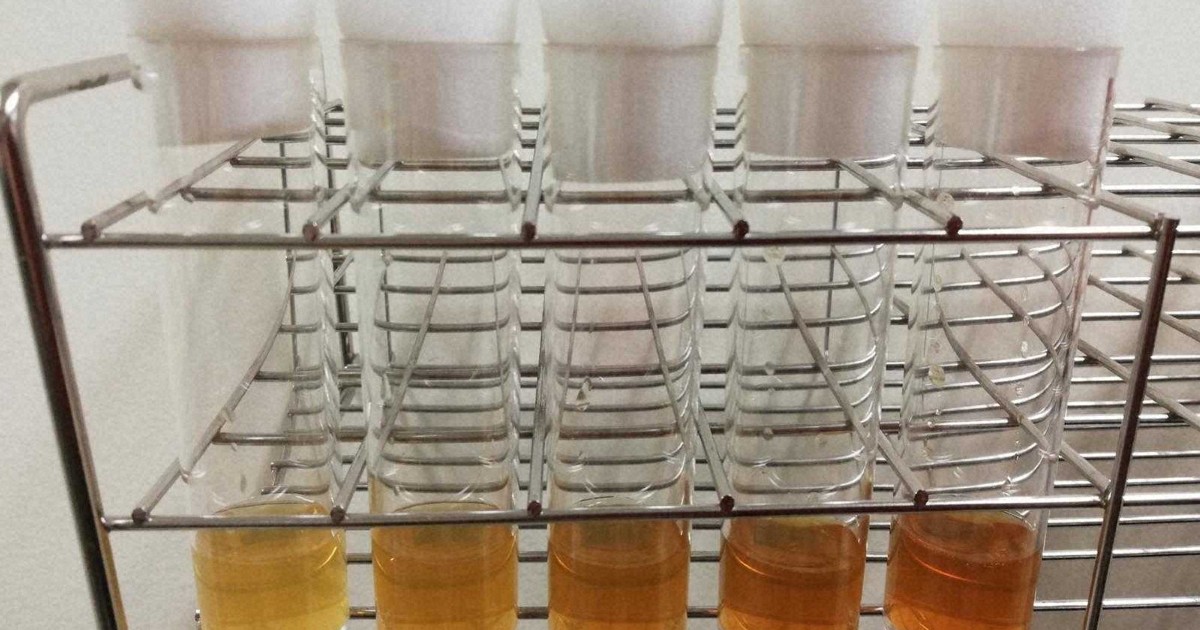

Tubes containing food used to rear flies are seen in this photo provided by Hina Kosakamoto, a visiting researcher at Riken.
TOKYO — A team from Japan’s comprehensive research institution Riken identified for the first time a protein that extends lifespan when diets are restricted early in life, using fruit fly experiments.
The team said the findings lend support to the Japanese saying, “Eat until you are eight-tenths full, and you won’t need a doctor.”
Regarding the relationship between diet and lifespan, a researcher at Cornell University reported in 1935 that rats lived longer when their food intake was restricted without causing nutritional deficiency. Since then, experiments have been conducted on various animals, and studies have reported that appropriate intake during development and growth stages in particular has a life-extending effect. But the mechanism by which differences in nutritional conditions during a limited period affect lifespan has long been a mystery.
Fumiaki Obata, a team director at Riken specializing in molecular biology, and his colleagues conducted experiments using flies, which have short lifespans and are easy to study throughout their development. The researchers restricted the flies’ food intake only during the larval stage from three to four days after hatching, while providing a normal diet after they emerged as adults. As a result, lifespans were about 20% longer than those of flies that were not subjected to dietary restrictions, regardless of sex, reaching about 50 to 60 days in males and about 50 to 70 days in females.
The team also developed a method to track how food consumed during the larval stage later behaves inside the body. It discovered that amino acids are stored in “ribosomes,” structures within cells, through the action of the protein “Lsp2.” When the researchers suppressed Lsp2 activity through nutritional restriction or genetic manipulation during the larval stage, various changes occurred in the body, including in ribosomes, and average lifespan increased by about 20%. The team concluded that Lsp2 plays a role in regulating lifespan.
Meanwhile, adult flies that underwent dietary restrictions were about 10% smaller, and females laid about 30% fewer eggs. However, these effects were not observed in flies in which Lsp2 did not function, indicating that Lsp2 is not involved in growth or reproduction.
“It is unclear at this point whether the same phenomenon occurs in humans, and this does not recommend the intake of specific foods,” Obata emphasized. “The existence of proteins that function similarly to Lsp2 has been confirmed in humans. We want to develop this research so we can propose dietary methods that contribute to maintaining one’s health.”
The findings were reported in the British scientific journal Nature dated Sept. 23.
(Japanese original by Yasuyoshi Tanaka, Expert Senior Writer)