
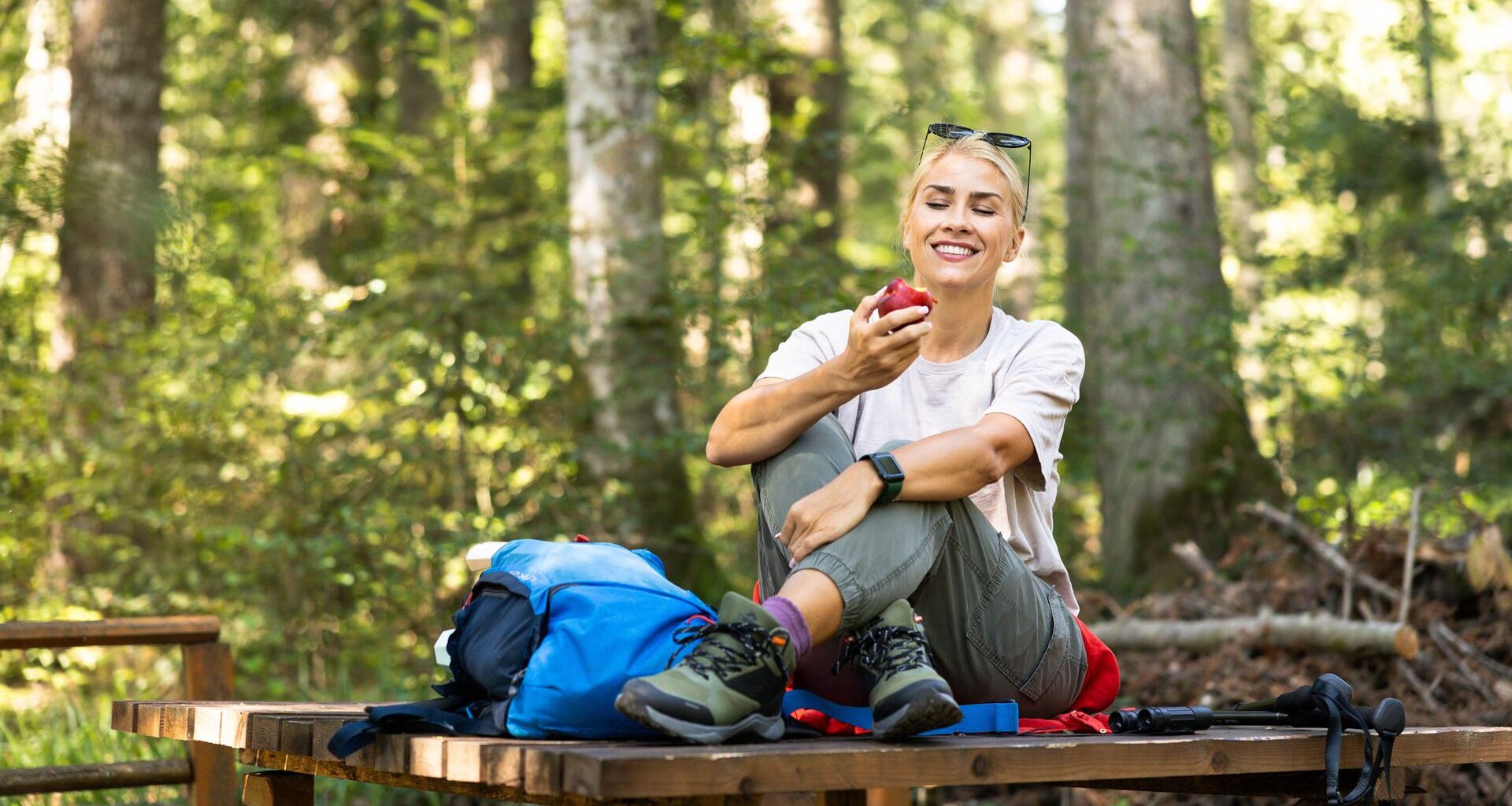
Intuitive eating was higher among adults with more contact with nature, and body appreciation and self-compassion carried most of the link.
Researchers keep finding new ways that spending time in nature relates to our health. The latest connection involves eating habits, but the explanation has more to do with how people feel about themselves.
In a survey of 500 adults in the United Kingdom, people who noticed and spent more time in nature scored higher on intuitive eating. That means following hunger and fullness cues rather than strict eating rules. Once the researchers accounted for how those people felt about their bodies and themselves, the direct link disappeared.
Viren Swami, a professor of social psychology at Anglia Ruskin University in Cambridge, England, led the survey with colleagues in the United Kingdom, Austria, Norway, and Malaysia. It is a snapshot: everyone answered once, online, in May 2026, so the results can show that two things go together but not that one causes the other.
In an interview with Earth.com, Swami said the role of self-compassion was no surprise because the team’s earlier work had already tied time in nature to being kinder to oneself. “When people have greater contact with nature, they are more likely to develop the ability and skills to be self-compassionate,” Swami said.
Measuring how people eat
Intuitive eating is a way of eating built on the body’s own signals. People who score high on it eat when they are hungry, stop when they are full, don’t label foods as forbidden, and eat for physical rather than emotional reasons. The survey measured it with 12 statements such as “I eat foods that feel good in my body.”
The researchers measured nature contact in three ways. Four questions asked how much people notice nature in daily life. One asked how often they visit natural areas, and one asked how many hours they spend in nature each week. Participants reported spending an average of about 19 hours in nature each week, though half reported 12.5 hours or fewer.
Participants also rated body appreciation, with statements such as “I respect my body,” along with self-compassion and how connected to nature they felt. They were recruited through Prolific, an online research platform, and paid £1.80 for a survey that took a typical participant about nine minutes.
The direct link did not hold
When researchers compared the measures in pairs, all showed positive associations. People with more nature contact ate more intuitively, and the strength of that pairing was moderate.
The picture changed when all five measures went into one statistical model. The direct link between nature contact and intuitive eating shrank to almost nothing and was no longer statistically significant.
What remained ran through the other measures. Nature contact went with higher body appreciation, and higher body appreciation went with more intuitive eating. A second route ran through self-compassion, and a third through self-compassion and then body appreciation.
Body appreciation was the strongest of the three routes. Connectedness to nature did not help. In the model, it pointed slightly the wrong way, which the authors read as a statistical artifact rather than a real effect.
The result held when the team swapped in the frequency and hours measures of nature contact. The findings also held after researchers adjusted for age, education, income security, disability, and other factors. They remained consistent when the team analyzed women and men separately. Swami said the findings stayed stable across those checks.
Why the body comes first
Earlier studies by Swami and others have found that people who spend more time in nature see their bodies more kindly. The authors think nature contact helps people feel more comfortable in their bodies and more aware of what their bodies need, and that awareness is the foundation of intuitive eating.
Self-compassion may work differently. The authors suggest it acts as a buffer. A hard day is then less likely to end in impulsive eating and more likely to end with food that meets a physical need. Earlier work has repeatedly linked self-compassion with body appreciation too.
One difference showed up between the sexes. Men scored higher than women on intuitive eating, and women scored higher on connectedness to nature, but the pathways themselves were the same for both.
No dose to prescribe
Asked by Earth.com what the smallest useful dose of nature might be, Swami said the study was not designed to answer that. More frequent and longer contact both went with more intuitive eating, but Swami does not favor prescribing a minimum.
“I find it much better just to advise people to spend as much time in nature as they are comfortably able to,” Swami said.
Parks and green space could still have a place in public health advice on eating, Swami said, though how to do that needs careful thought. “There are good reasons to think that nature – whether real or even digitized – could be part of public health strategies to promote healthier eating habits,” Swami told Earth.com.
What one survey can’t show
The survey asked people about themselves, and people tend to overstate how much time they spend outdoors. The sample was also better educated than the general population: about two-thirds held a university degree, compared with one-third of adults in the United Kingdom.
Because everyone answered once, the arrows could run the other way. Someone who already eats intuitively and likes their body may simply spend more time outside. Swami said further studies in other countries are needed.
Whether a season of more time outdoors changes how a person eats is the question this survey cannot answer. The authors say that will take studies that follow the same people over time. Any program that prescribes time outdoors for the sake of eating habits would have to wait for that evidence.
The full study was published in the journal Body Image.
—–
Like what you read? Subscribe to our newsletter for engaging articles, exclusive content, and the latest updates.
Check us out on EarthSnap, a free app brought to you by Eric Ralls and Earth.com.
—–