
In a rare occurrence social media messaging and science are promoting the same message when it comes to fibre — eat more. Rebecca Fox talks to Associate Prof Andrew Reynolds about why and how to go about it.
Fibre, once a word only uttered in whispers behind the hands of old-age pensioners, is becoming ‘‘sexy’’ to younger people.
Social media influencers are touting it as the latest thing to control weight, regulate hormones and improve your gut. While the science is not quite there to back all those things, it does support fibre’s important role in reducing heart disease and diabetes as well as having benefits for weight loss.
University of Otago Associate Prof Andrew Reynolds has been working in the area for 10 years and says research shows people who consume more fibre die less, get less heart disease and less diabetes.
Reynolds and Prof Sir Jim Mann pulled together that research, publishing it in 2019, and leading to recognition in academia that the role of fibre was more important than just being useful to make stools bulkier and softer preventing constipation or treating diarrhoea.
‘‘I think it’s becoming sexy. So it’s been a really interesting area.’’
Last month Reynolds and Mann called for fibre to be included on the list of essential nutrients needed to keep humans healthy just like vitamins A, B, C, D and E, minerals such as iron and copper and some of the building blocks of fats and proteins. But never has a carbohydrate been included.
Mann has long been an advocate for breaking up the collective term ‘‘carbohydrates’’ into its different types, sugars, starches and fibres as it is well-known people need to decrease sugars in their diet but increase fibre.
‘‘So when you talk about total carb it doesn’t make sense — you’re talking about reducing sugars, you’re talking about reducing fibres, but they have opposite effects on health.’’
More research, this time into diabetes management, has shown a stronger but similar effect from eating more fibre. Same with heart disease and hypertension management.
‘‘There are even more benefits for people who already have these conditions when increasing fibre intakes.’’
Fibre’s power comes from its diversity, he says.
‘‘Luckily for us, foods tend to contain a whole range of fibres, not just one type of fibre. So if you’re getting your fibre from foods, you’re probably getting a full range.’’
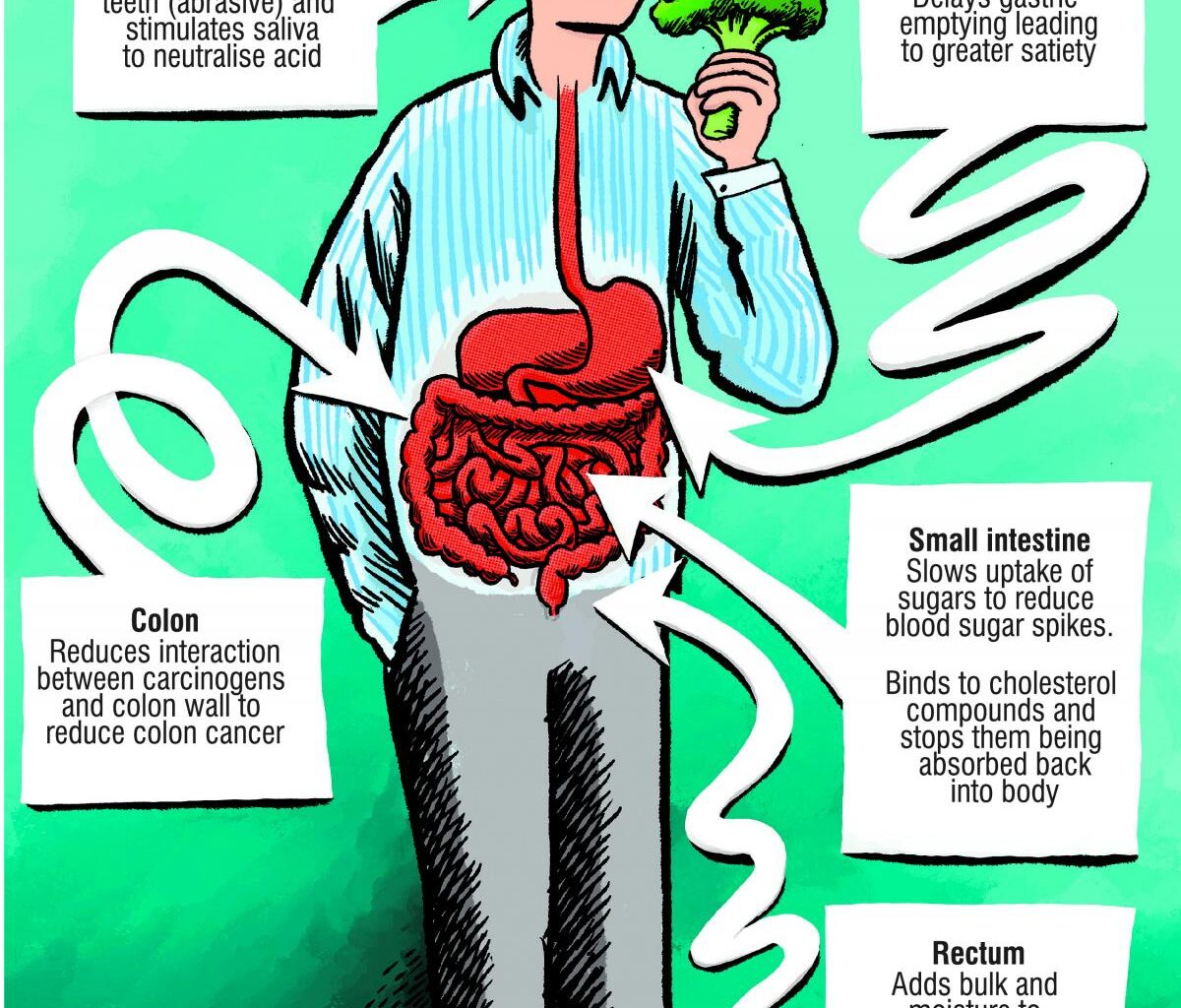
The reason fibre makes such a difference is that when people chew and swallow fibre it goes into the stomach and delays it emptying.
‘‘So it slows down the stomach action, which means it has more chance to mush up foods and you feel fuller for longer. So that’s the satiety signal.
‘‘It also stimulates the incretin response, which is what GLP-1RAs do, this new drug for weight loss. It’s just what fibre does, but it’s a lot stronger a signal. So they both affect satiety.’’
Once food leaves the stomach and gets to the small intestine, the sugars and nutrients are absorbed. The more fibre, the more it slows down the uptake of sugars into the body. Instead of a sugar rush, it creates a more prolonged peak which the body handles better.
‘‘It doesn’t have to act quickly and then deal with the resulting crash afterwards.’’
Fibre also grabs on to excess cholesterol and binds it so it cannot be reabsorbed into the body and is instead passed through the system.
Finally the fibre gets to the colon undigested where the microbiome can use it.
‘‘So there’s a whole pathway along the GI tract that fibre beneficially interacts with. Which is why we see the improvements in trials, where people with increased fibre intake have better blood pressure, cholesterol levels, body weight and glycaemia.’’
It is also thought to have a beneficial impact on blood pressure but there is still research to be done to understand how that happens, he says.
Reynolds has struggled with social media’s focus in recent years on increasing protein intake, something most people get enough of in their diets anyway so it has a minimal health gain.
But the increasing fascination with the gut and the gut microbiome has driven an interest in fibre.
‘‘That’s what the gut microbiome eat, they eat fibre. So if we don’t eat fibre, they don’t get to eat and they get angry.
‘‘I think if we can get more people thinking and talking about it, which is happening now, the health benefits could be ginormous. More so than anything related to protein.’’
At present, New Zealanders eat an average of 20g of fibre a day, but the World Health Organisation guideline recommended at least 25g per day.
‘‘So that is your minimum threshold to reach, with additional benefits for certain outcomes beyond that point. But to get to 25 is great.’’
Reynolds himself practises what he preaches, eating 50g of fibre at day by basing his diet on whole grains, legumes, vegetables, fruit, nuts and seeds. He finds it makes him happier and more energetic as well as having the benefit of reducing health risks.
‘‘All of those are key sources of fibre.They’re key sources of other beneficial nutrients. And so focusing my diet on those food groups gives me that much.’’
That translates into a breakfast of oats or wholegrain bread with peanut butter and jam, morning tea is a piece of fruit while lunch is ‘‘something grainy’’ like brown rice with vegetables or leftovers from the night before. Afternoon tea might be more grain toast with peanut butter and dinner will be lots of vegetables with a protein.
‘‘I eat everything. I still eat meat and chicken, fish, chips, beer, I drink alcohol. I don’t eat a lot of processed red meat as there’s a strong signal there for colorectal cancer so I prefer to avoid that.’’
As someone who did a year’s chef training before following an academic path he likes to cook but recognises that not everyone has the skills or time to do so.
‘‘That’s actually quite hard to do for some people. Because you have to have time to prepare all those foods.’’
People who will benefit the most from increasing their fibre intake are those who have low-fibre diets.
‘‘So the real aim is to get the lowest consumers to have a bit more fibre. That’s where you’ll see the most health benefits.’’
Processed foods are more accessible for many people who are time poor or on a restricted budget so Reynolds sees a real opportunity for food companies to add fibre back into those foods.
‘‘So all of those barriers relate to taking raw ingredients and making them something delicious. So there’s a real role here for the food industry for reformulation. To increase the fibre in products so that people can get that fibre gain but not suddenly lose an hour of their day. Because they might not have an hour of their day to spend in the kitchen to do those meals for their family.’’
But increasing fibre does come with a warning as it can cause discomfort especially if people are not used to consuming large amounts of legumes which are very high in fibre.
‘‘We’re talking kidney beans and lentils and things like that. So if you add half a cup a day. You might double your fibre intake. And if you double your fibre intake. Your stomach will take a little bit to adjust to that so that’s why we get our bloating and our gas.’’
Instead increase fibre slowly and steadily alongside increasing water intake so that it keeps moving through the digestive tract. Once the body adjusts to the increased fibre it is possible to eat high-fibre foods without the discomfort such as swapping half the mince in a Bolognese for lentils adding 17g of extra fibre to a meal.
‘‘I’ll add canned lentils to anything because they disappear pretty quickly. Kids don’t know about it. Other people don’t know about it but you’re making it slightly cheaper and also increasing the fibre profile a lot. And you’re not losing anything in terms of protein.’’
Courgette and lentil salad
An easy to put together salad that works well at barbecues as the courgette can be cooked then and there for added smoky flavour.
Equipment: fry pan, grill or barbecue
Ingredients
3 courgettes, cut lengthways into 5mm thickness
2 tsp cooking oil and pinch salt
1 packed cup of baby spinach, or any other salad leaf
1 x 420g tin lentils (Woolworths brand does no salt added)
200g tomato, standard or cherry sized
Any fresh herbs if you have on hand
Dressing
1 cup plain yoghurt
1 large garlic clove, minced
2 Tbsp lemon juice
1 tsp smoked paprika
2 Tbsp olive oil
Method
Make dressing by mixing ingredients together. Season to taste. Fry, barbecue or grill courgette slices with oil and salt, turning to brown on both sides. Drain lentils, slice tomato. Assemble ingredients with any fresh herbs if using, then add dressing and mix through right before serving.
Notes: The fibre comes from both the vegetables and lentils, pairs well with wholemeal pita breads warmed on the barbecue.
Hummus
A base recipe you can adapt with added flavours, use in sandwiches, or with different dippers.
Equipment: blender
Ingredients
1 x 420g tin chickpeas (Woolworths brand does no-salt-added)
1 Tbsp tahini
1 Tbsp lemon juice
1 Tbsp olive oil
1 garlic clove, peeled
3 ice cubes
Method
Drain chickpeas and add all ingredients to a blender and mix until smooth. Season to taste. Serve with any added flavours on top, including olive oil, cracked pepper, paprika, sumac, or cumin.
Served here with wholegrain breads or crackers, and vegetable sticks.
Notes: The fibre comes from the chickpeas, a common legume. Legumes in general are cheap, versatile and great sources of fibre and protein.
Tararua biscuit
More of a breakfast bar than a sweet treat, an old Kiwi tramping staple made lighter with fresh fruit.
Equipment: mixing bowl and oven
Ingredients
375g Harraways oats. I use ½ traditional wholegrain, ½ rolled.
225g wholemeal flour
2 apples, grated, skin on
200g frozen blueberries
150g table spread or butter
150g golden syrup
1 tsp salt
2 tsp baking powder
1 heaped Tbsp cinnamon
½ cup water
Method
Preheat oven to 180°C and cover a flat oven tray with baking paper.
Put butter in large mixing bowl and melt in microwave. Add golden syrup, salt, cinnamon, and baking powder and mix to combine. Add oats, flour, apple and blueberries with half a cup of water to loosen the mixture. Stir briefly to combine but do not over mix, this will not form a cohesive dough. Pour out on to the baking tray and shape with your hands into a 30cmx25cm rectangle of even height. Bake for 40-45 minutes until brown on top. If you like a crisper texture, slice into bars of desired size and bake a further 5 minutes to really dry out.
Notes: The fibre comes from the whole grains and fruit. Easy for meal preppers and highly portable. If focusing on protein intake, four scoops of a neutral protein powder/isolate.