
For most guys, building bigger, stronger shoulders sits high on the priority list. Whether it’s about filling out a t-shirt or staying pain-free as you get older, shoulder strength isn’t just aesthetic – it’s essential. In fact, research suggests shoulder strength can decline by up to 39% between the ages of 20 and 80, as tendons naturally stiffen and shorten over time.
That makes how you train your shoulders more important than ever. And according to Athlean-X’s Jeff Cavaliere, the traditional approach might not be enough. The 50-year-old coach has shared his exact method for building bigger, more resilient shoulders – and it doesn’t just rely on endless lateral raises.
Instead, his system is built around smarter programming, higher-quality volume and targeting all three heads of the deltoid across the week. Here’s how it works, along with the seven-move workout he uses to put it into practice.
The Theory
As Cavaliere explains in the video, building a sturdy pair of shoulders comes down to more than a few sets of lacklustre lateral raises spread across the week. Instead, it’s about making certain training days work in your favour. ‘When we really start to think about building big shoulders, you have to start thinking beyond just shoulders, or push day,’ says Cavaliere. ‘There’s plenty of opportunity to work them on back or pull day, and when we’re looking to build wider shoulders, the volume’s going to add up to help you get them.’
Back day, or pull day, he continues, offers another opportunity to increase overall weekly volume in the name of bigger delts. Cavaliere considers it the ‘second chance to increase the volume of the most under-developed two heads of your shoulders, the middle and rear delts.’ Exercises including chest-supported rows (which ‘heavily load the rear delts’), dumbbell high pulls (to ‘overload the middle delts’, says Cavaliere), seated cable rows and cable face pulls – which Cavaliere suggests plugging into leg day – all play a role.
However, ‘it’s on the dedicated shoulder day that the real gains are possible,’ Cavaliere says, ‘because if you’re not devoting at least some portion of your effort to developing all three heads of the delts, you’re not going to develop them fully.’ Consider this your battle plan.
The ExercisesDumbbell Standing Overhead Press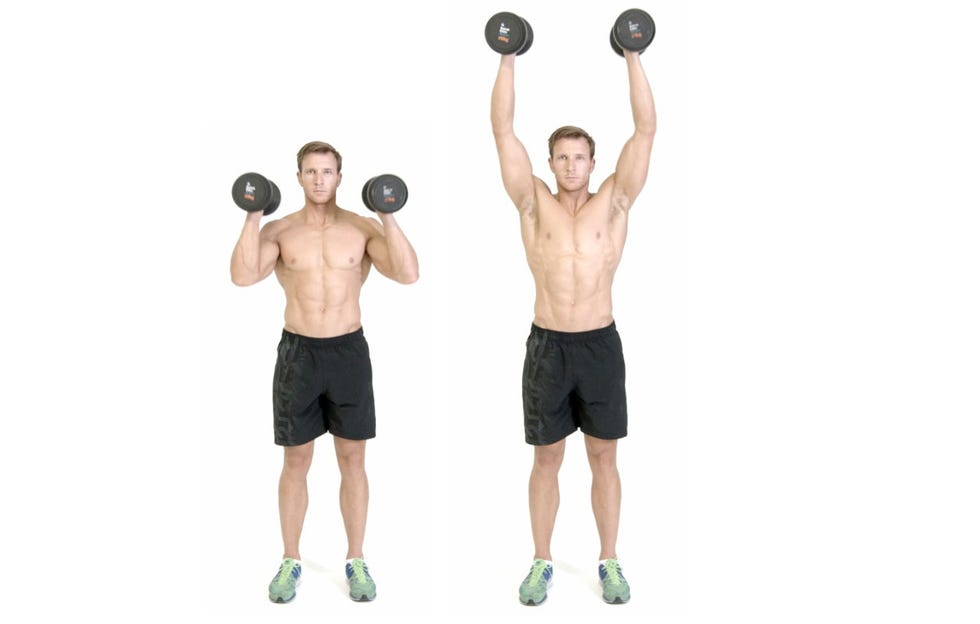
‘If you’re doing a push day, you’ve already got this covered on that day, but if you have shoulders split apart on their own [training split], then I recommend starting with a basic dumbbell standing press,’ says Cavaliere, who recommends this variation because ‘it’s the safest for your shoulders. It’s uninterrupted by the back of the bench in terms of normal shoulder biomechanics, with the bottom line being that it’s a good way to kick off your workout.’
Cavaliere recommends hitting 2-3 sets using a weight that brings you to failure within the 8-10 rep range.
Dumbbell Iso Alternating Front Raise
‘If you just isolate the front delt at the initial lift, you can then power the dumbbell up the rest of the way, but you’re guaranteeing that you’re recruiting the front delt to the task. That’s a good way to start the exercise and ensure you’re getting maximal development of that front delt and overall roundness.’
Cavaliere suggests 1-2 hard sets with a weight that causes failure in the 10-12 rep range.
Upper Limit Lateral Raise
Performed sitting on the floor with two light dumbbells (‘lighter than usual,’ he advises), the upper limit lateral raise uses ‘constant tension to light up your middle delts’, says Cavaliere. By not letting the dumbbells touch the floor and focusing on a squeeze at the top, it teaches you how to isolate and engage the middle delt without letting the traps take over or using body English to hoist the weight.
Shoot for 3 sets with a weight that causes failure between 12 and 15 reps.
Dumbbell Cheat Lateral Raise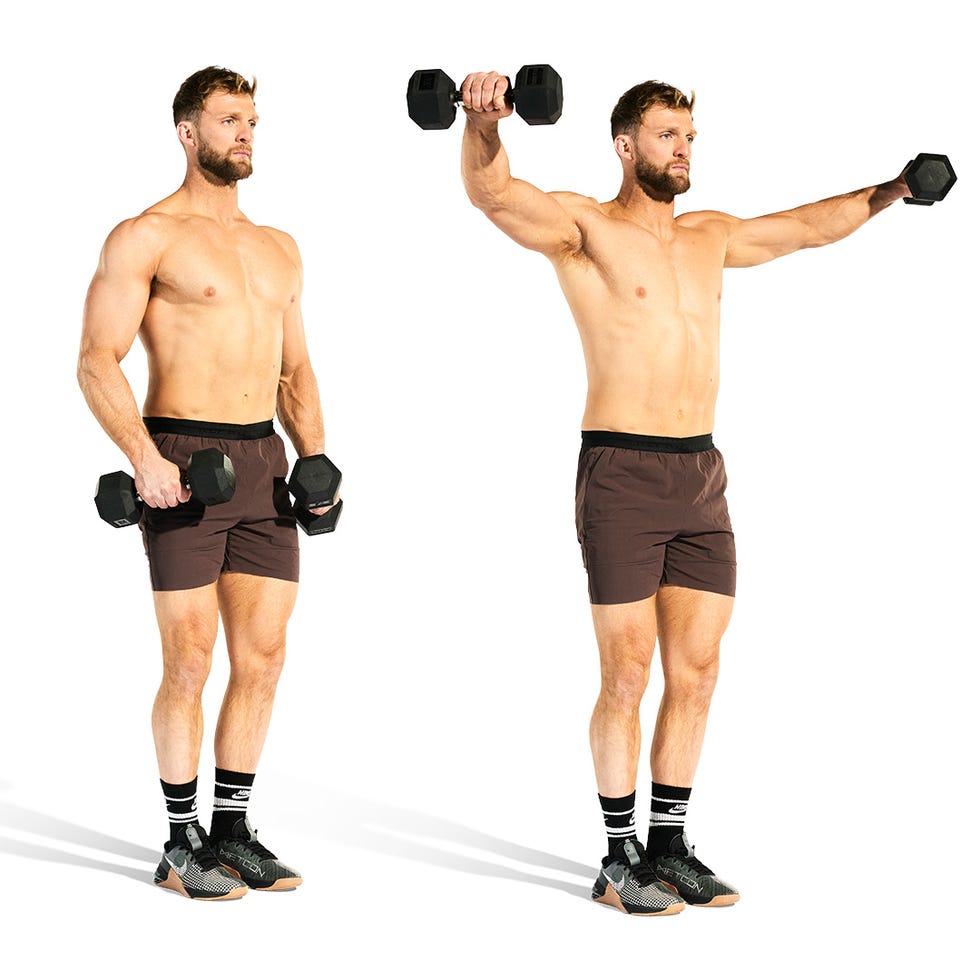
Cavaliere balances the light isolation work with this heavy, explosive movement. The goal here, he explains, is a different stimulus for growth – specifically, overloading the eccentric (lowering) portion of the move. Fight the weight on the way down to maximise the effect.
‘3 sets of 6-8 reps to failure on each arm to make sure you get it done,’ he says.
Rear Delt Row
Moving to the back and focusing on the rear delts, Cavaliere recommends the dumbbell rear delt row to hit the target effectively. One of his favourites for the back of the shoulder, he chooses this because it focuses on ‘extension as the main goal’, which is highly effective at isolating the rear delt head.
2-3 sets of 10-12 reps on each arm will do the job.
Dumbbell Hip Hugger
‘This is a great exercise for tying together the abduction of the middle delt and the extension focus of the rear delt to hit both of these more underserved areas of the delts in one shot,’ says Cavaliere. Done correctly, you’ll feel an ‘intense contraction on your middle and rear delts’.
Aim for 2-3 sets of around 12-15 reps.
Iron Cross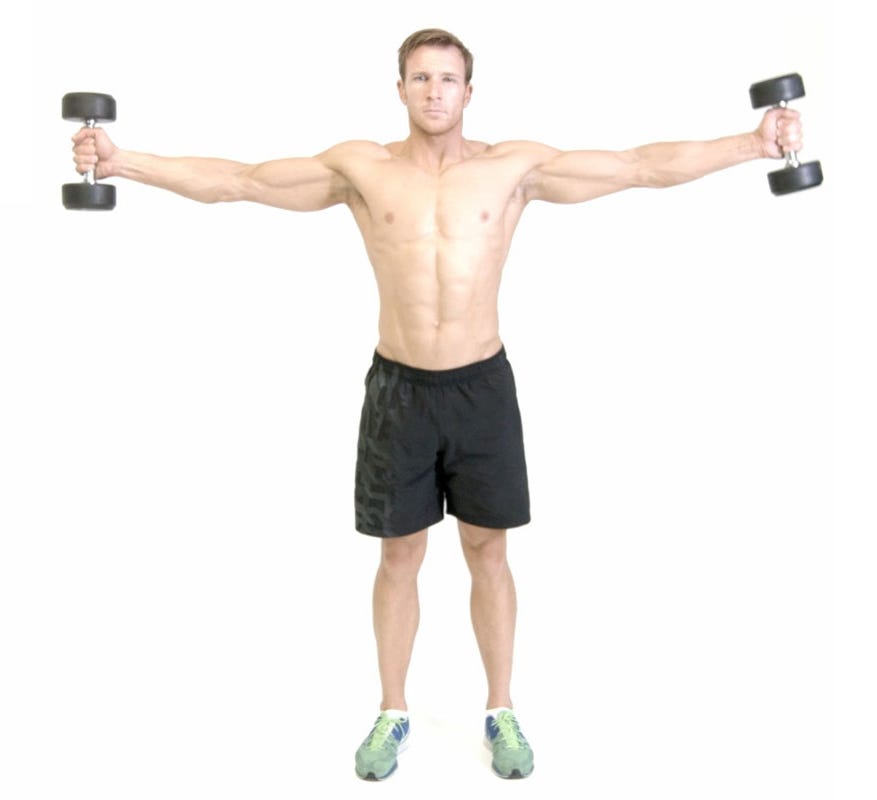
Consider this your final effort to empty the tank. Cavaliere includes this because your isometric strength (holding a weight still) is stronger than your ability to lift it. Even if you’re too fatigued for full reps, you can use these holds to squeeze out every last bit of effort. Using a slightly lighter pair of dumbbells, alternate between an isometric lateral raise (at the top of the movement) and a front raise, also held at the top.
Aim for 2-3 sets, alternating between 10-20 second holds in each position, working close to failure.
Related Stories