
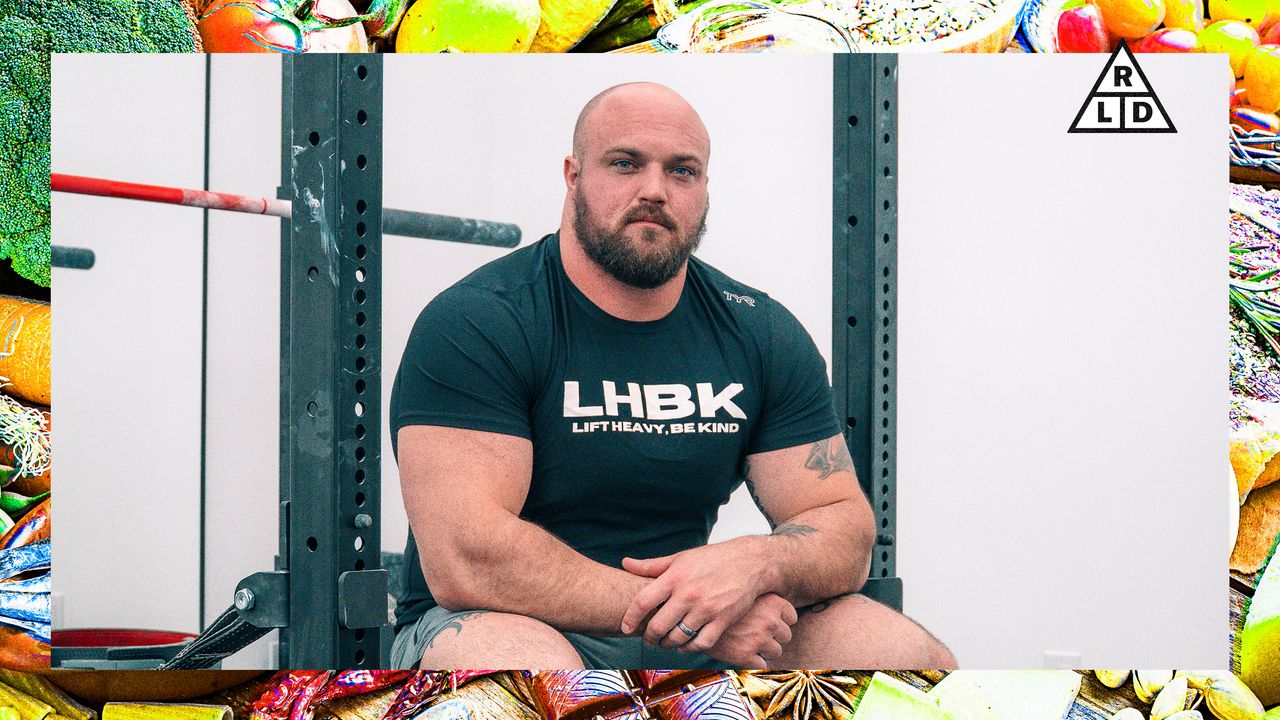
GQ: How did you initially take an interest in powerlifting?
Mitchell Hooper: The interesting part of that story is that I did my undergraduate in human kinetics. I worked as the head strength and conditioning coach with a professional basketball team. Then, I found that relatively meaningless in terms of sport results. So, I applied and got into a master’s of clinical exercise physiology at the University of Sydney. When I got into that, since I’d always been active, I thought there’s three things you ask people to do when you’re exercising them: that’s to lose weight, to get fit, and to get strong. Those are really three things that, if you can do that, you’re going to be reasonably healthy long-term.
I started by losing weight. I lost 100 pounds, stepped on a bodybuilding stage, then I ran three marathons. Just in the process of getting strong, I found guys who did powerlifting. That took me towards powerlifting contests, which eventually evolved into Strongman. And I had no idea how good I was going to be. It just went bananas and took me, ironically, back into the sports world.
Psychologically, where do you think this desire to be the World’s Strongest Man came from?
I think if any man truly doesn’t want to be the World’s Strongest Man, they’re lying to themselves.
There’s a small fraction of people who are in contention to be able to do that. Look, I didn’t set out to become the World’s Strongest Man. I set out to become as strong as I could be, and that happened to turn into being the strongest man in the world. I’ve just been really fortunate in that way.
Are you competitive in your general life?
Yeah, very much so, to a fault. It’s probably cost me some friendships over the years. But yeah, everything for me is a contest, and why would you ever want to lose?
At what age—or what part of your life—did you go from, let’s say, a more standard physique to the physique you have now? When was the initial bulk, if you will?
From when I was a kid, I always knew that I was stronger. Playing hockey, I was probably 30 pounds heavier than most kids on my team. I actually remember vividly my dad would always have Gatorade for me after games, and I thought that maybe I was bigger and stronger because my dad was putting steroids in the Gatorade or something. Genuinely, as a child, I thought that that was maybe the case. But when I graduated high school, I was about 240 [pounds] and played football in college. When I was running marathons, I was 235 pounds. I’m 335 now. So I’ve never been a small person. I think if I wasn’t 330 pounds on purpose, I’d be 330 pounds by accident.
Besides the alleged steroid Gatorade, what were the other methodologies?
When I first started powerlifting, I basically had a protein target for the day, and that was one gram per pound of body weight—so 240 grams of protein or so—and a calorie target for every meal. I would have five meals a day. That started at, say, 4,000 or so calories [per day]. Then I hit a wall, and that first wall was around 250. And then I went to 4,500 [calories] and that was 255 [grams of protein]. Then I went up to 5,500 calories and couldn’t break 265 pounds. That was just my limit at that point. But it’s a really good lesson, because I was eating relatively low-quality food to get there. My only parameters were my protein and total calories. There’s a lot more that goes into being able to absorb and process that food in a useful way. That’s changed and evolved quite a bit over time.