
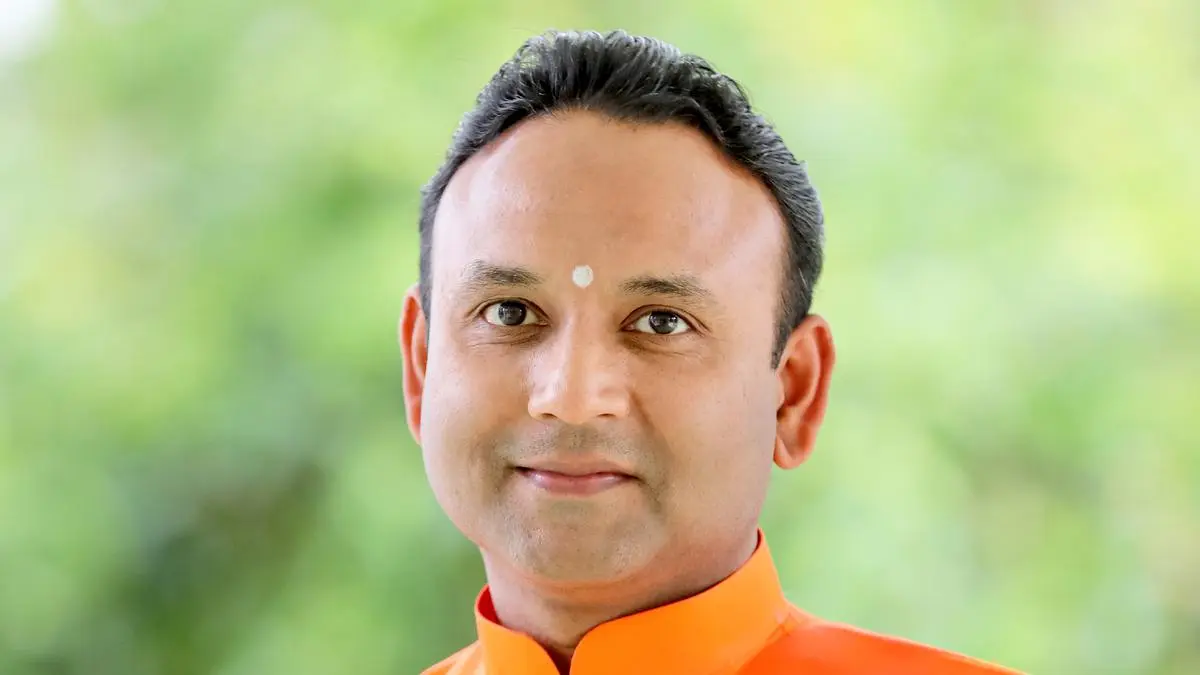
A spiritual leader, humanitarian and social reformer, Sadguru Sri Madhusudan Sai is the founder of the One World One Family (Vasudhaiva Kutumbakam) Mission, a global service initiative focused on nutrition, free education and healthcare. Over the past decade, he has spearheaded the creation of a network of free schools, hospitals and nutrition programmes that today serve millions of beneficiaries in India and several other countries. Under his leadership, the mission has established India’s first free rural medical college and expanded the Annapoorna Morning Nutrition Programme to reach over 10 million children daily. His work is guided by the belief that access to quality education, healthcare and nutrition is a fundamental human right rather than a privilege. Edited excerpts:
What made you shift from being a successful investment banker to a spiritual mentor and somebody who is deeply involved in large-scale philanthropy?
I never viewed it as a career shift; service has always been my life’s underlying purpose. Initially, Bhagawan Sri Sathya Sai Baba guided me to work in the corporate world, and I followed that path sincerely. Looking back, I see that phase as preparation rather than a destination. Investment banking taught me discipline, governance, strategy and financial stewardship – invaluable lessons that seamlessly support our global humanitarian projects today.
Following Baba’s passing, I felt a natural, profound calling to dedicate myself entirely to his core message: Love All, Serve All. What began as a personal commitment to return to my original passion for social service gradually scaled into a global mission.
Many people assume philanthropy is simply about giving away resources. However, I believe it is about recognising that our lives find their greatest meaning when they become useful to others. When you experience the joy of transforming lives, service ceases to feel like a sacrifice – it simply becomes a way of life.
What made you specially focus on healthcare, nutrition and education which have become the three pillars of your work?
Universal healthcare, nutrition and education form the very foundation of human development. They are deeply interconnected: a child who is hungry cannot learn, a person who is unwell cannot contribute productively, and a society without education cannot progress sustainably.
Historically, India recognised these essentials as collective responsibilities. Through systems like the Gurukulas and community temples, education was free and value-based, food was shared with all, and healthcare was viewed as an act of service. Over time, however, we began to commoditise these basic needs, making access increasingly dependent on personal wealth.
Our Mission is simply to ensure that no one is denied these fundamental rights due to financial barriers. When healthcare is compassionate, nutrition is accessible and education is value-based, we do more than just help individuals survive – we create responsible citizens who will go on to build a selfless, harmonious society and strengthen the nation as a whole.
“One World One Family” is an ambitious idea. How do you translate such a philosophical concept into measurable action on the ground?
Many people view ‘One World One Family’ as a philosophical ideal, but I see it as a practical necessity. The challenges facing humanity today, such as poverty, healthcare inequality and social division, cannot be solved in isolation. They require a profound sense of shared responsibility.
We translate this concept into measurable action by building a selfless society through tangible initiatives. The philosophy becomes real when internationally acclaimed doctors volunteer at our free hospitals simply because serving others brings them genuine joy. It materialises through our value-based education system, which empowers underprivileged students, and through our Morning Nutrition Programme, which ensures children are nourished, attentive and ready to learn.

Sadguru Sri Madhusudan Sai
At One World One Family, every hospital, school and nutrition initiative is a living expression of this shared humanity. Today, our presence across 100 countries demonstrates that people everywhere respond naturally to the universal values of compassion, service and unity. Ultimately, a philosophy becomes meaningful only when it is lived.
What problem across the world worries you the most today — hunger, healthcare inequality, education gaps or something else?
The greatest challenge facing humanity today is not a lack of resources, but a lack of shared responsibility. The world has enough wealth, knowledge and capability to address all of these issues, yet millions continue to suffer because our collective priorities are misaligned. What worries me most is the growing sense of separation between individuals, communities and nations. When people stop seeing each other as connected, compassion diminishes and conflict increases. The solution to this problem of separation is nurturing a sense of collective responsibility.
I firmly believe that if we secure the three critical human needs – health, nutrition and education – many of the world’s most complex problems become much easier to solve. By providing value-based education, compassionate healthcare and eradicating malnutrition, we do more than just relieve immediate suffering. As we have witnessed over the past few decades, this approach actively creates a society of healthy, responsible and compassionate citizens.
Many philanthropic efforts remain localised. Why was scale important to you from the beginning?
Need does not recognise geography. When a child is hungry, it does not matter whether they live in India, Africa or South America. Human suffering is universal, and so our response must be too. In truth, scale was never the primary objective – impact was. Today, we witness growing economic inequality, societal disparities and conflict across the globe. The only solution to these widespread challenges is to unite people through shared values and mutual respect. Ultimately, the larger the challenge, the broader the collaboration required to solve it.
That is why our Mission is deeply rooted in the ancient Indian philosophy of Vasudhaiva Kutumbakam – the belief that the whole world is one family. Because we look beyond artificial dividers like caste, creed, religion or nationality, people across cultures have naturally embraced this vision of selfless service, allowing our work to organically expand across multiple continents.
Is your work ultimately charity, nation-building, or social systems transformation?
All three are deeply interconnected. Charity addresses immediate suffering, nation-building develops long-term capacity, and social system transformations change mindsets and establish lasting social behaviour.
You can see this progression in a single child. When we provide a child with daily nutrition, it may appear as simple charity. When that child goes on to receive a quality education and becomes a productive citizen, he or she contributes to nation-building. And when that individual develops compassion and begins serving others in their community, it becomes true social transformation.
Ultimately, our goal is not merely to provide services – all of our initiatives are simply the means to a greater end. The true aim is the inner transformation of every individual, as that is the only way to build a lasting, compassionate and harmonious society, not just in India, but across the globe.
What do you think India in particular and world at large still misunderstands about philanthropy?
Many people view philanthropy simply as an act of generosity – those who have more giving to those who have less. I see it very differently. Our ancient wisdom, particularly the ‘Isha Upanishad’, teaches us that we are not owners but merely trustees of what has been given to us. Wealth, knowledge, influence and opportunity all carry a shared responsibility. The Upanishad reminds us that because the entire universe is connected by the same consciousness, we must live and consume with a spirit of sacrifice. The fundamental misunderstanding lies in the concept of ownership. The truth is that anything we possess beyond our actual needs does not truly belong to us – even if we have rightfully earned it. It belongs to someone who needs it more. True philanthropy, therefore, is not about giving away excess wealth. It is about recognising our inherent duty towards society. When giving is viewed as a profound responsibility rather than a casual act of charity, it becomes transformative for both the giver and the receiver.
What personally motivates you every day to continue this work at such intensity?
The beneficiaries themselves – the millions who often have nowhere else to turn for their fundamental needs – are my greatest source of motivation. Every patient who regains health, every student who discovers opportunity, and every child who receives proper nutrition reminds us exactly why this Mission exists. I am equally inspired by the thousands of doctors, teachers, volunteers, staff and global supporters who work relentlessly alongside us. Their selfless commitment reinforces my belief that humanity is capable of extraordinary compassion when given the opportunity.
Ultimately, this goal is much larger than any single individual. That higher purpose itself generates all the energy needed to continue this work every single day.
Do you see this mission as spiritual service, social entrepreneurship, or humanitarian action?
At its heart, it is spiritual service expressed through humanitarian action. Without a profound spiritual understanding of our interconnectedness – the concept of oneness – it is incredibly difficult to sustain selfless service over a long period. Service only becomes truly meaningful when we recognise that another person’s wellbeing is intrinsically linked to our own.
Today, spirituality is often misunderstood as a withdrawal from the world, or misrepresented for selfish motives. In reality, true spirituality inspires a much deeper responsibility towards society. While our daily initiatives are humanitarian in practice, their fundamental basis rests on this simple spiritual truth: humanity is one family.
Was there a defining moment in your life that shaped your worldview around service?
Rather than a single defining moment, my worldview was shaped by a continuous process of learning in the presence of Bhagawan Sri Sathya Sai Baba. What influenced me most was witnessing someone who never differentiated between people based on wealth, status, religion or nationality – everyone received the exact same unconditional love and compassion.
Over time, I realised that the highest expression of spirituality is not personal achievement, but service to society. That understanding fundamentally transformed how I view success, leadership and purpose, and it continues to guide every initiative we undertake today.
What keeps you optimistic despite the scale of poverty and inequality you encounter?
My optimism stems from the innate goodness that exists within people. The world often appears divided when viewed through daily headlines, but when you work on the ground, you witness extraordinary acts of compassion every single day. I see doctors serving well beyond their duty, volunteers selflessly giving their time, and donors supporting people they will never even meet. We ensure this impact endures by creating replicable service models. We are not just helping people today – we are preparing the next generation of humanitarians to take this mission forward.
Finally, I draw great hope from the power of collaboration. Sustainable change becomes possible when we follow what I call the ‘3S’ model, bringing together Sarkara (Government), Samaja (Society) and Sanstha (Institutions). When these three pillars work in unison, lasting transformation is not just a theory – it is an achievable reality.
How do you avoid burnout while overseeing initiatives across multiple countries and sectors?
No mission of this scale can be built by a single individual. We are blessed to have passionate leaders, professionals, respected advisors and dedicated volunteers who carry this work forward every day. My role is simply to provide direction and ensure we remain aligned with our core values. Furthermore, I do not see this work as a burden. When your work is deeply aligned with your purpose, it generates energy – rather than consuming it. Ultimately, the spiritual foundation of our mission provides the inner balance and perspective required to carry out our activities seamlessly, allowing us to navigate any challenge with clarity.
What has been the most emotionally difficult moment in your journey so far?
The most difficult moments are when we encounter suffering that could have been prevented. Meeting a child denied treatment because of financial constraints, seeing a student forced to abandon education due to poverty, or witnessing families struggle to meet basic needs leaves a deep impact. The difficult part is knowing that solutions exist, yet access remains unequal. At the same time, those moments strengthen our resolve. They remind us why this work matters and why we must continue expanding our efforts.
What gives you the greatest sense of fulfilment today?
The greatest sense of fulfilment comes from witnessing human transformation. Buildings, programmes and institutions are important, but they are merely instruments. True joy lies in seeing people regain hope, dignity and purpose – whether that is a patient returning home healthy, a child overcoming malnutrition, or a student becoming the first graduate in their family.
What is even more profound is seeing some of our earliest beneficiaries graduate and choose to work within our institutions. They are selflessly giving back what they received to ensure someone else’s life can be transformed. This beautiful cycle affirms our belief that goodness is self-perpetuating. When the spirit of selfless service becomes deeply ingrained in individuals, it creates a ripple effect – proving that, step by step, global transformation is genuinely achievable.
How important is faith in sustaining your work?
Faith is absolutely fundamental. However, I do not mean faith in a narrow, religious sense, but rather a profound faith in the goodness of humanity, the power of selfless service, and the belief that every act of compassion creates positive change.
Spirituality is the core foundation of our mission. The ultimate essence of all scriptures and religions is exactly the same – oneness. This principle of oneness, and the universal love it inspires, acts as a powerful unifying force. Without this deep spiritual understanding, sustaining a mission of this magnitude across the globe would simply be impossible.
Ultimately, faith provides us with strength during challenges, clarity during uncertainty and humility during success. It constantly reminds us that service is not merely an activity, but the highest expression of our shared humanity.
Your projects involve large investments in hospitals, nutrition programmes and education. How are these initiatives funded?
Our greatest source of capital is trust. Financial contributions are the visible outcome, but trust is what makes them possible. Thousands of individuals, institutions, foundations, corporations and well-wishers support our initiatives because they resonate with the philosophy behind the work and have confidence that every resource entrusted to us will be utilised responsibly.
We are fortunate to receive support through philanthropy, CSR partnerships, foundations, governments and supporters across the world. What is encouraging is that many contributors begin as observers and become partners only after witnessing the work firsthand. Ultimately, the sustainability of any humanitarian effort depends less on fundraising and more on building trust through consistent impact.
What proportion of funding comes from Indian donors versus international contributors?
Historically, a significant portion of support came from our international community, many of whom have been associated with the philosophy of selfless service for decades. At the same time, we are witnessing increasing participation from Indian philanthropists, corporate partners, CSR initiatives and institutions. As awareness of our work grows and people see the impact being created, more organisations and individuals are joining the journey.
What encourages me most is not where the support comes from, but how people from diverse backgrounds are uniting around a common purpose. That itself reflects the spirit of One World One Family.
Do you actively court corporates and CSR funding, or do donors approach you organically?
Both happen simultaneously. Some organisations approach us organically after learning about our impact, while we proactively engage with institutions that share our core values. As we scale our services, corporate partnerships and CSR funding become crucial for long-term sustainability. Social impact cannot be built in isolation. It requires the ‘3S’ model – Sarkara (Government), Samaja (Society) and Sanstha (Institutions) – working collaboratively. After years of consistent work, many corporates now actively trust our mission for their CSR initiatives.
How do you convince philanthropists to support long-gestation social projects?
People support long-term projects when they fundamentally believe in three things: the purpose, the people and the process. We demonstrate that large initiatives – whether a hospital or a university – are not mere expenses, but profound investments in human potential. By engaging with us, philanthropists have an opportunity to elevate their own life’s purpose by alleviating the misery of underserved communities. When they realise their contribution will transform entire generations rather than just individuals, they begin to see themselves as true partners in social transformation.
Are your donors largely individuals, institutions, family offices or corporations?
We are fortunate to have a wonderfully diverse mix of all of them. The mission began with individual donors who believed in our process and contributed whatever they could. Today, corporations, family offices, foundations and governments are increasingly joining this journey. Each brings something unique: individuals bring deep conviction, corporates bring scale, foundations support innovation, and governments expand our reach to larger populations. The common factor across all of them is trust.
How transparent is your funding structure, and do you publish audited impact and financial reports?
Transparency is fundamental to trust. Every donor, whether contributing a small amount or supporting a major project, deserves confidence that their contribution is being utilised responsibly and effectively.
Our entities comply with all applicable regulatory requirements, undergo audits and maintain governance systems designed to ensure accountability. We also continue strengthening impact measurement frameworks so that stakeholders can understand not only how resources are utilised but also the outcomes they create. For us, transparency is not merely a compliance requirement. It is a moral responsibility.
In an era of scrutiny around NGOs and foreign funding, how do you ensure credibility and trust?
Trust cannot be claimed; it must be earned. For us, credibility rests on three pillars: transparency, compliance and impact. We follow regulatory requirements diligently, maintain governance structures and ensure accountability to all stakeholders. We are also proud to have entities listed on India’s Social Stock Exchange, which reflects a commitment to rigorous standards of governance and transparency. Ultimately, credibility is built through consistency. When people witness service continuing year after year with the same sincerity and integrity, trust naturally follows.
Have you ever had to turn away funding because it conflicted with your values?
Yes. Resources are important, but principles are more important. Every partnership must align with the values and purpose of the Mission. If there are conditions attached that compromise the integrity, independence or spirit of service behind the work, we would rather decline the support. Short-term funding can never compensate for long-term erosion of trust. Our greatest asset is credibility, and that must always be protected.
What is the biggest misconception people have about how philanthropic organisations are financed?
One common misconception is that many philanthropic organisations operate with hidden agendas. While there may be exceptions in any sector, the vast majority of people involved in genuine service are driven by compassion and commitment. Many of our doctors, teachers, administrators and volunteers have left highly successful careers because they believe in a larger purpose. Their motivation is not personal gain but the opportunity to create meaningful impact. Philanthropy is often sustained not only by large contributions but also by countless acts of generosity, sacrifice and trust that happen quietly behind the scenes.
How difficult is it to build sustainable funding models for free healthcare and nutrition?
Creating infrastructure is often easier than sustaining it. A hospital can be built through capital support, but operating it free of cost year after year requires ongoing commitment. The same applies to nutrition programmes, schools and universities. Long-term sustainability requires awareness, participation and shared ownership. Society must recognise that these are not merely charitable projects; they are investments in human capital. The healthier, better-nourished, and better-educated our citizens become, the stronger our society and economy will be.
Running hospitals and nutrition programmes at scale is operationally complex. What has been the toughest execution challenge?
The greatest challenge is undoubtedly long-term sustainability. One of our most ambitious execution challenges was establishing a completely free medical college integrated with a free tertiary-care hospital. Many experts advised against it due to the enormous operational and financial commitment. However, we took this bold step because if we want compassionate healthcare in the future, we must train doctors who view medicine as a service. Today, many of our graduates – whose education was entirely free – choose to stay and run our institutions, beautifully giving back to the society that supported them. The challenge continues, but so does the need.
How do you measure impact beyond headline numbers?
Numbers are important because they help us understand scale. However, numbers alone rarely capture transformation. A student graduating is a number. A student becoming the first graduate in their family and transforming the future of an entire household is impact. A patient receiving treatment is a number. A patient regaining dignity, health and productivity is impact.
We therefore focus on both quantitative and qualitative outcomes. Increasingly, technology and data systems are helping us better understand long-term impact and measure meaningful change.
What lessons from the corporate world can philanthropy adopt better?
The social sector can learn a great deal from the corporate world in areas like governance, rigorous execution and discipline. Successful businesses establish strong systems and measure outcomes relentlessly; philanthropic organisations benefit greatly from adopting this level of professionalism. Additionally, non-profits must adopt the powerful storytelling techniques used by corporations to clearly communicate their impact. Conversely, businesses can learn from philanthropy about the importance of being genuinely purpose-driven.
Is India producing enough professional talent for the social sector?
There is still a significant gap. Many talented young people genuinely want to contribute to society, but the pathways in the social sector are not always as visible or professionally attractive as traditional corporate careers. We are actively working to bridge this gap through our educational institutions. By integrating value-based education from an early age and establishing innovative academic programmes such as dedicated courses in NGO Management, we are preparing the next generation of professional managers, healthcare leaders and social reformers. Ultimately, our goal is to help create a generation that sees service not simply as an alternative career but as a highly meaningful and respected path of leadership.
What role does technology and AI play in your initiatives today?
Technology is a vital enabler that democratises opportunity. Across our operations, we already utilise robust platforms, including hospital and student management systems, alongside enterprise software for donor management. We are also actively integrating Artificial Intelligence into our workflows to optimise operations, measure impact and reduce administrative costs.
To ensure we embrace the latest technological advancements, we are continually endeavouring to collaborate closely with industry and academia. A perfect example of this is our partnership with RuralShores, which successfully brings digital transformation and new employment opportunities directly to economically underserved rural areas. While implementing these advanced technologies requires investment, their ability to improve efficiency at scale when combined with genuine human compassion is truly transformative.
How do you decide which regions or communities to prioritise?
Our decision is driven by two main factors: the absolute scale of the need, and the ability to build sustainable local partnerships. No service initiative can succeed in isolation. Lasting impact requires active community participation, local leadership and deep local ownership. Our objective is not simply to start projects, but to create meaningful solutions that the local community can confidently sustain over the long term.
Which initiative are you personally most proud of?
Every initiative addresses a different human need, so it is difficult to compare them. However, establishing a completely free medical college integrated with a free tertiary-care hospital has been one of the most ambitious initiatives we have undertaken. Many believed such a model would be difficult to sustain. Yet we felt strongly that if we wanted compassionate healthcare systems in the future, we had to invest in training compassionate doctors today. More than the infrastructure itself, I am proud of the possibility it creates—the opportunity to nurture future generations of healthcare professionals who combine excellence with empathy and service.
Have there been projects that failed or did not meet expectations? What did you learn from them?
No project has failed so far, but there have been hurdles and challenges that have slowed down the pace. Notwithstanding that, we have learnt to reinvent ourselves and make course corrections as and when needed. Any organisation attempting meaningful, large-scale change will inevitably encounter setbacks. Some initiatives progress more slowly than expected, while local realities sometimes demand a completely different approach mid-way. What we have learnt is that failure is not the opposite of success – it is an essential part of the journey towards it. Every single challenge has helped us improve our planning, partnerships and execution. The key is to never lose sight of your ultimate purpose, even when the path requires adjustment.
What kind of leadership mindset is required to build humanitarian institutions at scale?
Clarity of purpose is the foundation. A humanitarian leader must be compassionate, but compassion alone is not enough. Good intentions must be supported by strategy, governance, accountability and professional excellence. One also needs patience. Social transformation does not happen overnight. It requires long-term commitment and the ability to continue despite challenges and setbacks. Most importantly, a leader must remain humble. In missions of this scale, no individual can claim ownership. The role of leadership is to align people around a common purpose and empower them to contribute their best.
Do you believe philanthropy should complement governments or challenge them to do better?
I firmly believe philanthropy should collaborate with and complement governments, rather than simply challenging them. Governments possess the mandate, policy influence and massive scale. Meanwhile, civil society has grassroots understanding, and institutions bring agility and innovation. This is the essence of the ‘3S’ model – Sarkara (Government), Samaja (Society) and Sanstha (Institutions). Sustainable, lasting change only happens when all three work together towards a shared objective.
Can compassion be institutionalised, or does scale inevitably make philanthropy bureaucratic?
Compassion not only can be institutionalised, it must be. If compassion remains dependent solely on individuals, its impact will always be limited. Institutions allow compassion to become systematic, sustainable and scalable. The true challenge is ensuring that our administrative systems do not replace our humanity. Processes are essential, but they must always support the service rather than overshadow it. The ideal organisation seamlessly combines the efficiency of a professional enterprise with the heart of a compassionate individual.
How do you maintain accountability within a mission-driven organisation?
Accountability begins with purpose. When people understand why they are serving, accountability becomes natural. At an organisational level, we rely on governance structures, audits, compliance frameworks and transparent reporting. However, the strongest accountability comes from culture. When individuals genuinely see themselves as custodians of resources entrusted for public good, responsibility is no longer imposed from outside—it comes from within. In mission-driven organisations, systems and values must work together.
What role should wealthy Indians play in nation-building today?
India’s wealth creators have already contributed significantly through innovation and economic growth. The next crucial frontier is what I call Individual Social Responsibility (ISR). Corporate Social Responsibility (CSR) has already shown what structured giving can achieve. If successful individuals voluntarily dedicate a portion of their personal wealth, expertise and time towards solving societal challenges, India’s progress will accelerate dramatically. Ultimately, true wealth finds its highest purpose when it creates opportunities for those in need.
Is India becoming more philanthropic as a society, in your view?
Yes, I absolutely believe so. India has always possessed a rich cultural tradition of generosity. What is changing today is that philanthropy is becoming much more organised, measurable and impact-driven. CSR mandates have helped institutionalise a structured culture of giving, while more individuals and corporations are taking personal responsibility for nation-building. Furthermore, young Indians are increasingly seeking purpose-driven work, proving that social responsibility is no longer viewed as solely the government’s job.
How do you respond to critics who say large-scale philanthropy can sometimes substitute for systemic policy reform?
Philanthropy should never replace policy reform; it should complement, demonstrate and accelerate it. Governments alone have the mandate and scale to enact sweeping systemic change. However, philanthropic organisations have the agility and flexibility to innovate, test new models and demonstrate what is practically possible on the ground. When these successful models are openly shared, governments can confidently replicate and scale them. The most effective approach is always collaboration, never substitution.
What is your long-term vision for One World One Family over the next decade?
Our vision is to build highly scalable models of human development. In India, our specific goals over the next decade include reaching 8 million students through our Morning Nutrition Programme, establishing free, value-based education in every district, and building a wellness centre in every district – all of which will be sustained primarily by professionals who themselves benefited from these initiatives. Globally, across the 100 countries we operate in, we seek to unite governments and philanthropists around a common purpose. Our ultimate goal is not mere organisational growth, but profound societal transformation.
Which sectors beyond healthcare and nutrition are you now focusing on?
Education continues to be our major focus, particularly value-based education that prepares young people not just for employment, but for life. Alongside this, we are increasingly focusing on skill development and human capacity building, which is the absolute need of the hour. Healthcare, nutrition, education and skilling must work together; they form the complete foundation required for sustainable human development.
Do you see your model expanding significantly outside India?
Yes, we are already expanding significantly. We currently run a free school for 1,100 students in Nigeria, nutrition programmes across Africa, a free clinic for the underinsured in the United States and completely free hospitals in Nigeria, Fiji and Sri Lanka. We also operate human development centres across five continents. However, our objective is never blind replication. Every region has unique cultural circumstances, so while the philosophy of oneness is universal, the implementation must always remain contextual and driven by strong local ownership.
What would success look like to you 20 years from now?
Success will not be measured by the number of buildings or institutions we construct – it will be measured by the number of lives transformed and the values our society embraces. As a tangible goal, we aim to positively impact 2 billion lives over the next two decades. Beyond the numbers, I would consider our mission a true success if future generations inherit a world where compassion is entirely natural, where service is universally respected, and where financial constraints deny no one their basic opportunities. Above all, I want to see a society where those who receive help today naturally become the ones who help others tomorrow. This continuous cycle of responsibility and giving is the ultimate foundation of a harmonious world.
If you could persuade India’s business leaders to act on one social issue immediately, what would it be?
I would strongly encourage them to focus on accessible and compassionate healthcare. There are few experiences more painful than seeing a family forced to choose between their financial survival and a loved one’s medical treatment. Having studied major global health programmes such as the NHS in the UK, Medicare and Medicaid in the US and India’s Ayushman Bharat, among others, it is clear what a large nation like ours requires. The focus must be on capacity building, affordable medical education and accessible financing for healthcare infrastructure, alongside establishing boundaries to check excess profiteering in the private sector.
India already possesses the technological talent and institutional capability to achieve this. If business leaders, governments and philanthropists come together to support these structural shifts, we can build a healthcare system that is not only world-class but deeply humane – a true model for the rest of the world.
What advice would you give young Indians who want to dedicate their lives to public service or philanthropy?
Start early. Do not wait until you have accumulated massive wealth, influence or status. When you have the energy of youth, that is exactly the time to begin this journey. Young people possess idealism and courage, which are incredibly powerful forces for social transformation. I urge them not to measure their success merely by income or corporate titles, but by the number of lives they positively touch and transform. Build a life of active contribution – that is a legacy far greater than any material achievement.
At the end of the day, what legacy do you hope your work leaves behind?
I genuinely do not think in terms of a personal legacy. Individuals come and go; it is only values that truly endure. I hope our legacy is not a monument, a building or a named institution. Instead, I hope we leave behind a compassionate and harmonious society that inspires future generations to continue the work of selfless service. If we can help foster a culture where people genuinely view humanity as one family, and where success is measured by what we give rather than what we gain, then our purpose has been entirely fulfilled. That, to me, is the true meaning of One World One Family.
When you experience the joy of transforming lives, service ceases to feel like a sacrifice – it simply becomes a way of life.Sadguru Sri Madhusudan SaiFounder, One World One Family (Vasudhaiva Kutumbakam) Mission
Published on July 6, 2026