
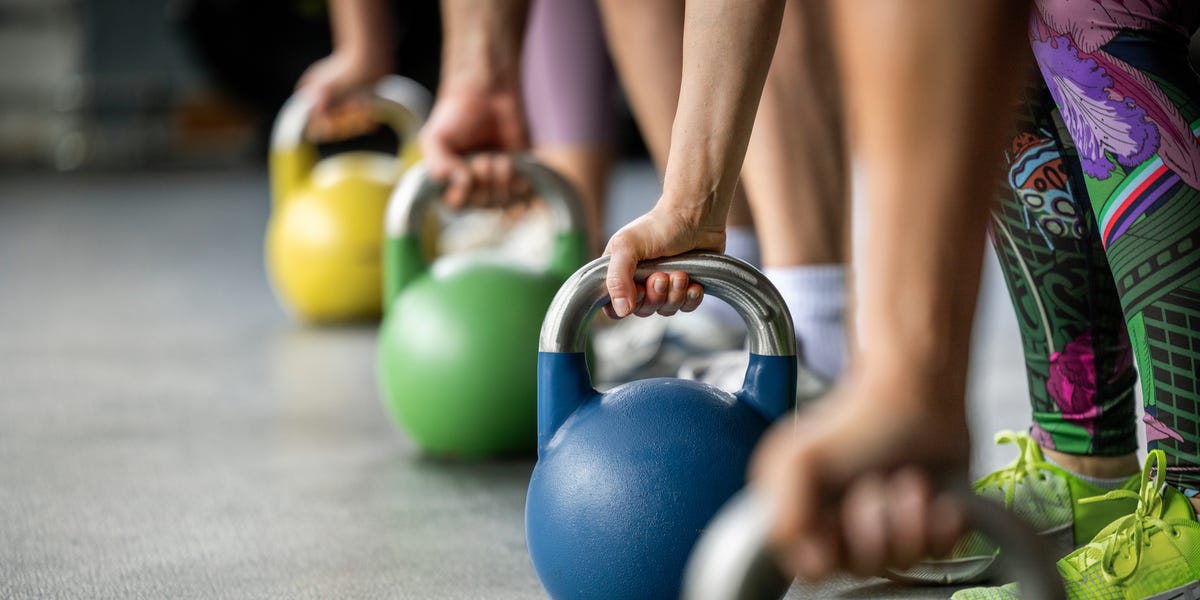
‘Many people think core training means crunches or planks, but one of the most functional ways to strengthen the core is by learning to resist movement,’ says personal trainer Alice Jordan.
Her go-to exercise for doing exactly that? The kettlebell suitcase carry.
‘Holding a kettlebell in one hand and walking with good posture forces the deep abdominal muscles, obliques and spinal stabilisers to work continuously to keep your body upright,’ explains Jordan, who specialises in strength training during (peri)menopause.
Why is the kettlebell suitcase carry so effective?
‘For women over 50, this is particularly valuable because it develops balance, posture and stability while also improving grip strength, which is an important marker of healthy ageing,’ notes Jordan.
Indeed, one landmark study published in The Lancet found that lower grip strength was consistently associated with a higher risk of early death – even after accounting for age, physical activity, smoking, body size and other cardiovascular risk factors. Notably, the researchers reported that grip strength predicted somebody’s risk of dying better than systolic blood pressure.
The single-arm kettlebell suitcase carry, adds Jordan, ‘also translates directly into everyday activities such as carrying shopping, lifting luggage or playing with grandchildren, making it a highly functional exercise’.
How to do a kettlebell suitcase carry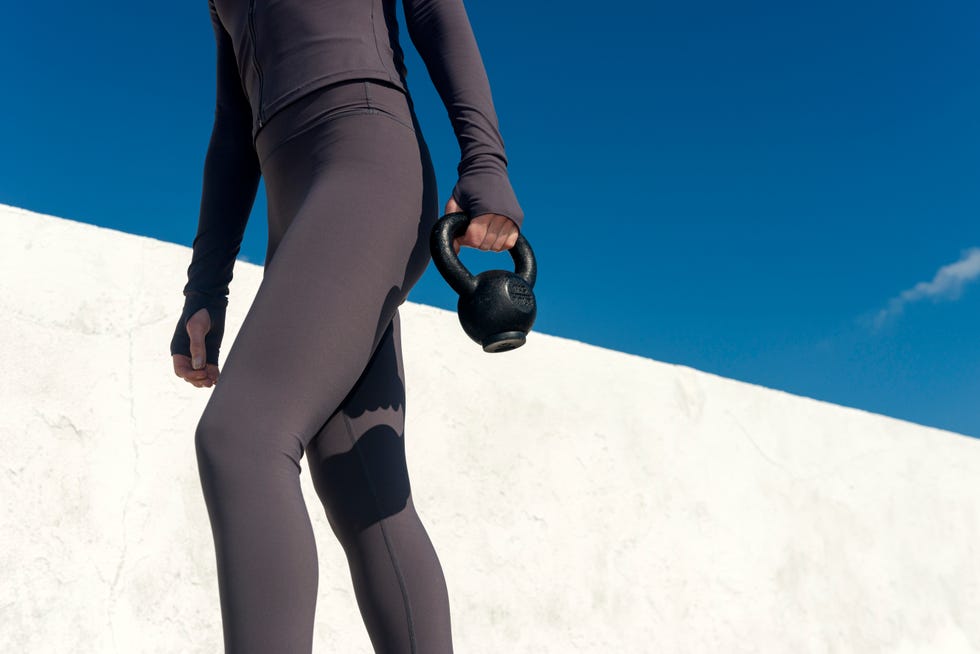 Rob Wilkinson//Getty Images
The single-arm kettlebell suitcase carry is a highly functional exercise, says Jordan
Below, Jordan explains how to do the exercise effectively and safely.
Hold a kettlebell in one hand by your side and stand tall with your shoulders level.Brace your core as though you’re preparing for a gentle punch to the stomach and walk slowly for around 20-40 metres (or for around 30-45 seconds if space is limited) without leaning towards or away from the weight.Keep your ribs stacked over your hips, maintain good posture and breathe normally throughout.Repeat the exercise 2-3 times per side.
‘Aim to include the exercise 2-3 times per week as part of a strength training programme. It’s particularly effective when performed after your main strength exercises or as part of your core training,’ adds Jordan.
How heavy should your kettlebell be?
As for how heavy a weight you should use for this exercise, Jordan recommends ‘choosing a kettlebell that feels challenging while still allowing you to maintain perfect posture throughout the walk’.
‘You should be able to resist leaning to one side, keep your shoulders level and your core engaged from start to finish,’ she adds.
‘As a general guide, beginners might start with around 8-12kg, while those with more strength training experience may use 12-20kg or heavier, depending on their ability.’
Mistakes to avoid
Below, Jordan highlights four key mistakes to avoid while performing this exercise.
Choosing a kettlebell that’s too heavy and allowing your body to lean.Shrugging the shoulder up towards the ear instead of keeping it relaxed.Walking too quickly rather than focusing on control.Holding your breath instead of breathing steadily throughout the movement.
One of our most frequently asked questions here at Women’s Health? How to build muscle and burn fat at the same time. So, we asked superstar trainer Oyinda Okunowo exactly how to do it. In this 4-week plan – created exclusively for Women’s Health COLLECTIVE members – yrrou’ll get the workouts and nutrition guidance needed to help you on your way to better body composition. Tap the link below to unlock 14 days of free access to Oyinda’s plan and start training today.
Hannah Bradfield is a Senior Health and Fitness Writer for Women’s Health UK. An NCTJ-accredited journalist, Hannah graduated from Loughborough University with a BA in English and Sport Science and an MA in Media and Cultural Analysis. She has been covering sports, health and fitness for the last five years and has created content for outlets including BBC Sport, BBC Sounds, Runner’s World and Stylist. She especially enjoys interviewing those working within the community to improve access to sport, exercise and wellness. Hannah is a 2024 John Schofield Trust Fellow and was also named a 2022 Rising Star in Journalism by The Printing Charity. A keen runner, Hannah was firmly a sprinter growing up (also dabbling in long jump) but has since transitioned to longer-distance running. While 10K is her favoured race distance, she loves running or volunteering at parkrun every Saturday, followed, of course, by pastries. She’s always looking for fun new runs and races to do and brunch spots to try.