
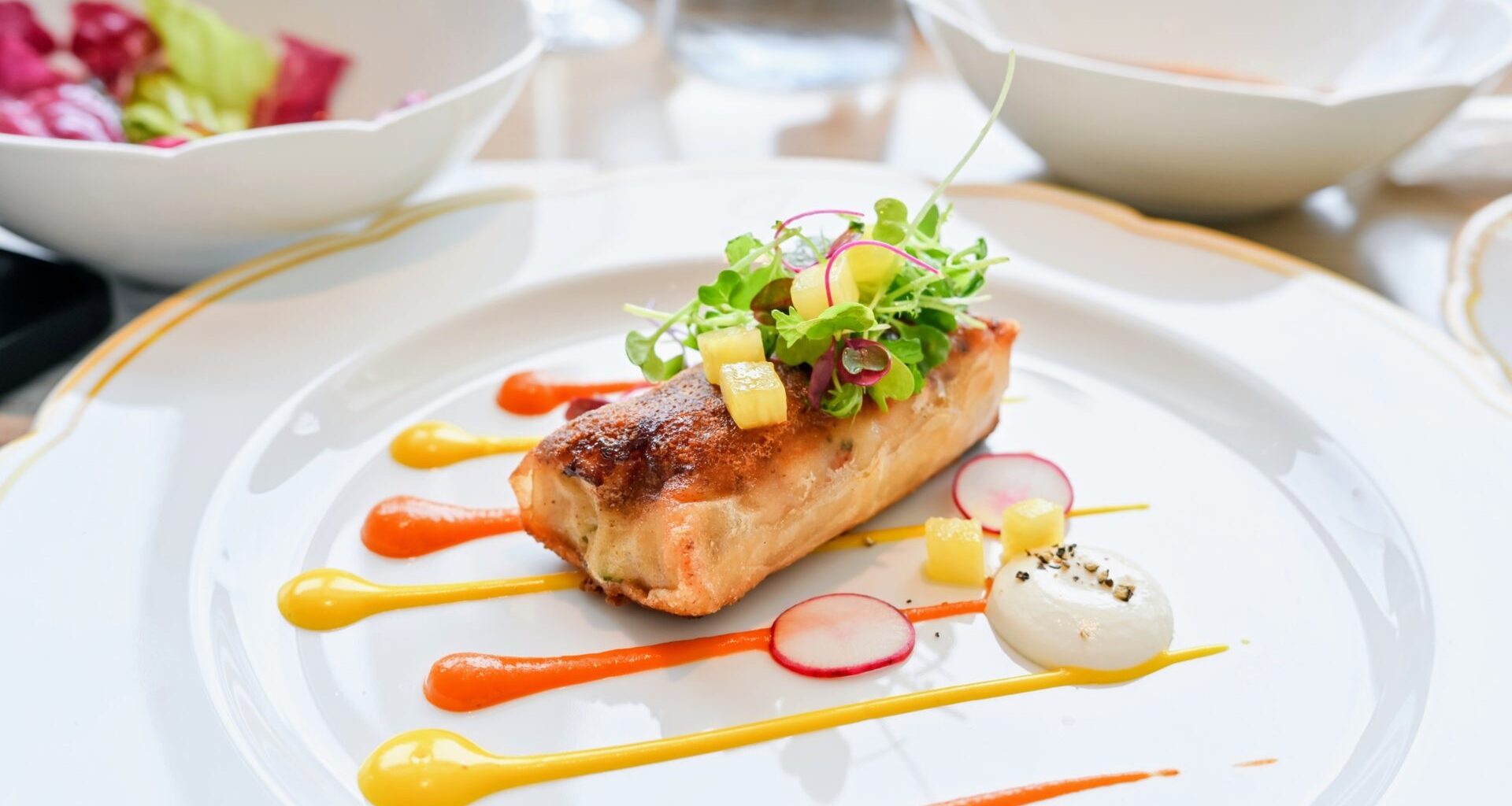
A restaurant study reveals how a simple change in sauce placement can make the same meal appear healthier, even when the food itself stays the same.
A chef can drizzle sauce across a plate or leave it in small dabs beside the food. Diners may see those choices as decoration, but the arrangement could also shape how healthy they think the meal is.
In a Tokyo restaurant, people judged a piece of sturgeon as healthier when its two sauces sat beside the fish.
They gave the same food a lower healthiness rating when the sauces were drizzled across the plate.
Kosuke Motoki, an associate professor in Keio University‘s Faculty of Business and Commerce, led the study.
“We observed that minimal plating made the same dish appear healthier, showing how small visual details can influence our first impressions of the food,” Motoki said.
Diners made that judgment before their first bite. The study involved just 57 people, so the finding offers an early clue about how presentation shapes expectations.
We judge dinner before tasting it
Diners judge a dish by its looks before they’ve taken a bite. From the plate alone, they decide whether the food seems delicious, artistic or healthy.
Researchers have studied how plate size, food arrangement and neatness shape those first impressions. In a 2025 study, people gave salads their highest liking ratings when the food was stacked upward on a large plate.
Sauce is different, because diners both look at it and eat it. Drizzled across a plate, it’s already spread over the food, while sauce set off to one side lets each diner decide how much to use.
In much of the earlier research, people judged photographs of food or took part in lab tests. Motoki’s team ran its test in a working restaurant, where diners saw each dish and then ate it.
One dish arrived in two styles
The experiment took place at 8go, a restaurant inside Gastronomy Innovation Campus Tokyo.
A professional chef who has received a Michelin Green Star, which recognizes sustainable practices, helped prepare the dish.
Each diner received both versions, one after the other, with a single piece of sturgeon on each plate. One had separate dabs of sauce, which the researchers called “minimal,” while the other had the “drizzle” arrangement.
The researchers determined the serving order, with 29 diners receiving the drizzled version first and 28 receiving the minimal version first.
Before eating, diners scored statements such as “looks delicious” and “is healthy” from one to seven, ranging from strongly disagree to strongly agree.
They also named a price, up to 3,000 yen, that they would pay for a full six-piece serving.
The separate sauces looked healthier
The minimal plate earned an average healthiness score of 4.65 before tasting, compared with 4.05 for drizzle.
Diners were fairly neutral about the drizzled dish’s healthiness but leaned toward calling the minimal version healthy.
That was a modest difference, and the researchers needed to check whether chance could explain it. When a study compares lots of ratings, some can come out differently simply by accident.
The difference in perceived healthiness remained statistically significant even after the researchers applied their strictest statistical test.
Neither plate clearly looked tastier or persuaded diners to pay more, and people found them about equally artistic.
The drizzle did not win an artistic advantage, which is why the researchers used neutral names for the two styles.
What happened after the first bite
After eating, diners no longer rated one plate as reliably healthier than the other.
They did give the minimal plate slightly higher scores for overall liking, 5.75 compared with 5.37 for the drizzle.
Their wish to eat more was also a little stronger for the minimal version. But the team couldn’t confirm either difference with its stricter test, so chance could explain both.
Diners gave both plates tastiness scores about 0.8 points higher after eating than before.
The higher ratings may mean that diners enjoyed the food more than they expected.
However, the researchers noted that other factors, including answering the same questions twice, may have influenced their responses.
So the team could say more about how healthy the dish looked than about how much diners enjoyed eating it.
Sauce placement could change each bite
There is another reason to be careful with the tasting results. Moving sauce to the side gives diners more say over how they eat the dish.
Someone can add a little sauce, use plenty or try the fish on its own. With sauce already drizzled around the fish, the starting point is different.
The researchers did not record how much sauce anyone ate.
They therefore could not tell how much the later ratings reflected the appearance of the dish and how much reflected the way diners used the sauces.
Weighing plates before and after eating could help answer that question. It would give future researchers a clearer picture of what people actually consumed.
Why would neat dabs look healthier?
The researchers suggested that a simpler appearance might explain the first impression.
Earlier studies indicate that people sometimes associate less crowded designs with products that seem healthier or more natural.
But this experiment did not ask diners how simple the plates looked. It also did not measure whether they thought one version contained more sauce or more calories.
Those ideas remain possible explanations, rather than findings from this study. The experiment tells us about perceived healthiness; it does not establish a nutritional benefit from moving the sauce.
Study limitations and future research
The team recruited diners through personal contacts, and everyone ate the same dish in the same restaurant.
The authors wrote that the group shouldn’t be taken to represent Japanese diners or restaurant customers in general.
Because everyone saw and ate both versions, some diners may have guessed what the researchers were comparing.
Each impression was also measured with a single question rather than a full questionnaire.
Diners rated both plates fairly favorably before tasting, which may have made differences between them harder to detect.
And since the researchers didn’t choose a main outcome before collecting data, they treat every result as preliminary.
The authors suggested that future experiments change one feature at a time, such as the drizzle pattern, the amount of sauce, or whether diners add it themselves.
For now, the clearest finding is that something as simple as where a chef places the sauce can change how healthy diners think a meal is.
The study is published in the journal Foods.
—–
Like what you read? Subscribe to our newsletter for engaging articles, exclusive content, and the latest updates.
Check us out on EarthSnap, a free app brought to you by Eric Ralls and Earth.com.
—–