
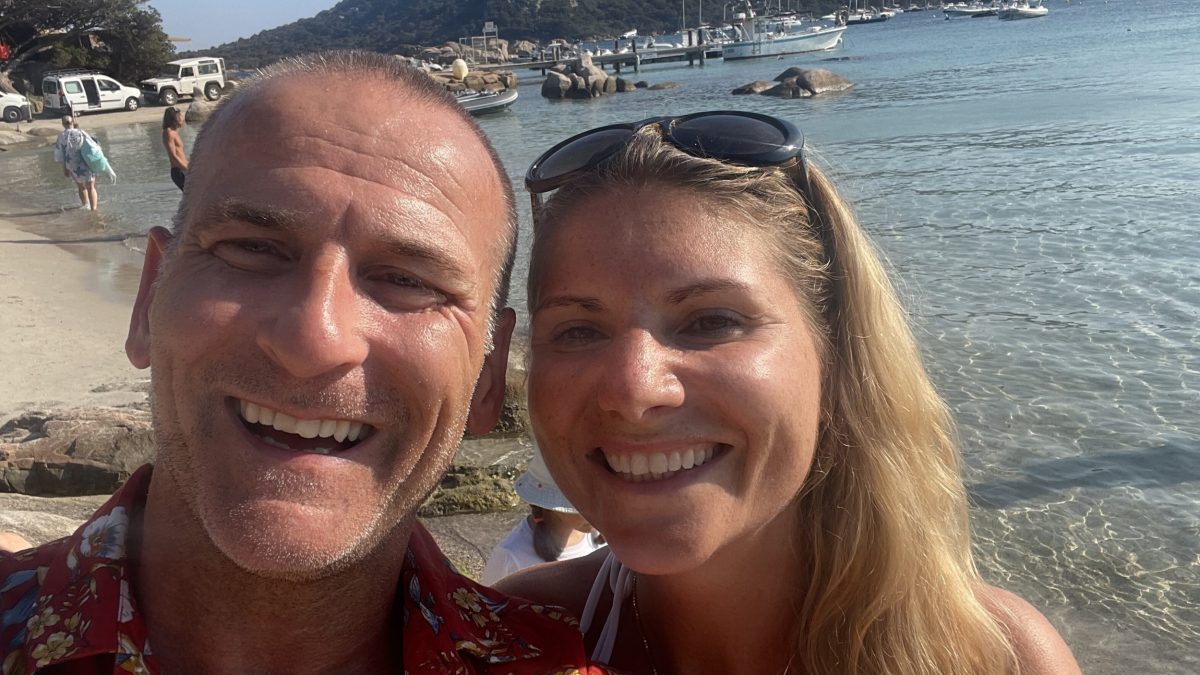
Since my forties, I’ve lost two stone and four inches from my waist by cutting out booze and junk, taking inspiration from my partner
Thirty-year-old me gives me the ick: I was a grey, bloated ghost, drifting into middle age, nudging 13 stone with an expanding 34-inch waist that was bigger than my inside leg. I had a round face, like Casper with a double chin. I had sciatica, recurring acid reflux, and a nightly alcohol dependence.
I exercised regularly, but couldn’t work out why, year after year, I was getting fatter.
I was laying down the foundations for metabolic syndrome, the depressingly common cluster of conditions that include increased waist circumference and high blood pressure, which can lead to type 2 diabetes and cardiovascular disease.
New FeatureIn ShortQuick Stories. Same trusted journalism.
I can laugh about it now because today I’m a shadow of my former self and I strut around with a smug health halo above my head.
I went through a transformation in my forties which included a complete diet overhaul, a reduction in alcohol consumption, a focus on healthy eating, a gym membership, and a relationship with a much fitter and younger person, now my wife of nine years.
By 45 I was down to 11 stone and had a 30-inch waist, both markers that have remained stable ever since.
Now I’m 56, and I’m in the best shape of my life. While I can’t do everything I did in my mid-forties, such as circuit training wearing a 10kg weighted vest, I can run faster, last longer exercising at maximum effort, and lift heavier than I ever did.
The key has been adaptation, a better understanding of diet, and realistic goal setting, factors that fitness expert Fraser Smith, founder of Vive Fitness EMS and reformer Pilates studios in London, says middle-aged men would do well to consider when embarking on later-life fitness.
 Nick Harding in his 30s – he exercised regularly yet kept gaining weight
“The majority of men in their fifties look to remain functionally strong, ensure heart health is optimal and avoid weight gain,” he explains. “You don’t need to lift as heavy as possible or beat your body doing endless reps. Your joints are 50 years old, so even if you are injury-free, there will be some wear and tear.”
However, he adds that with the right training, most people in their fifties can actually get fitter and functionally stronger than they have been in the past.
“But age will eventually win when you get to your seventies and eighties.”
He recommends resistance and functional training to concentrate on range of movement, strength and load, plus one or two cardio sessions a week, aiming for 20 to 30 minutes of intermittent breathlessness in each.
“Eat a sensible, healthy, balanced diet and get quality sleep for recovery and adaptation,” he adds.
I started to lose weight and build muscle when I swapped my haphazard training for structured circuits and Blaze HIIT classes at the David Lloyd gym I joined. I also discovered a few added high-tech helpers along the way, the first being Myzone fitness trackers. These monitor heart rate and give feedback in real time. Importantly for me, you earn points for effort and these accumulate towards a monthly status level. I’ve been using my tracker for nine years now and am so invested in maintaining and improving my status level (currently Hall of Fame: Elite) that I take my Myzone on holiday with me so I can continue to earn points when I exercise.
The other extra I discovered was Electric Muscle Stimulation, or EMS. This form of exercise works by sending low-level electrical impulses through pads on your skin, triggering the same muscle fibres you’d fire up during a workout. Working with a personal trainer, it enhances strength training by improving muscle activation. You can choose the level of activation so it works well for rehab and injury. Equally, with the dials increased, I can get a more intense muscle workout in 20 minutes than hours in the gym lifting weights.
In the past year, I have also increased the amount of resistance training I do and eased back on circuit training. I was finding that increasingly in the afternoons I was feeling tired and struggling to concentrate.
Cognisant that as we get older, we lose strength and muscle through a process called sarcopenia, and that men experience a gradual reduction in testosterone with age, I decided to try a three-day-a-week resistance training programme, coupled with three Blaze classes a week and one active recovery day. At first, I worried that I’d start to gain fat and was pleasantly surprised when I started to gain muscle instead and remained the same size and weight, suggesting that the muscle was replacing fat. The afternoon crashes also stopped. For a man of my age, it seems to be the perfect balance, and hopefully will defend against the damaging effects of the sedentary work life I live.
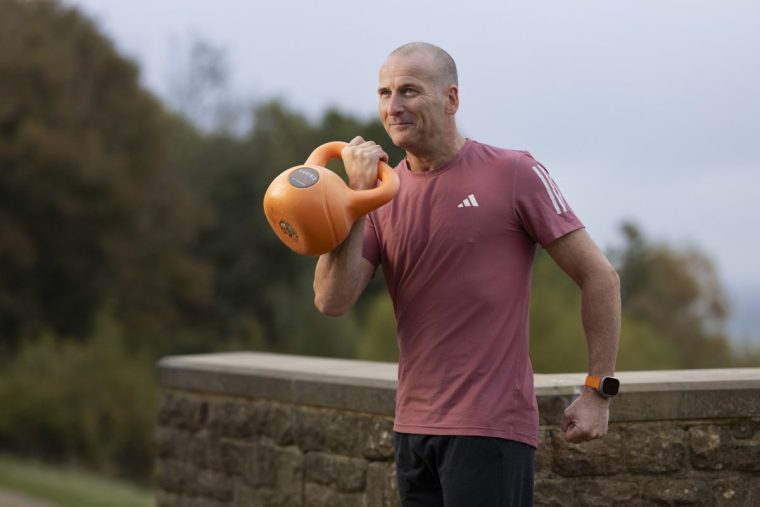 Over the past year, Nick has increased the amount of resistance training in his routine (Photo: Jason Alden)
The exercise protocol, however, is just one side of the equation. The most important lessons I learned when I started taking my health seriously was that you can’t outrun a bad diet. In my thirties my fat gain despite exercising was purely down to my calorie intake.
Fat loss is a simple equation of calories in versus calories out (weight loss is different because muscle weighs more than fat, so theoretically you can gain weight whilst losing fat if you are building muscle). For years I fooled myself that a hard gym session would allow me guilt-free treats such as cakes, beer and biscuits. Unfortunately, 500 calories burnt on a 10k run, while great for cardiovascular health, is quickly undone by three chocolate caramel Hobnobs and a medium latte. You’ve only got to look at the men in cycle cafes up and down the country, who are still spilling out of their Lycra with a milky drink in one hand and a cinnamon bun in the other after a 50-mile cycle, to understand the problem.
For me, diet now means a fibre-maxing breakfast of fruit, chia seeds, oat bran and ground psyllium husk, a lunch of protein (eggs, salmon or chicken) with vegetables or salad, and a similar dinner with meat, fish or vegetable protein, grains, pulses and vegetables.
I still eat out and treat myself, and also enjoy a beer or a glass of wine occasionally, but make sure the majority of days in the week are alcohol-free. I up my protein intake with a daily ESN Isoclear whey protein isolate shake, which is easier on the stomach (anyone who’s experienced a male gym toilet in the morning will understand why this is important).
Indeed, in order to stay healthy, nutrition needs to change with age, as Bini Suresh, lead for dietetics at Cleveland Clinic London and British Dietetic Association spokesperson, explains: “Emerging evidence suggests that men in mid to later life may benefit from a slightly higher protein intake than the basic RDA, particularly if they are active and want to preserve muscle.”
According to studies, roughly 1.0 to 1.2 g of protein per kg body weight per day is beneficial, and in those with sarcopenia or very high activity, this can increase up to 1.2 to 1.6 g per kg body weight, provided kidney function is normal.
This should be spread throughout the day.
“About 20 to 30 g of protein at each meal appears to support muscle protein synthesis more effectively than having most protein in one large evening meal,” continues Bini, who also points out that you can overdo it, and that 1.8 g of protein per kg and above may be associated with a higher risk of cardiovascular events in older adults.
You can’t predict what will happen in the future, but you can reduce risks and in my fifties, I’m hoping that I’ve now banished the ghost of the past. I’ve learned that staying fit is about adapting, eating smarter and training with purpose. Do that, and middle age stops being a slow decline and becomes a chance to build the strongest, healthiest version of yourself yet.