
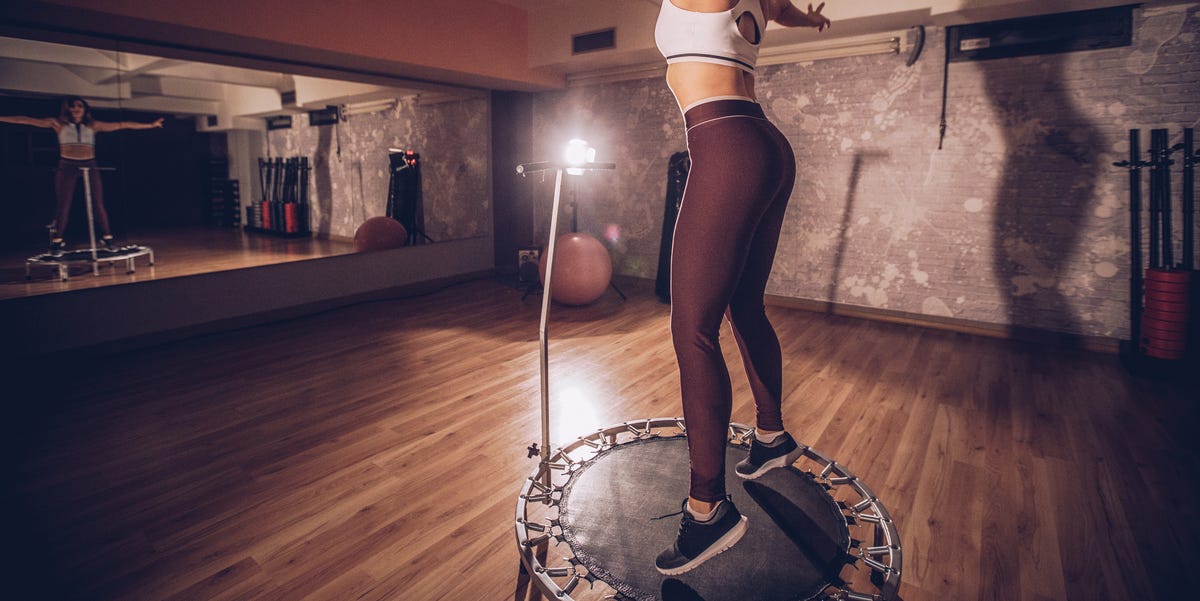
Initially trendy back in the 80s, trampoline workouts – otherwise known as rebounding – have experienced somewhat of a renaissance recently. One commonly cited NASA study found the exercise to be up to 68% more effective at working the muscles and joints than treadmill running, and many people have shouted about the fat loss benefits, like Sydney Ross, otherwise known as jumpnjacked online, who said rebounding helped her lose 40lbs (16kg).
Below, we look at the three reasons she feels it was so effective – and a physiotherapist and strength coach gives her verdict on how it compares to other types of exercise.
3 reasons Sydney found rebounding so effective Firstly, she said that she had so much fun doing the workouts that she wanted to do it more consistently.She also said that because ‘it didn’t wreck my nervous system, I felt more energised as opposed to drained like I did for other workouts.’Finally, Sydney added that because she found so much joy in the rebounding workouts, it became integral for her mental health, too. The benefits of rebounding
Physiotherapist, strength coach and founder of Move Well Gym, Kim Johnson, says that while rebounding might just look like a trend, ‘there are actually some solid physiological reasons why it may benefit women – particularly as they age.’
 Olga Yastremska//Getty Images
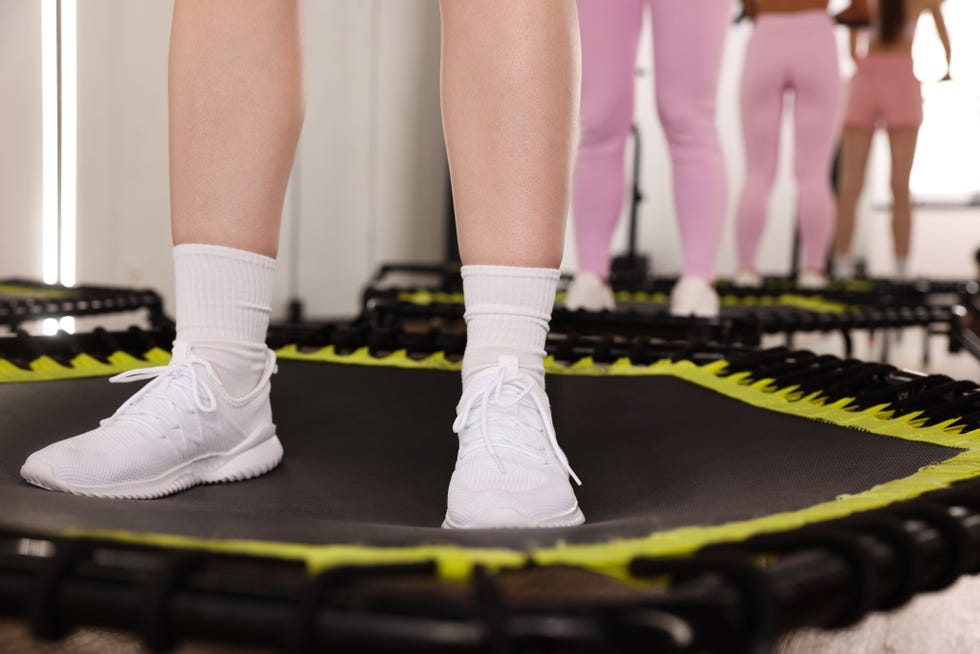
Johnson highlights the bone density benefits of rebounding
Bone density
‘Rebounding is essentially low-level plyometric work performed on a compliant surface. That surface changes the ground reaction forces compared to hard-floor jumping, reducing joint impact while still exposing the body to acceleration and deceleration forces,’ she explains, making it particularly beneficial for (peri)menopausal women experiencing a decline in oestrogen, which plays a key role in regulating bone density.
‘Bone responds to load, specifically to rapid changes in load. Small jumps, hops and accelerations stimulate osteoblast activity and help maintain bone mineral density,’ adds Johnson.
Cardiovascular fitness and coordination
She also highlights the cardiovascular and coordination benefits of rebounding, which ‘can elevate heart rate quickly, and challenge coordination, reactive stability and neuromuscular timing, which, as we age, become important for fall prevention and maintaining athleticism.’
Fat loss
As for fat loss? Several scientific studies, including this review have highlighted the benefits of rebounding for weight management. A study published in The Journal of Sports Medicine and Physical Fitness also found that 12 weeks of rebounding workouts significantly improved body composition and fitness in overweight women, and another paper published in the International Journal of Preventative Medicine found that 20 weeks of rebounding workouts had a significant effect on body fat reduction.
However, Johnson says it’s important to look at the bigger picture, and to view ‘a mini trampoline as a tool – not inherently better or worse than skipping, sprint drills or low-level plyometrics on the floor.’ While it ‘allows women who may not tolerate hard-floor plyometrics to introduce gentle impact safely,’ she says, ‘rebounding alone is not a replacement for progressive resistance training.’
In other words, while rebounding is great for cardiovascular health, metabolism, mental health and overall longevity, it doesn’t eliminate the need for resistance training, especially for women 40+ looking to preserve lean mass and bone density.
The verdict
Ultimately, when it comes to fat loss, the key is finding an activity you enjoy and can sustain – that’s when you’ll see results, as was the case in Sydney’s experience with rebounding. The science shows there’s fat loss benefits, but as Johnson highlights, it’s crucial not to lose sight of other important training types – namely, strength training – as you age.
After years living with endometriosis and undergoing seven rounds of IVF, Radio 4 presenter Emma Barnett turned to training with PT Frankie Holah to rebuild strength and a more positive relationship with her body. Download the Women’s Health UK app to access Emma’s full training plan.
 Related Stories
Hannah Bradfield is a Senior Health and Fitness Writer for Women’s Health UK. An NCTJ-accredited journalist, Hannah graduated from Loughborough University with a BA in English and Sport Science and an MA in Media and Cultural Analysis. She has been covering sports, health and fitness for the last five years and has created content for outlets including BBC Sport, BBC Sounds, Runner’s World and Stylist. She especially enjoys interviewing those working within the community to improve access to sport, exercise and wellness. Hannah is a 2024 John Schofield Trust Fellow and was also named a 2022 Rising Star in Journalism by The Printing Charity. A keen runner, Hannah was firmly a sprinter growing up (also dabbling in long jump) but has since transitioned to longer-distance running. While 10K is her favoured race distance, she loves running or volunteering at parkrun every Saturday, followed, of course, by pastries. She’s always looking for fun new runs and races to do and brunch spots to try.