
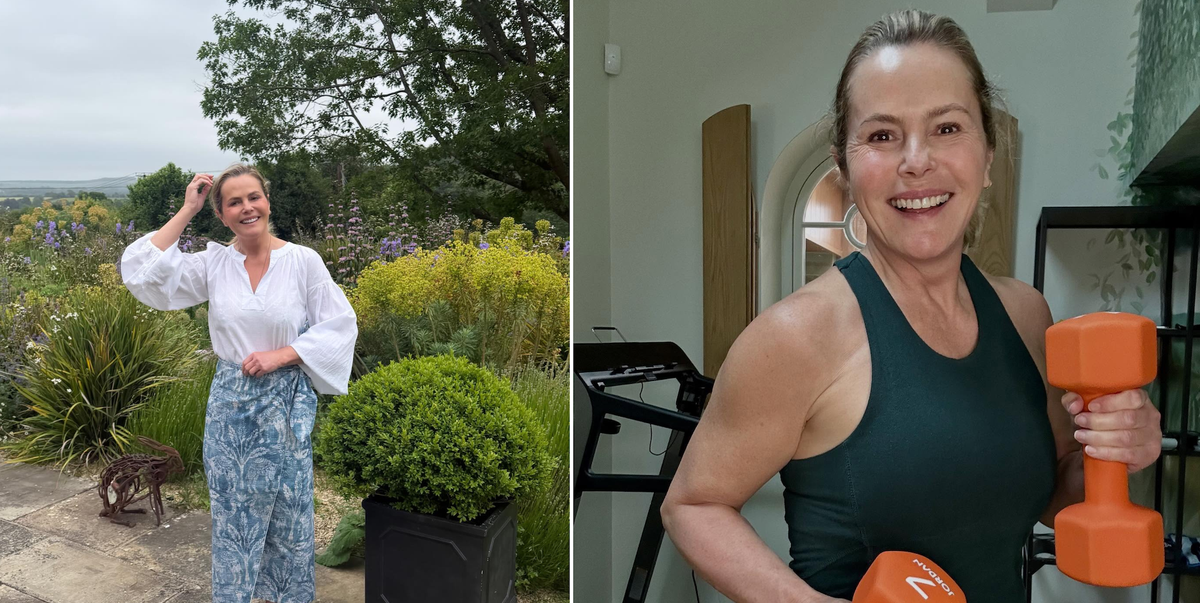
In recent months, wellness guru Liz Earle has given us an insight into how she trains to future-proof her body. And now, after many requests, she’s shared her current full weekly workout routine – and it’s surprisingly simple.
‘You do not need to spend hours in the gym – I certainly don’t,’ she says in her new YouTube video. ‘But what you do need is a bit of consistency.’
Here, we go through Liz’s workout routine and explore why it’s so effective for building strength and fitness in midlife and beyond.
Monday Home strength workout
In her home gym – where she has dumbbells – Liz will follow a strength session on YouTube or led by her personal trainer Michael Garry remotely.
And if she’s travelling, Liz still tries to strength train, but uses her bodyweight for resistance instead. This typically includes exercises such as squats and countertop push-ups. For extra weight, Liz recommends using household items, like bags of potatoes or adding extra weight into your pockets or a rucksack. But just doing ‘more reps with no weights’ is also an option.
Countless research studies have demonstrated the health and longevity benefits of regular strength training, including this recent 30-year study of more than 140,000 participants. Researchers found that doing around two hours of strength training per week was linked to a 19% lower risk of death from cardiovascular disease and a 27% lower risk of death from neurological disease.
Tuesday Cardio and endurance
If Liz has time, she’ll go ‘for a really nice long walk’ outdoors or a quick run if not.
Or, she will do walk-sprint intervals – ’I’ll make it [the walk] quite explosive,’ she explains. ‘I’ll do a little bit of a walk and then a sprint and then a bit more of a walk and then a sprint. It’s these fast, reactive movements that the body likes.’
‘The body – a bit like the gut microbiome – loves diversity,’ adds Liz. ‘It doesn’t like it when we do the same thing time and time again; if you’re a tennis player and you’re always playing tennis using the same movements, the body doesn’t respond as well to that as it does [to variety].’
Indeed, a recent landmark study found that exercise variety is key for longevity. Researchers found that compared with the lowest variety group, participants in the highest physical activity variety group had a 19% lower risk of death from any cause, and a 13-41% lower risk of dying from cardiovascular disease, cancer, respiratory disease and other causes.
Midweek Mobility, flexibility + more cardio
‘It’s not prescriptive, but maybe later in the week, I might do a bit of yoga or Pilates,’ adds Liz. ‘Maybe that’s online – I’ve got various free apps downloaded which are really helpful.’
If she’s out and can meet her PT in person, Liz sometimes goes for a short, slow run with him. Or, if she’s near a gym, she’ll do a treadmill run or power incline walk.
This zone 2 cardio work (activities brisk enough to get your heart rate up but not so much that you can’t speak) is a crucial part of the midlife fitness formula.
Experts typically recommend the 80/20 training principle – where 80% of your training is done in lower HR zones and 20% at a much higher intensity – to optimise heart health, longevity and fitness.
Friday Skipping or jumping 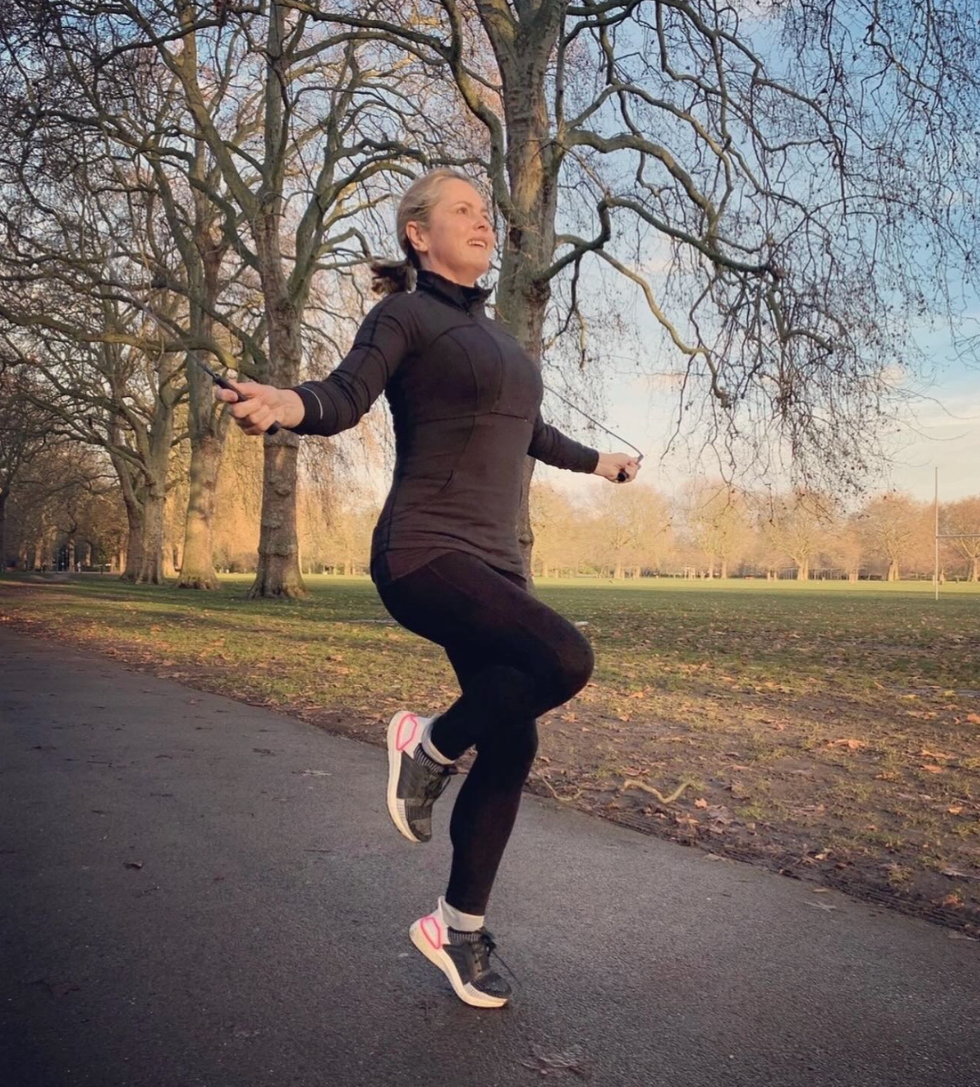 Instagram / @lizearleme
Skipping can benefit your joints while also improving cardio fitness
To work on her power, agility and balance, Liz says she also takes some time to skip or jump each week – exercises which experts typically recommend for better bone density and cardio fitness. ‘Skipping typically produces higher cardiovascular intensity per minute than steady jogging because it’s more plyometric and keeps heart rate elevated,’ personal trainer Eryn Barber previously told WH.
SaturdayYoga + outdoor walk
‘On a Saturday morning, I do an hour-long online yoga class,’ says Liz, who adds that ‘the opening movements’ involved with yoga are a great antidote to the time she spends working over a screen during the week. Saturday afternoons, adds Liz, usually include a walk with her children.
Sunday Rest + recovery
Sunday is for rest and recovery, says Liz – ‘to allow your body to take on board all the changes and strength work you’ve done and actually translate that into helping to build that strong body’.
While she might go for a gentle walk and/or do some slow stretching (static lunges if she’s been sitting for long periods), Liz highlights the importance of ‘having an active rest day at least once a week’.
Above all, advises Liz, it’s about consistently moving little and often and ensuring there’s variety in your routine.
One of our most frequently asked questions here at Women’s Health? How to build muscle and burn fat at the same time. So, we asked superstar trainer Oyinda Okunowo exactly how to do it. In this 4-week plan – created exclusively for Women’s Health COLLECTIVE members – you’ll get the workouts and nutrition guidance needed to help you on your way to better body composition. Tap the link below to unlock 14 days of free access to Oyinda’s plan and start training today.

Hannah Bradfield is a Senior Health and Fitness Writer for Women’s Health UK. An NCTJ-accredited journalist, Hannah graduated from Loughborough University with a BA in English and Sport Science and an MA in Media and Cultural Analysis. She has been covering sports, health and fitness for the last five years and has created content for outlets including BBC Sport, BBC Sounds, Runner’s World and Stylist. She especially enjoys interviewing those working within the community to improve access to sport, exercise and wellness. Hannah is a 2024 John Schofield Trust Fellow and was also named a 2022 Rising Star in Journalism by The Printing Charity. A keen runner, Hannah was firmly a sprinter growing up (also dabbling in long jump) but has since transitioned to longer-distance running. While 10K is her favoured race distance, she loves running or volunteering at parkrun every Saturday, followed, of course, by pastries. She’s always looking for fun new runs and races to do and brunch spots to try.