
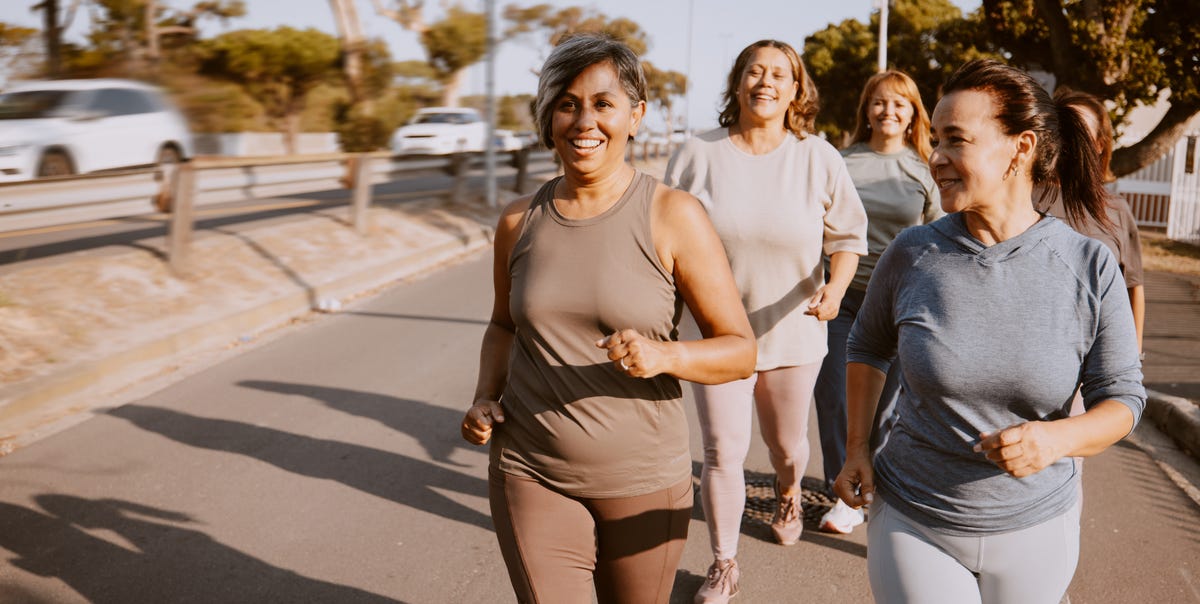
According to a new study published in The BMJ, which explored the link between different types of exercise and bone mineral density, brisk walking and jogging came out on top.
What did the study find?
Hoping to better understand how different types of exercise influence osteoporosis risk, researchers analysed the results of 124 existing trials involving more than 18,000 adults aged 40 and over.
They compared six main exercise categories: mixed aerobic exercise, resistance training, combined aerobic and resistance training, brisk walking or jogging, mind-body exercise (such as tai chi and yoga), and whole-body vibration (a.k.a. vibration plates).
Overall, structured exercise was associated with improvements in age-related bone density decline.
When the researchers compared the different exercise categories, brisk walking and jogging emerged as the most effective.
Combined aerobic and resistance exercise – for example, combining running, cycling or walking with weights – was also beneficial, although the effects were seen in fewer areas of the skeleton.
The researchers also investigated how much exercise might be needed to produce clinically meaningful benefits. Their answer: around 600 MET minutes per week (MET stands for Metabolic Equivalent of Task, a measure of energy expenditure).
In practical terms, they note, that’s roughly equivalent to two to three hours of brisk walking or jogging each week.
What does this mean for us?
The findings reinforce something we’ve been hearing for years: never underestimate the health benefits of walking.
Yes, an ideal exercise routine includes a mix of strength, impact, balance and aerobic training. But depending on how you do it, a brisk walk can tick several of those boxes – especially if you’re walking at pace or carrying heavy shopping.
The researchers suggest brisk walking may be particularly effective because it’s a weight-bearing activity that repeatedly loads the skeleton with moderate impact, helping stimulate bone maintenance.
5 simple ways to walk more
While two to three hours of brisk walking each week might sound like a lot, it becomes much more manageable when broken into smaller chunks.
Walk whenever you can – It sounds obvious, but look for easy opportunities to add steps, whether that’s getting off the bus or Tube a stop early or walking to the supermarket instead of driving.Make it social – Arrange a weekly walk with a friend. It’s easier to stay consistent when someone else is expecting you. That’s exactly what Dragons’ Den star Sara Davies does.Consider a walking pad – As the colder months approach, a walking pad can help you increase your daily step count without leaving the house.Take a post-meal walk – Making a 10-minute walk after eating part of your routine may also help reduce blood sugar spikes.Build movement into your working day – Get up every 30 minutes for a quick walk around the office. This type of ‘exercise snacking’ has also been associated with a lower risk of cancer.The bottom line
While the nature of this study means not all of the underlying evidence was of equally high quality – the trials varied considerably in their design – the findings add to the growing body of evidence showing that walking can support everything from heart health to bone health.
And with osteoporosis and related fragility fractures affecting more than 200 million people worldwide, it’s another reminder of just how powerful everyday movement can be for healthy ageing.

Hannah Bradfield is a Senior Health and Fitness Writer for Women’s Health UK. An NCTJ-accredited journalist, Hannah graduated from Loughborough University with a BA in English and Sport Science and an MA in Media and Cultural Analysis. She has been covering sports, health and fitness for the last five years and has created content for outlets including BBC Sport, BBC Sounds, Runner’s World and Stylist. She especially enjoys interviewing those working within the community to improve access to sport, exercise and wellness. Hannah is a 2024 John Schofield Trust Fellow and was also named a 2022 Rising Star in Journalism by The Printing Charity. A keen runner, Hannah was firmly a sprinter growing up (also dabbling in long jump) but has since transitioned to longer-distance running. While 10K is her favoured race distance, she loves running or volunteering at parkrun every Saturday, followed, of course, by pastries. She’s always looking for fun new runs and races to do and brunch spots to try.