
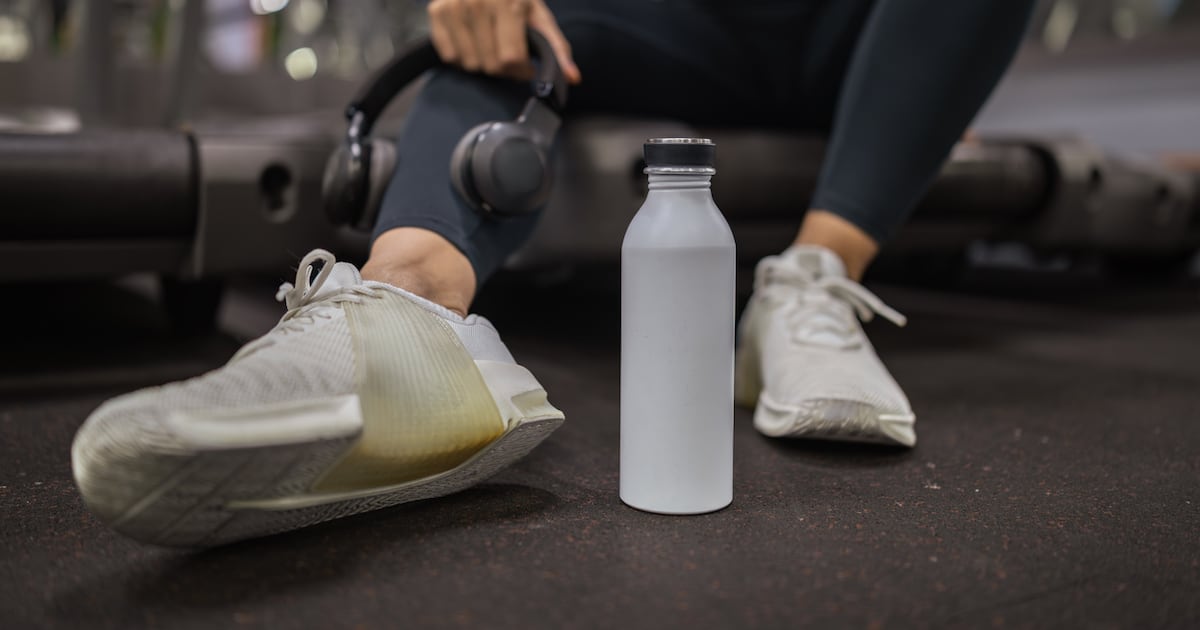
I’m at the age where I spend my disposable income on a fancy gym. It’s a bit depressing to consider if you think, as I do, that your behaviour and not your professed beliefs evidence what you really value. I don’t drink alcohol or smoke – not because I’m trying to be healthy but because I grew up around too much of both and went in the other direction as a consequence.
I don’t really take holidays or have expensive hobbies. Instead, I pay for a gym with an endless supply of clean towels and mouthwash in the bathrooms, and where you can comfortably shower without getting staph or somehow ending up with verrucae on your eyeballs. The equipment is plentiful and spotless. There’s natural light and plenty of space. There are quiet corners where you can stretch or do embarrassing exercises without anyone gawking at you, and people leave you in peace.
It’s kind of sad, really, as a hobby. Less thrilling than a secret cocaine addiction and less endearing than a pathological crochet habit. Thoroughly normie millennial stuff. “Oh, going to the gym, is it? How original. What a unique individual you so clearly are.” I really don’t want to be like one of those people you meet at a party who talk about cycling on the weekend; they own numerous pairs of those preposterous shorts and make pedal clips their entire personality. The sort of person who is so dull to talk to that you feel as though they’ve somehow sedated you.
And yet regular exercise has been transformative for me. Not just on the outside, though that too, and that’s often what we’re encouraged to view as the barometer for much of our broader progress. Rather, it’s the means by which I’ve gathered significant data that proves all my former assumptions about myself wrong.
Most millennial women grew up at war with their bodies – hating them, viewing them as limiting, alien objects that kept us in constant horror of ourselves; not so much practical or useful as deeply shameful – vessels of betrayal. Our bodies were physical manifestations of our bad genetics, our ungovernable appetites and our fundamental weakness. Fallen, failed animal hosts.
We underrate and overate, dressed to conceal, compared ourselves with one another and wept over the intransigent refusal of our bodies to bend to the inexorable rage of our self-loathing will. It is no trivial thing to hate yourself. It’s no isolated thing. You cannot wish the best for someone while you hate them. It’s very difficult to treat them with care or determine what is truly in their best interest. You cannot be rational about a person you hate. In their company you are reduced – you become reactive, petty, vindictive. You become grotesque.
This puts the expensive gym with the notions toiletries into context. To make that membership the nice thing I do for myself in a month is in such total contravention of that younger, sadder, angrier and less healthy version of myself as to make really clear how different a person can become with age.
About three years ago, when I first moved to Australia, I walked into a gym full of conventionally attractive, physically fit Australians and instantly felt that adolescent self-disgust fill my chest like hot liquid. It was enough to drown me.
For months I went in, head down, talking at myself. Nothing looked or felt very different with time and it felt like a futile exercise in self-flagellation. I was weak and felt that I failed every time I tried to lift something, including my own body weight. I was overweight; self-conscious in my gym gear. I was slow. I felt like a fraud – nothing was easy or intuitive; nothing was experienced without the agonising self-awareness of standing off to one side watching myself be bad at what I was trying to do.
The self-judgment felt like a way of distancing myself from the failure. That hateful, narcissistic former self trailed into the gym after me several times each week for months on end, thinking about herself. Pouting, complaining and being awful company.
And yet every visit proved her conception of me wrong. It disproved the theory that I couldn’t do something difficult and embarrassing over and over again. It rendered untrue the story that given the chance I would always choose my own emotional comfort over progress; that I was weak and not athletic and should feel too embarrassed to try; that I would always be locked in this loathing of my body – doomed to feel betrayed and misrepresented by it. My behaviour was evidence that assuming I could not change how I looked or how I thought was incorrect, because I was already doing it.
Our culture is obsessed with optimisation – this utterly illusory idea that we can improve forever even as we age and confront the reality of our own mortality. It’s a lie we are sold and sell to ourselves. People who become lost to the cult of optimisation tend to sacrifice the whole living life bit in pursuit of an unattainable ideal. They mistake the target for the thing that measures it. They become entombed.
[ How to behave at the gym: ‘Behaviour is definitely getting worse’Opens in new window ]
I try to balance this knowledge – that the cycling-obsessed guy is a complete dry shite nobody wants to have a pint with – with the knowledge I am stronger and healthier now than I was at 20 simply because I take care of myself now in a way I didn’t then. I try to appreciate the one body I will ever have to live in, to treat it with respect even when it fails me or I catch a glimpse of it from some unflattering angle, and cringe.
The millennial woman’s remedy for all that loathing is not optimisation, but acceptance. It is not to chase an unrealistic goal, but a realistic one, and through action, to make all those old stories untrue. Just don’t buy bicycle clips.