
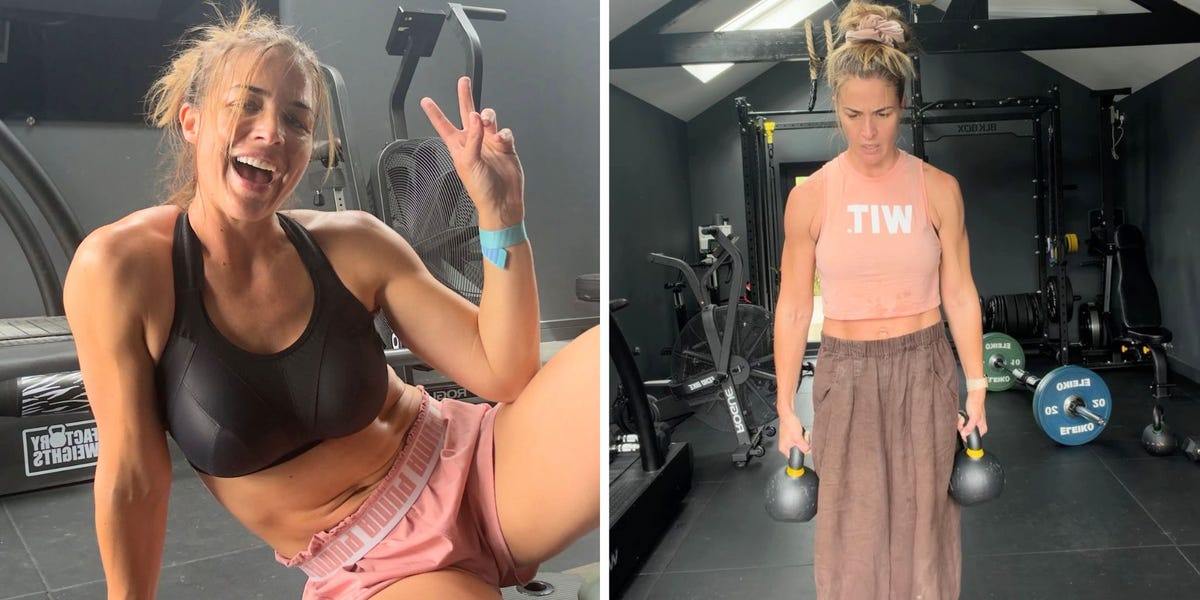
Getting back into exercise after some time off doesn’t have to mean spending hours in the gym. In fact, a handful of well-chosen, minimal-kit exercises is all you need to work multiple muscle groups, build strength and get your heart pumping. Just ask Gemma Atkinson, who recently shared the five moves she’s been using to get back into training after time off.
The former Women’s Health cover star shared that she’d taken 2.5 weeks away from training due to a sinus infection. Alongside a video of her workout on Instagram, she wrote:
‘After 2.5wks off from training due to a sinus infection today I was well and truly back! It hurt, it was sweaty, the endorphins were boosted. Just how I like it. I even hit a new PB on my hip thrust. Sometimes a rest and reset pays off and clearly I needed one.
‘The body is always communicating with us. Physical tension, stress, Gut health, inflammation or in my case the infection. I was doing a lot and constantly moaning about needing rest without actually taking a rest until I had no choice. Sleep and nutrition was my priority and although frustrating at the time I’ve clearly benefited from it both mentally and physically.’
The five exercises she’s now using to rebuild her strength and fitness combine resistance training, functional strength and cardiovascular work – and all are particularly time-efficient. Here’s how to do each move, and why they’re so effective.
1.Hip thrustHow to do it: Sit on the floor with your upper back resting against a bench, knees bent and feet flat on the floor, hip-width apart. Position a barbell across your hips, then drive through your heels and squeeze your glutes to lift your hips until your torso is parallel with the floor. Pause at the top, keeping your ribs down and avoiding arching your lower back. Lower your hips back towards the floor with control and repeat.Why it works:
If you’re short on time but want to build lower-body strength, hip thrusts deliver a big amount of stimulus in one movement. It’s a compound exercise that primarily targets your gluteus maximus – the largest muscle in the body – while also recruiting your hamstrings and other muscles around the hips.
How to do it:Stand with your feet hip-width apart, holding a dumbbell in each hand in front of your thighs.Push your hips backwards, lowering the dumbbells down the front of your legs while keeping your back neutral and a soft bend in your knees. Stop when you feel a stretch through your hamstrings, without allowing your lower back to round.Drive your hips forwards to return to standing, squeezing your glutes at the top.Why it works:
This is another multi-muscle movement that makes efficient use of your training time. It’s a hip-hinge exercise, meaning it trains your posterior chain – the muscles along the back of your body – including your glutes, hamstrings and spinal erectors. And rather than isolating one muscle at a time, you challenge several at once. They’re also a great way to develop strength for everyday activities such as bending down and picking things up.
3. Kettlebell walking lungesHow to do it: Stand tall, holding a kettlebell in each hand by your sides. Step forwards with one foot and bend both knees to lower into a lunge. Keep your front knee tracking in line with your toes and your torso upright. Push through your front foot to stand and bring your back leg forwards. Continue alternating legs as you walk forwards.Why it works:
Walking lunges combine strength, balance and coordination in one exercise. They work your quads, glutes and hamstrings while challenging your core to keep your torso stable. Because you’re working one leg at a time, they also help address differences in strength and control from side to side. Adding kettlebells increases the resistance, giving your lower-body muscles more of a challenge without needing multiple exercises to target the same area.
How to do it: Put on a securely fitted weighted vest and start in a high plank position, with your hands underneath your shoulders and legs extended behind you. Brace your core, keeping your hips level and your body in a straight line from head to heels. Walk one hand sideways, followed by the other, taking small controlled steps. Continue moving sideways while resisting the urge to let your hips twist or sag.Why it works:
This move packs a lot into one exercise. The plank position challenges your core, shoulders and upper-body stabilising muscles, while the added load from a vest increases the demand on your body. Moving your hands also introduces an element of coordination and dynamic stability, forcing your core to work harder to resist rotation or your hips dropping. It’s an efficient way to combine core strength and upper body at the same time, instead of treating them as two separate parts of your workout.
How to do it: Hold a skipping rope with your hands just outside your hips, elbows tucked close to your sides. Swing the rope over your head using small movements from your wrists. As it approaches your feet, make a small jump, landing softly on the balls of your feet. Keep your jumps low and your shoulders relaxed, maintaining a steady rhythm.Why it works:
Few exercises offer quite as much cardiovascular bang for your buck as skipping. It gets your heart rate up quickly, challenges your aerobic fitness and develops muscular endurance in your calves and lower legs. The repeated jumping provides an impact stimulus for your bones, too, which helps boost bone density, while timing your jumps to clear the rope challenges coordination and rhythm. Even a few rounds of skipping at the end of a strength session can provide an effective cardiovascular challenge, rather than needing a separate treadmill or lengthy cardio session.

As Women’s Health UK’s fitness director and a qualified Pilates and yoga instructor, Bridie Wilkins has been passionately reporting on exercise, health and nutrition since the start of her decade-long career in journalism.
After earning a first-class degree in journalism and NCTJ accreditation, she secured her first role at Look Magazine, where she launched the magazine’s health and fitness column, Look Fit, before going on to become Health and Fitness writer at HELLO!
Since, she has written for Stylist, Glamour, Cosmopolitan, Marie Claire, Elle, The Metro, Runner’s World and Red. Today, she oversees all fitness content across Women’s Health online and in print, spearheading leading cross-platform franchises, such as ‘Fit At Any Age’, which showcases the women proving that age is no barrier to exercise.
She has also represented the brand on BBC Radio London, plus various podcasts and Substacks – all with the aim to encourage more women to exercise and show them how. Outside of work, find her trying the latest Pilates studio, testing her VO2 max for fun (TY, Oura), or posting workouts on Instagram.