
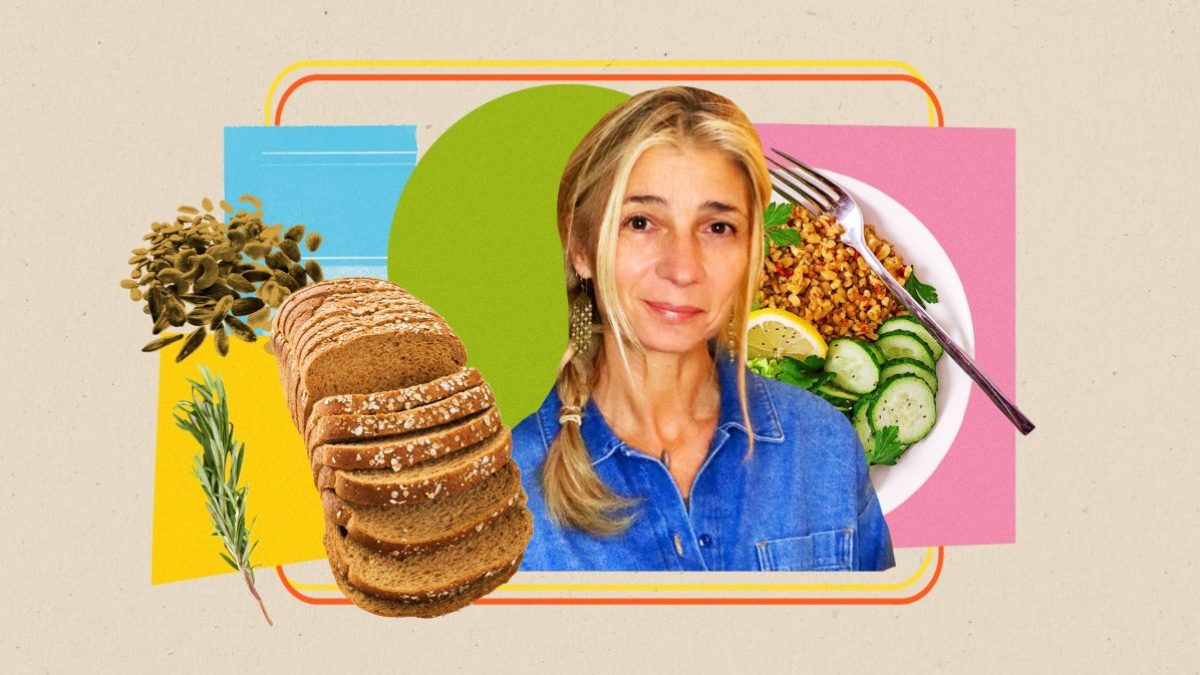
Mimi Spencer, author of ‘The Fast Diet’, shares her top six daily habits for a healthier diet
Mimi Spencer is the journalist and author who helped transform intermittent fasting from a niche concept into a global health movement. She co-authored The Fast Diet, a book that changed how we think about fasting, metabolism and long-term health, and invented the 5:2 diet, which involves low-calorie consumption for two days a week and regular eating for the other five days.
For our new weekly series Life Lessons, she shares her daily habits and the way in which her life is informed by her research and experience in the field.
At a certain age, for me it was around 52, a satisfying epiphany happens. A realisation that you actually know stuff! All those years of gathering information, accreting wisdom, listening and learning and writing things down in scrappy little notebooks, finally pays off and something subtle but important has sunk in to inform everything you do. You have somehow arrived at a hard-won, easy-access philosophy of life.
For me, my “knowing” centres specifically on diet and healthy eating, since that’s the arena in which I’ve spent much of my career as a writer. But, it also brings in ideas about absorption and flow, principles divined over many years from my other lifelong love – yoga.
These are the principles I know I like to live my life by – and have found pay off now that I’ve reached midlife.
New FeatureIn ShortQuick Stories. Same trusted journalism.
Eat two meals a day – when you’re hungry
I have been fasting, in one form or another, since I wrote The Fast Diet with Dr Michael Mosley back in 2012. Most days, I don’t eat until 11am because I am not hungry till then, and I’ll stop eating by about 7pm.
I’m old enough and wise enough these days to eat to my own schedule, one of those delicious freedoms that comes with midlife, when the kids have left home and it turns out you are the boss of you. This schedule not only allows a good long “fasting window” – with all its well-rehearsed health benefits – but it also amounts to two meals a day, not the textbook three. Which means fewer calories.
In midlife, of course, our metabolism needs less fuel: the World Health Organisation (WHO) estimates that our basal metabolic rate decreases by two per cent every decade; typically, we’ll put on a kilo or two for every four years in middle age. So two meals a day makes sense to me.
Look for variety in the supermarket
If you carry one word with you as you traipse around Sainsbury’s filling up your trolley, make it variety. We’re beginning to recognise that a well-fed gut microbiome is associated with countless enhanced health outcomes, both physical and mental.
Recent research suggests aiming for 30 different plant foods a week, though I reckon there’s no need to overthink it. You don’t need to hyperfocus on the lycopene in tomatoes, the quercetin in onions or exactly how much curcumin you’ll absorb from a turmeric latte. Just keep diversity in mind with every meal and mouthful, seeking to maximise the bandwidth of your diet. In some ways, it’s a question of eating outside the box – literally.
Here are some easy principles that I use to access diversity: try to eat something every day that you haven’t eaten so far that week. Eat more of the plant (so, beetroot leaves, coriander stalks). Change the usual colour, so purple carrots, blue poppy seeds, golden beetroot, black raspberries (darker-coloured fruit and veg suggests a higher anthocyanin antioxidant profile and therefore enhanced health benefits). And change the record – perhaps choose hemp oil over sunflower oil – and test-drive new things when you see them.
At the moment, I’m flirting with walnut butter, hibiscus, carlin peas and black turnips.
Add jars of extras to your kitchen counter
I’ve found that one way to maximise variety in my diet is to add low-key extras – seeds, nuts, sprouts, herbs, spices, a dollop of kefir, a drizzle of tahini – to everything.
Channelling my inner Nigella, I keep Kilner jars of dried cherries, pistachios, pine nuts, all manner of things, placed provocatively on an open shelf in the kitchen to be spooned onto yoghurt, porridge, salads, wraps, visitors. It’s a way of getting loads of goodies in without overthinking it.
I buy these items in bulk to halve the cost. I also bulk-buy expensive extra virgin olive oil; weight for weight, it costs about the same as a decent bottle of wine. And it makes me smile everytime I use it – which is about six times a day, taken almost like a vitamin supplement. There are two more actual supplements I take every day: vitamin D3, to support bone health, and vitamin B complex, for energy and mood.
‘In this slice of bread, there is sunshine’
Those words of Vietnamese monk Thich Nhat Hanh are my gentle reminder that food is energy. It’s fuel, of course, but every bite we eat somehow connects us to this planet. In fact, each spoonful, from a Buddhist perspective, contains the universe.
Take a single little pumpkin seed. In all its unassuming glory, it promises the thrilling potential for the whole plant. It is a mighty powerhouse of fibre, polyunsaturated omega 3 fatty acids, vitamin E, B vitamins, iron, zinc, choline. Eaten daily, with abandon and joy, it can help protect against heart disease, lower LDL cholesterol and stabilise blood-sugar levels. It can even improve mood thanks to its mind-soothing tryptophan – an essential amino acid required for the production of serotonin. All that in one pumpkin seed.
Only eat to 80 per cent full
As far as nutritional advice goes, a healthy plate ought to contain 50 per cent vegetables and fruits, 25 per cent lean protein and 25 per cent healthy carbohydrates, with good fats added in moderation. Fine. But, I’m also increasingly drawn to the Japanese concept of Ma, the intentional empty space on a plate. This philosophical principle, which translates as “pause” or “gap” is fundamental to Japanese art and culture; applied to food plating it helps create a sense of harmony and focus by allowing the food to breathe, allowing a little room for contemplation. Nice, right?
Another Japanese principle that I’ve warmed to is hara hachi bu. This traditional Confucian practice suggests we “eat until 80 per cent full”, allowing us to recognise the satiety hormone leptin, which takes 20 minutes to kick in. It’s one reason why Okinawans are renowned for their good health and longevity.
Your next read

Stop eating ‘on the go’
There is no more dispiriting phrase to me than “food on the go” – where exactly are we going?
For me, mindful eating isn’t just a fad. It’s the foundation of a healthy relationship with food. On a physiological level, mindfulness – eating with presence, free from distractions – allows us to tune into our bodies, to the nuances of our hunger and satiety hormones. This in turn helps with food choices and portion control.
The upshot is a positive feedback loop instilling habits of lightness, engagement, intention. And this, in itself, is a practice of yoga – “yoga chitta vriti nirodaha” or “stilling the mind noise”. We might think yoga is done on a mat, but I’ve found over the years that it can just as well be practised on a plate.
The Midlife Kitchen, by Mimi Spencer and Sam Rice, is out now (£27, Mitchell Beazley)