
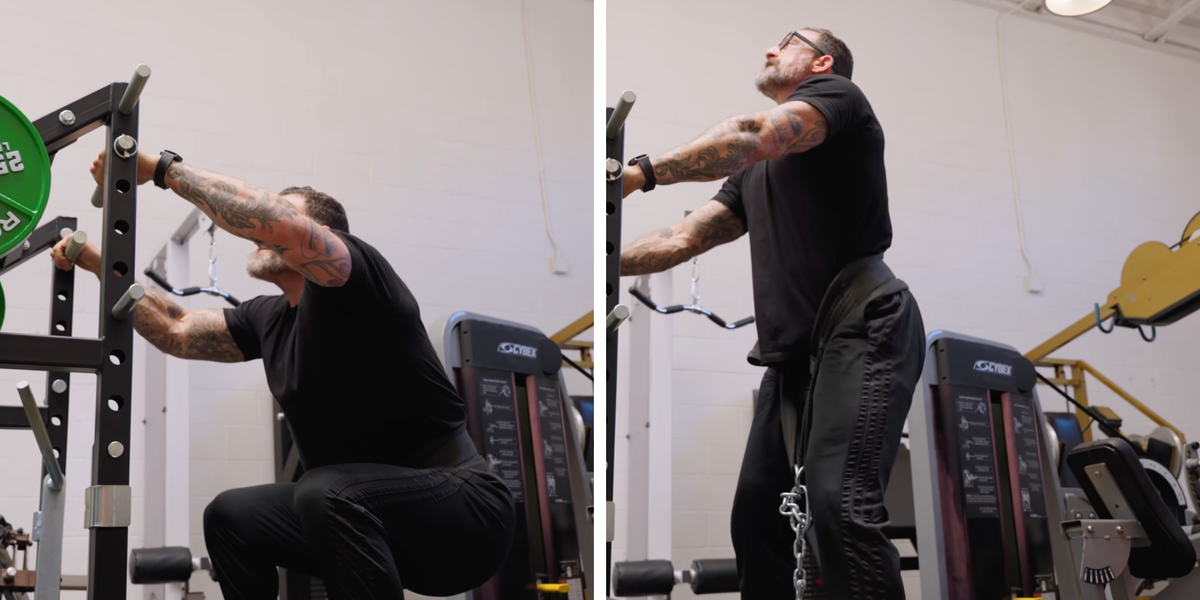
There’s still a lingering belief in some gyms that leg day only really counts if you’ve spent at least part of it with a heavy barbell across your back. Which is all well and good if you enjoy back squats, have the mobility to get comfortably under the bar and find that your legs don’t outlast everything else that’s holding you upright. But – as much as some people give the back squat the crown – there are other ways to build a formidable pair of quads.
Andrew Huberman’s current favourite is the belt squat. Speaking to Men’s Health during a tour of his gym, the 51-year-old explained that the exercise has helped turn lower-body training into something he actively looks forward to.
‘Lately, leg day is my favourite,’ he says. ‘And when I say lately, I mean for the last five years.’
His enthusiasm extends to loading up the machine, then finding ways to add even more resistance.
‘I’ll load that whole thing up and now I have to strap on additional weights,’ he says.
The appeal? Heavy leg training with the weight attached to the hips. As Huberman puts it, with the belt squat, ‘you can get really, really strong without having to load the shoulders’.
What Is a Belt Squat?
A belt squat is a squat performed with resistance attached to a belt around your hips. On a dedicated machine, that belt connects to a cable or lever beneath you, pulling down through your pelvis as you bend your knees and hips.
Your quads do much of the work of straightening your knees, while your glutes and other hip muscles contribute throughout the movement. Your hands are free, and most machines have handles to help you steady yourself.
It’s simply a different way of performing a familiar movement pattern, and a useful option if back squats are starting to feel like more trouble than they’re worth.
What Are the Benefits of Belt Squats?Train Your Legs with Less Demand on Your Lower Back
Moving the resistance to your hips reduces the amount of work your upper body and spine have to do to support a heavy load.
In a small study comparing belt squats with back squats, researchers found similar quadriceps activation alongside substantially lower activation of the lower-back muscles. That doesn’t prove identical muscle growth or guarantee relief from back pain, but it supports the exercise’s appeal: challenging your thighs while asking less of the muscles supporting your trunk.
For anyone whose lower back regularly becomes the limiting factor on leg day, that’s a compelling option.
Take Your Shoulders Out of the Set-Up
Getting into a back squat position requires you to reach behind the bar and support it throughout the set. Belt squats remove that requirement, offering an option if that position feels too challenging for your shoulders, elbows or wrists.
Huberman is particularly enthusiastic about being able to load his legs heavily ‘without having to load the shoulders’. You can also use the handles for balance, leaving you free to focus on the movement rather than wrestling a bar into position.
Keep Building Strength as You Get Older
Huberman’s preference for belt squats sits within a broader training philosophy centred on longevity.
‘I feel comfortable when I lift,’ he says. ‘I can run and I can sit for a long time and also not be in pain.’
That’s his own experience rather than a claim that one exercise fixed everything. He describes several changes to his training over recent years, including paying more attention to smaller muscles he previously neglected.
Nor does he think turning 40 means retiring the barbell.
‘I totally disagree that as a person in your 40s or 50s, since I’m 51, that you can’t do those kinds of free weight movements,’ he says.
The belt squat simply gives you another way to keep progressing. And Huberman’s approach to progression is more straightforward than you might expect from one of the world’s best-known neuroscientists.
‘I always try and add more weight or add more reps with the same weight, at least on one set of each of the exercises every week.’
How to Do the Belt SquatStart light. Position the belt securely around your hips and attach it according to your machine’s instructions. Adjust it so you can squat to your preferred depth without the resistance bottoming out.Place your feet slightly wider than shoulder-width apart with your toes turned out slightly. Hold the handles lightly, stand tall and release the safety mechanism.Take a deep breath, brace your core, then bend your knees and hips, allowing your knees to track in line with your toes. Keep your whole foot planted.Lower as far as you comfortably can without losing your position or letting the machine pull you off balance.Drive through your feet to stand back up, keeping the movement smooth. Use the handles only for balance, rather than pulling yourself up. Re-engage the safety before unhooking.
Huberman notes that the belt can take some getting used to around your pelvis. Getting the fit right matters: if the belt pinches or causes pain, adjust it rather than assuming you simply need to tolerate the discomfort.
Belt Squat Alternatives
No belt squat machine? With the right set-up, you can still load the hips without putting the weight across your shoulders. As Huberman explains, the appeal is being able to get ‘really, really strong without having to load the shoulders’.
Loading-Pin Belt Squat
Probably the closest substitute. Attach a loading pin stacked with weight plates to a suitable dipping or belt-squat belt, allowing the weight to hang between your legs. Stand across two sturdy, load-rated platforms or boxes with enough clearance for the plates to travel between them. Squat under control, then drive back up, keeping the weight hanging beneath you. Adjust the chain so the plates don’t touch the floor before you reach your intended depth.
Low-Cable Belt Squat
A low pulley can provide the resistance, provided you have a suitable belt and attachment. Connect the cable to the front of your belt, face the stack and step back until the cable is taut. Lower into a squat, then stand tall against the resistance. Unlike a dedicated machine, the cable pulls forwards as well as downwards, so start light and find a position where you can stay balanced without leaning excessively backwards.
Landmine Belt Squat
Secure a barbell in a landmine attachment and connect the loaded end to your belt using a purpose-built belt squat attachment. Straddle the bar, facing the anchor, with the loaded end beneath your hips. Squat under control, allowing the sleeve to follow its natural arc, then drive back up. Make sure there’s enough clearance for your chosen depth and that the attachment keeps the belt securely in place.
Dip-Belt Squat with Plates or Dumbbells
For a simpler version of the loading-pin set-up, thread the chain of a dip belt directly through one or more weight plates. Let them hang between your legs and squat from sturdy, load-rated platforms so the plates have room to descend. This works best with moderate loads; as you add more plates, the bundle becomes increasingly cumbersome and can swing or catch against your legs.