
The market for panettone, a sweet, domed Italian bread eaten around the holidays, is littered with mediocre options. Maybe you’ve had one of these more unremarkable loaves from a grocery store, leaving you with the impression that panettone is dry and fruit cake-esque. But it’s time to give panettone a second chance, because the East Bay has mouthwatering options that you will not want to turn down: panettone straight from Italy or handmade and hand-flipped (to be explained) right in Berkeley.
Unlike the common misconceptions, panettone is airy, moist, and indulgent. There are factories in Italy that specialize in producing specific ingredients for this holiday delicacy — special panettone flour and candied fruit. Plus, the process of making this domed bread, when done well, requires following meticulous steps that take multiple days and close observation throughout.
There are many options for finding panettone in the East Bay, with Fournee Bakery, Mariposa Baking Company, and Cafe Gran Milan among them. Here, Nosh is profiling two businesses that represent the two routes to enjoying the holiday classic: shipments from the source country and East Bay bakers brave enough to tackle the highly technical process — Donato & Co., which imports a specific small Italian brand, Infermentum, and Starter Bakery, which makes its own.
Donato & Co. executive chef, Gianluca Guglielmi, grew up in Italy in a town north of Venice, eating panettone every holiday season. His parents owned delis and would have panettone in stock, so they had the best panettone they could find at the time in order to compete with the local bakers and pastry shops in town.
Every holiday season, Guglielmi’s parents would take him to Milan, where they would see what the delis were selling there and try the best of the best. His dad would get different brands of panettone to try so that they could choose which ones to buy. So, each year, Guglielmi would get to try and compare different panettone brands.
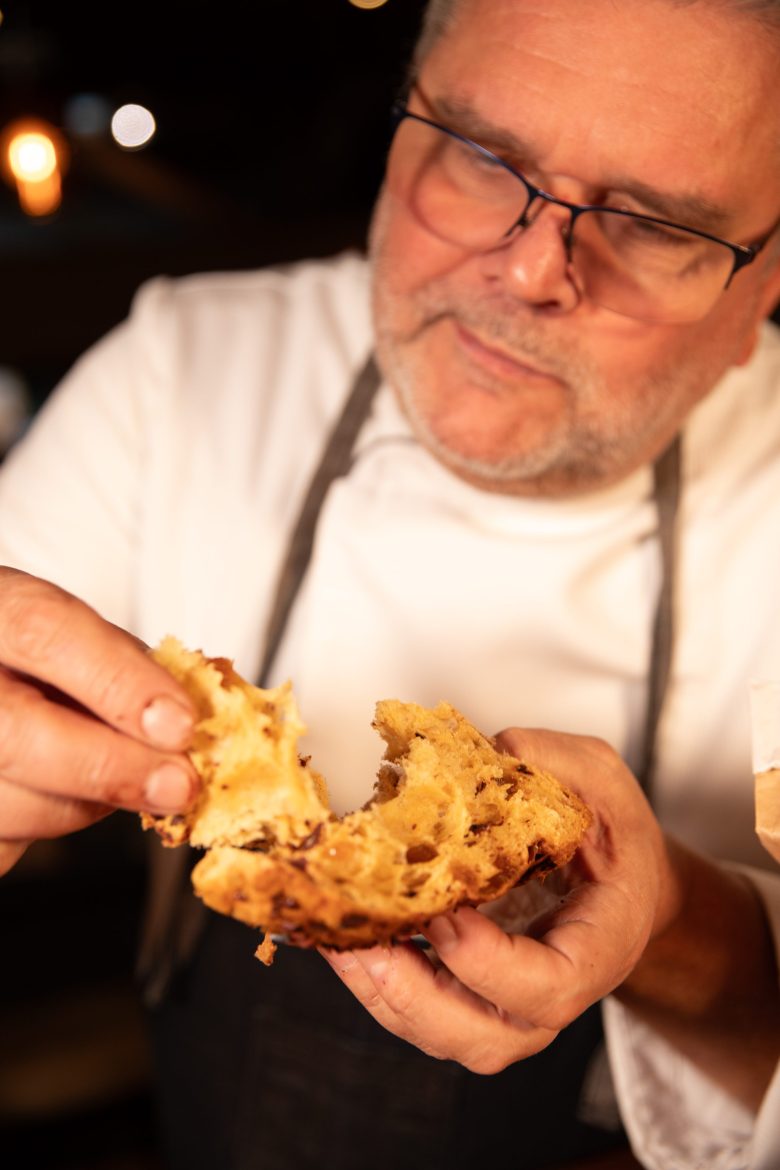 Gianluca Guglielmi, executive chef at Donato & Co., inspects a Infermentum panettone. Credit: Nadia Andreini courtesy of Donato & Co.
“I think panettone is, to me, if it’s well done, one of the most decadent pastries made in Italy,” Guglielmi said. He attributed this to the ingredients and the amount of work that goes into making one. He’s made his own before, but said that currently, the price of making his own is more than importing it from Italy.
For Brian Wood, founder/CEO of Starter Bakery, he never tried panettone until he was teaching at the San Francisco Baking Institute in the early 2000s and learned how to make his own. He said some call the undertaking of baking panettone, “the Mount Everest of baking”. He got back into making his own in 2020 at Starter.
Making panettone takes multiple days. And, according to Guglielmi, there are some rules: the high-gluten flour, made in Italy exclusively for making panettone, is crucial; traditional panettone has candied oranges and raisins; and the size of the fruit is also very important, ideally half an inch by half an inch for raisins.
At Starter, they make two flavors: one with the candied lemon, oranges, and raisins, and one with bittersweet chocolate and candied orange. After five years, now they’re making around 1,000 panettone a year. The candied oranges are imported from Italy, while the raisins are from California.
Panettone is made with a specific sourdough starter that you keep alive all year. Wood explained that sourdough has a spectrum of flavor, some sort of mild and others very sour, “San Francisco style.” For panettone, Wood said that you want something not sour at all since it’s a sweet dough, but achieving the correct composition requires a very precise feeding schedule and maintenance for the starter throughout the year to get the proper balance of bacteria and yeast.
The first step of making panettone is the “first dough,” which ferments overnight. The first dough has the Italian panettone flour, starter, water, sugar, egg yolk, and butter. The second day, the bakers mix the “second dough,” adding in a little more flour, more sugar, and egg yolks.
In a big mixer, around 80 kilos of dough is formed while constantly being checked to make sure it’s strong enough. One way to check is to see if the dough will stretch to form a translucent window without ripping or breaking. This is one of the trickiest parts, Wood explained, because it is extremely hard to get all of the steps of the process right — the temperature, the amount of mixing, the balance of the formula. At Starter, only the most experienced bakers were helping with the panettone, including their head bread baker Grayson Kopperud, their culinary director Jill Thomas, and their product manager Jonathan Glicksberg.
“As much as we’re looking for good development of the dough, we also don’t want to over-mix it,” Wood said. “We’re reaching this pinnacle, and you can hang out there for a little bit, but after that it’s called dough degradation.”
While the dough is mixing, aromatics are added, including vanilla, lemon oil, orange zest, and a “fair amount of honey.” The honey adds flavor but also helps keep the bread moist. After that, the butter is added, which must be at an exact level of softness, then water. Next come the citrus and raisins. The dough (a kilogram for each panettone) then ferments before going into the molds, where it proofs. Then the toppings of almond glaze, pearled sugar, blanched almonds, and powdered sugar are added, and the panettone bake for around an hour. The glaze helps make sure the panettoni aren’t getting hard on the top and can grow to their full potential height.
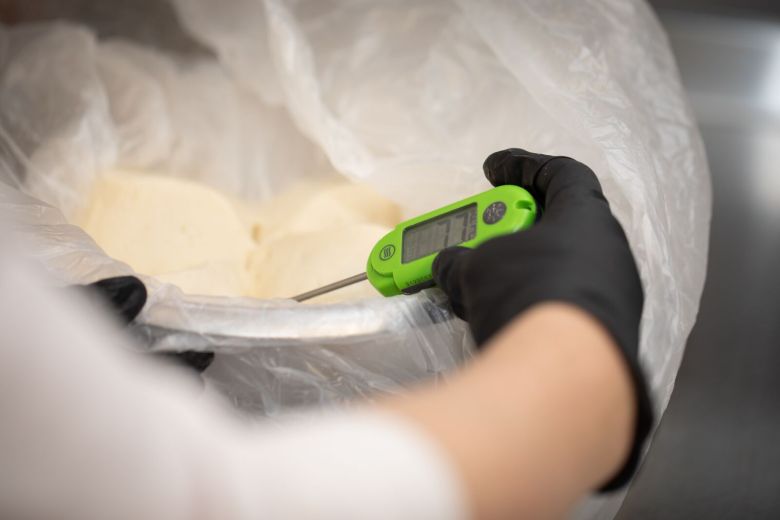
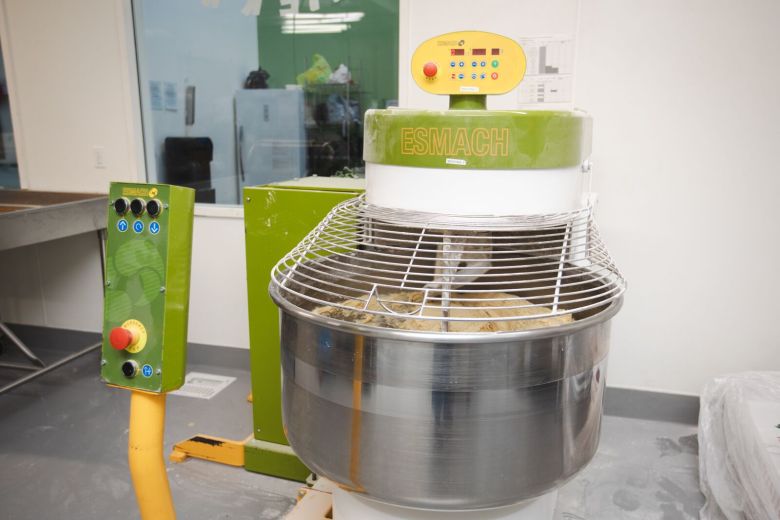
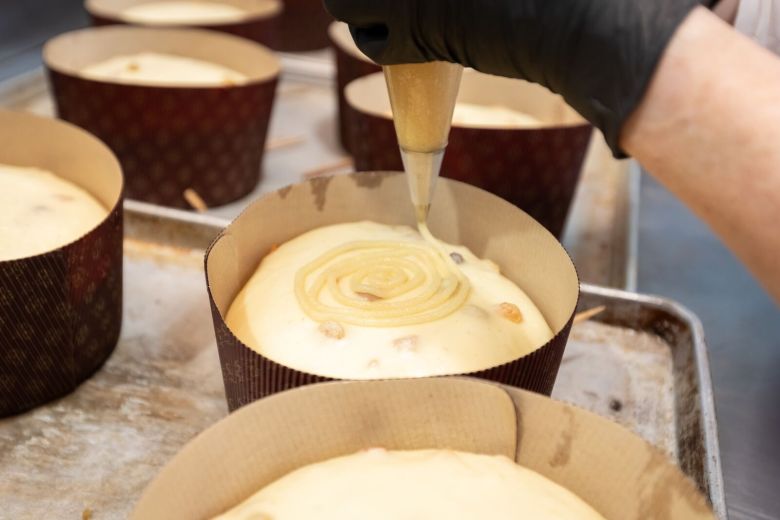
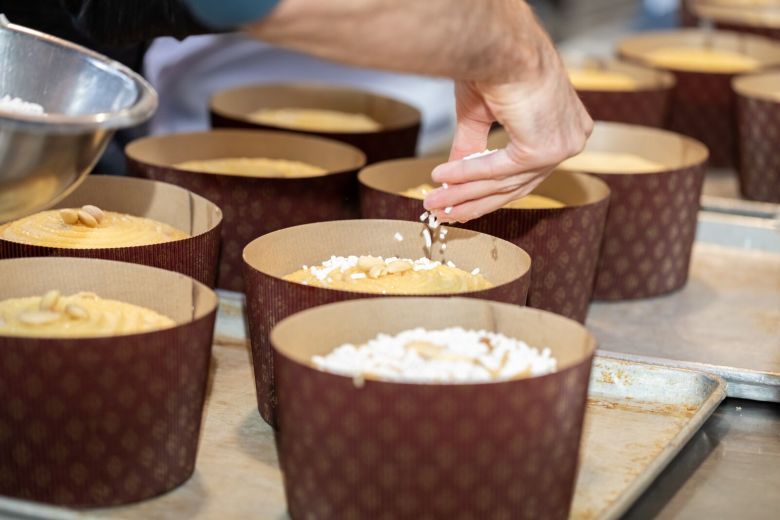
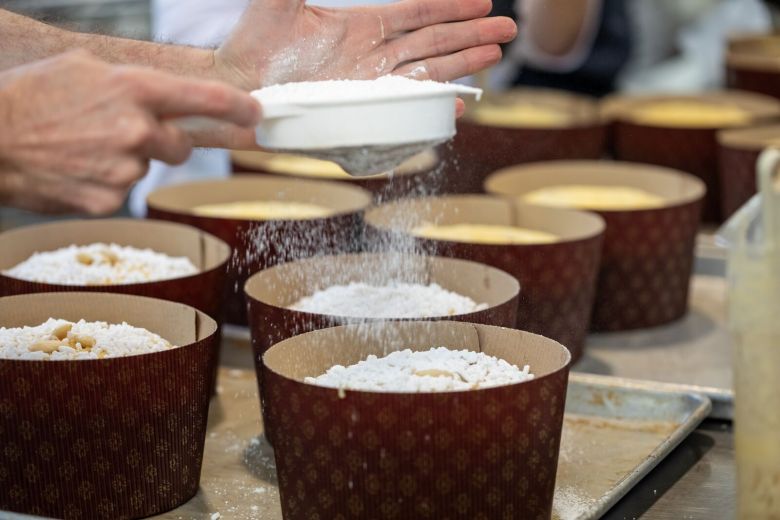
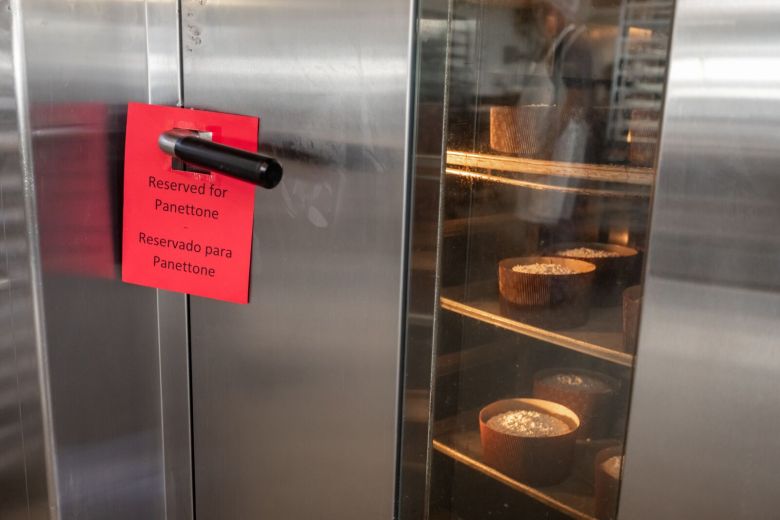
Top row: The temperature of the sourdough starter is checked, before the pannetore dough is mixed. Middle row: The pannetore are glazed and topped with candied fruit. Bottom row: Powered sugar is added before the pannetore go in the oven. Credit: Kelly Sullivan for East Bay Nosh
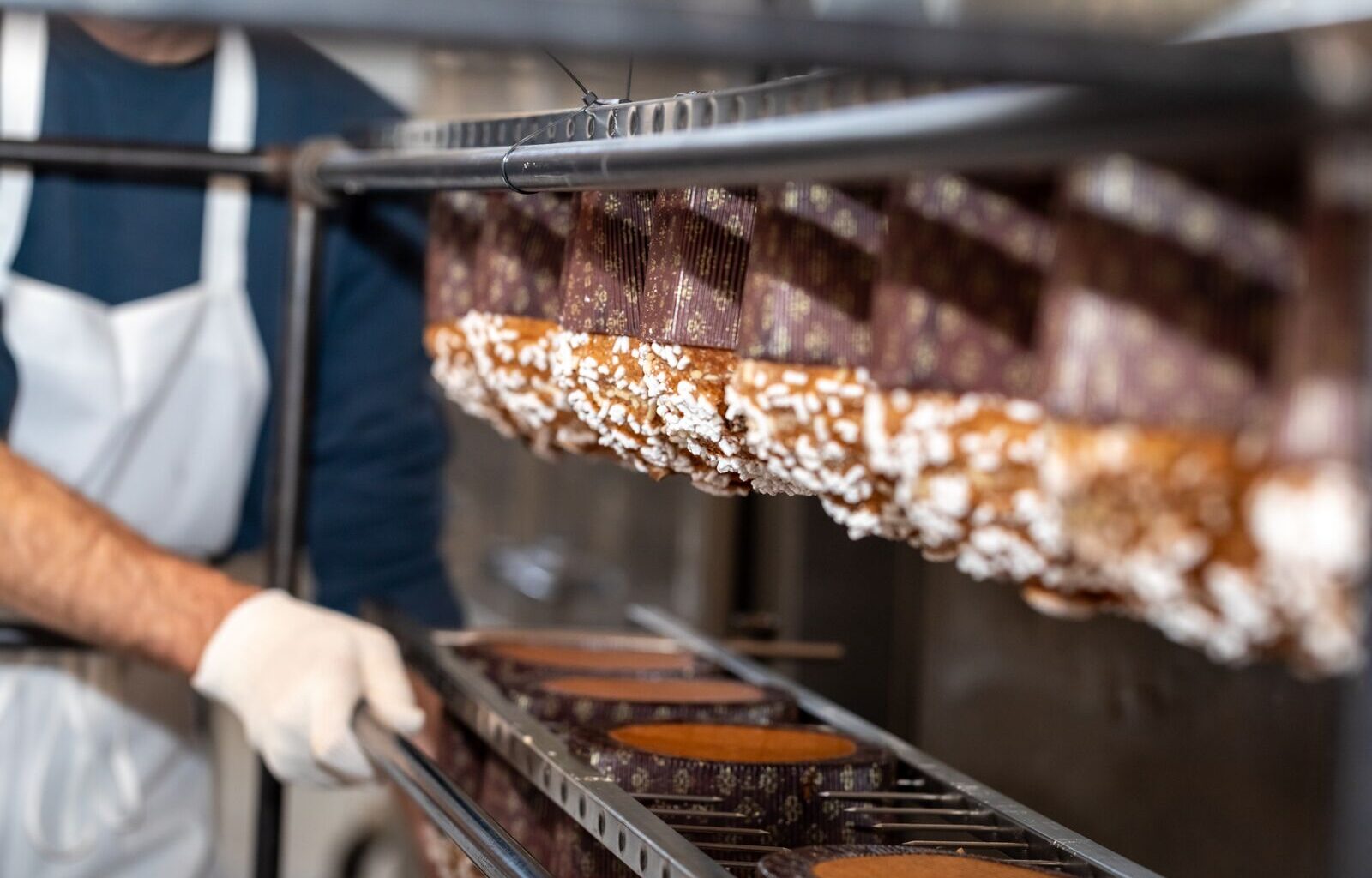
When the panettone is ready to be taken out of the oven, a team of people stands at the ready so they can quickly put each panettone onto a rack that allows them to skewer the bottom of the loaves and then flip them upside down. If they don’t flip the panettone quickly, the dome-shaped top immediately starts collapsing when taken out of the oven. After that, the panettone hangs upside down for a minimum of 10 hours but usually longer, before it’s ready.
Wood said that he’s drawn to making panettone each year because of the challenge.
“Wanting to make something that’s technically difficult, trying to understand it,” Wood said. “It gets to a point where, in theory, once you understand it, that’s quite simple, but the execution of that, and that discipline around all of the steps, that’s the part that really matters.”
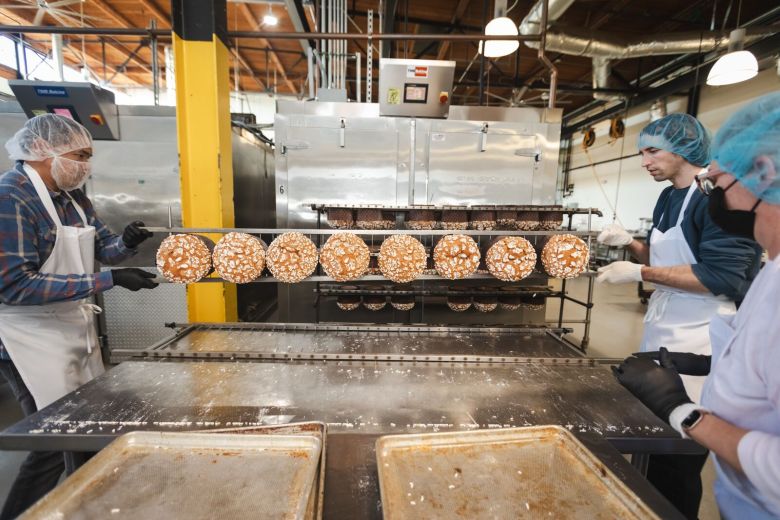 The panettone are flipped upside down when they come out of the oven so the domed top doesn’t collapse as they cool. Credit: Kelly Sullivan for East Bay Nosh
“It’s really a balance of making sure that as the gluten is getting stronger, we’re adding these things that weaken it at the right rate so that we don’t weaken it too much, so that it still goes on a trajectory that is getting stronger,” Wood said.
When Guglielmi was growing up in Italy, there weren’t too many flavors, just traditional and then maybe one with chocolate. Now, lots of different flavors have been created. At Donato & Co, they sell five flavors including traditional, three chocolate, apricot & dark chocolate, dolce quattrogusti, and one with figs, apples, and walnuts. They also sell Monte Nuvola pandoro. A lot of these are already sold out, but Donato & Co. has other Italian imports and homemade items for the season if you don’t manage to get your hands on a panettone this year. Or you can head to Donato & Co’s Christmas Eve dinner, where the dessert is a panettone bread pudding.
Donato & Co opened in 2017, and they’ve been offering Infermentum’s panettone for the Christmas season for the past five years. Guglielmi said he believes this is the best panettone available. At the start, Guglielmi ordered just 100 panettoni; this year he ordered over 1,000, enough to ensure they’d all be bought this season.
Infermentum is a small company in Stallavena, Italy, right outside of Verona. Their production is small. This year, Guglielmi asked for 1,500 panettoni, and they managed to make 1,200. They placed the order in May to give the company enough time to get them ready for the holiday season. Donato & Co is Infermentum’s only customer in the United States.
“The reason we chose them is only because we thought Infermentum will represent us more than any other company, because they have the same philosophy that we have. Let’s buy the best of the best that you can buy at the market,” Guglielmi said.
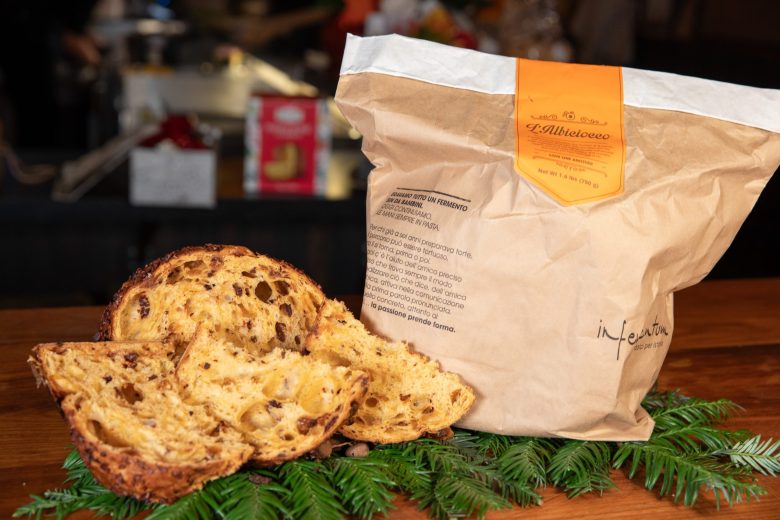 Donato & Co. sells five different flavors of the Infermentum panettone from Italy. The 1,200 panettoni Donato received this season from the company have already sold out. Credit: Nadia Andreini courtesy of Donato & Co.
The shelf life of the panettone is around 120 days, up to the end of January. It will still taste fine after that date, but just a little drier than it should be.
Guglielmi said panettone is not best fresh out of the oven.
“The raisins and the fruit that gets soaked in syrup, they release over time, over a week or 10 days, they release the juices, and that makes the panettone moist,” Guglielmi said. “That’s kind of the secret of somebody who doesn’t put any other ingredient to keep it moist inside.”
For Guglielmi, Infermentum’s high-quality ingredients and nice packaging make them worth the $61 to $64 price, as well as their lack of preservatives and artificial flavors that some bakeries add to make the product last longer. Guglielmi said this doesn’t necessarily make a panettone bad, but it’s just not the type of product that he wants to sell.
Starter also uses no emulsifiers, and its shelf life is roughly three to four weeks. It’s still good to eat after that period, but it won’t be as tender. Starter’s panettone is $62.
Guglielmi said that people start asking around the beginning of October about the panettone. At Starter too, customers start asking about the panettone every year as the holidays get closer. This year, one customer ordered 53 at once as gifts for his employees.
After trying both of these panettone, Nosh can attest that you can’t go wrong with either one. You can see the specks of vanilla in both airy breads. They were both sweet, flavorful, and moist, and the fruit was just the right size.
While Nosh isn’t here to dissuade anyone from making an excellent French toast or bread pudding with their leftover panettone, Guglielmi said that even when the panettone is a bit past the shelf date, people in Italy do not make it into French toast or bread pudding; they just eat it straight.
“We don’t manipulate the panettone,” Guglielmi said. “We just cut slices, and we eat it. The only thing you do on Christmas Day is you cut your panettone, or you cut your pandoro, and then you get either a mascarpone cream or a zabaione cream and put it next to it, not on top, next to it, and then you just grab a piece, and you dip it in the cream, and you eat it.”
“*” indicates required fields