
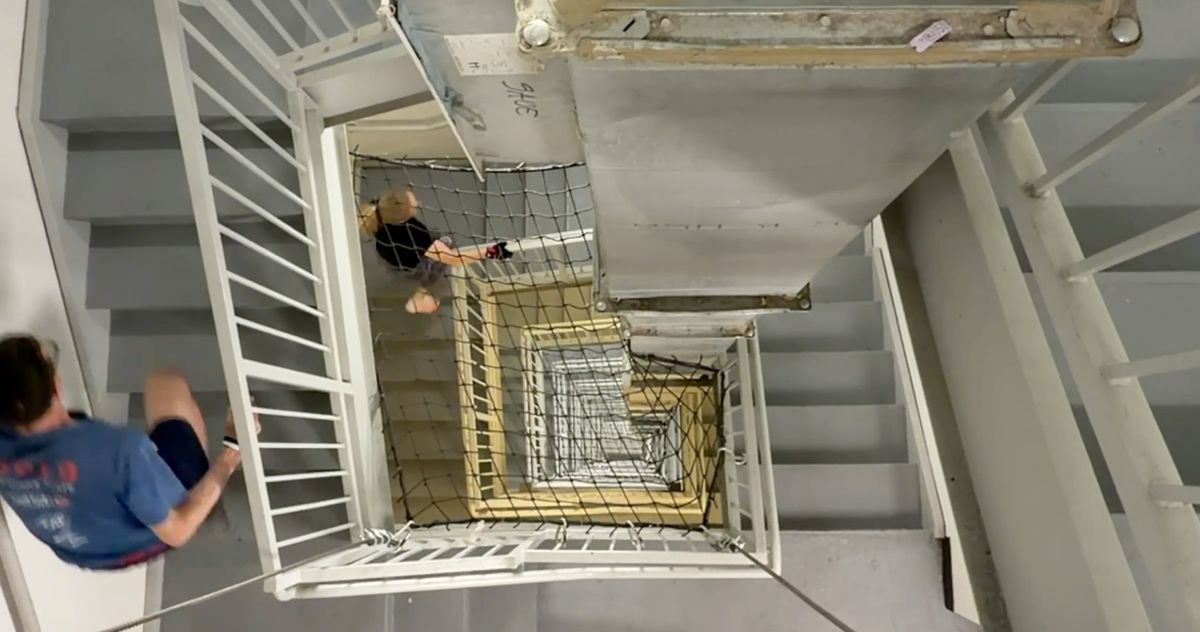
The stairs at 30 Rock are extremely steep. Today, New York City zoning rules and the International Building Code generally cap stair height at seven inches, but the steps in the Art Deco tower, which opened to the public in 1933, measure in at 7.5. Half an inch doesn’t sound like a lot, but it feels like a lot when you’re taking them two at a time up 66 stories. It doesn’t help that running 30 Rock is like navigating a vertical maze — there are hallway breaks and stairwells that change direction every few floors — that demands a constant recalibration of pace and focus, making it nearly impossible to establish a rhythm.
I started racing skyscraper stairwells a little over a year ago and have since run a dozen buildings ranging from 25 to 105 stories. While this may sound like a possibly unhinged way to spend one’s weekends, tower running, as it’s officially called, is a real sport, with organized races, rankings, commentary, and a global following. And these races do more than test endurance. They reveal the hidden logic of these buildings, particularly the architectural nuances and eccentricities of their often unseen stairwells.
For most, stairs are an afterthought, but they are designed with intention. (One developer I spoke to went so far as to call stairwell design an art form.) The 1901 building code devoted just three brief paragraphs to stair width, treads, and risers. By 1929, city regulations had expanded considerably to include stair construction, egress loads, and geometry. Even so, these were still works-in-progress. “High-rises hadn’t been around that long,” says Donald Friedman, a structural engineer with expertise in historic buildings. These old stairwells wind their way around changing floor-plate sizes, setbacks, and mechanical rooms.
At 30 Rock, the railings sit along the interior, forcing you to work only one side as you pull yourself upward using the handrails. The Empire State Building’s stairs are similarly steep but much narrower, so you can grasp both handrails at the same time. These “old weirdnesses,” as Friedman calls them, were a product of the technology available at the time. And the Empire State Building, which hosted the first tower-running race in 1978, is in fact all “old weirdnesses.” The elite race opens in total chaos as the world’s top runners surge to be first through a single narrow door to the stairs. It is the only mass start in the country. (All other climbers are released in staggered intervals every 15 seconds and directed through the building by staff in Art Deco–inspired uniforms.)
Inside, the course unfolds as a highly varied sequence, and I found myself racing through random office hallways reminiscent of Severance, into long, straight stair runs, across extended landings, and finishing with tight scissor stairs. The constantly shifting rhythm demands tactical pacing and forces runners to adapt. Oddly, reaching the observatory does not mark the end of the race. Competitors must complete a final lap on the roof deck before crossing the finish line, where wind, sweeping night views, and physical intensity combine to elicit a surge of euphoria.
Our modern towers are a different story. By 2008, New York City overhauled its building codes, fully absorbing the lessons of 9/11, with a focus on stair width, ceiling height, and airflow. Stairwells started to have more uniform geometry, better lighting, improved ventilation, and wider paths of travel. These are safety improvements, but developers have a great incentive to improve the science of stairwells as these spaces have no sellable square footage. One more reason modern designs are extremely efficient.
One World Trade Center, which I raced last June, has two interlinked stairs, one solely dedicated to first responders. The two stairwells are set within a 110-foot-wide core made of a concrete that’s stronger than any rock, creating a pressurized, smoke- and blast-resistant fortress. The race there begins somberly in the museum before runners bound up one flight of stairs into a hallway that leads into the main stairwell; from there, the steps settle into continuous, shallow right turns providing a repetitive, hypnotic cadence. Compared with those of the older behemoths, the stairs of this 105-story giant do have an airiness about them, which was apparently an intention in the design. “Because of the nature of the destruction that was here before, you don’t want to give the impression that this is a place of refuge and of fear,” said David Childs, the architect of One World Trade Center. “You want there to be a sense of openness.”
The race up One Vanderbilt is advertised as 93 stories, but the first time I ran to the Summit observation deck, I found myself, rather unexpectedly, on the third story of the observatory after passing a sign for the 77th floor. Wasn’t the observatory supposed to be on the 93rd floor? Had I messed up my count? In tower running, knowing the exact floor count is critical as it dictates pacing strategy and determines when to conserve energy and when to make your final push to the end.
So what happened? The discrepancy seems to result from a wild variation in the total number of steps per floor, ranging from 18 to 36 (which is painfully high), where many double scissor stairs equal only one “story” (a heartbreaking revelation as you race). When I asked about it, I was told the marketing team determined the observatory’s vertical height was equal to 93 stories. Counting quirks aside, I was awed when I finally got there: The observatory has expansive views, mirrored double-height ceilings, and dramatic floor cutouts that induce a sense of vertigo. It’s maybe my favorite in the city — even the bathrooms offer spectacular vistas.
This is the other pleasure of tower running: the aha moment of reaching your destination. In contrast to the flashy newness of One Vanderbilt, the observation deck at 30 Rock has old-school romance. After I lurched over the finish line there, the refreshing blast of wind and breathtaking 360-degree views beyond the ornamental surround were a welcome relief. I caught my breath, snapped a few photos, and then descended one flight on the escalator as the Rockettes cheered us into the elevator for a much faster trip down.
Sign Up for the Curbed Newsletter
A daily mix of stories about cities, city life, and our always evolving neighborhoods and skylines.
Vox Media, LLC Terms and Privacy Notice
Related