

My children are growing like weeds, so perhaps it’s just that. And over the past few years, I’ve definitely (and definitively) stopped wearing heels. So that could account for some of it. Still… for a while now I’ve been aware of a strange but unshakeable suspicion. I am, I think, shrinking.
What’s going on? Am I imagining it? Just being a little neurotic? Making a (short) molehill out of a (tall) mountain? Highly probable. But while it’s a comforting concept, as it turns out, it’s probably not true. I am, in all likelihood, actually getting shorter.
Why we shrink
After the age 40, we all lose about a centimetre in height with every passing decade. Women fare worse – descending by 0.12-0.14% per year, but men aren’t exempt (0.08-0.1% annually).
Some of this is just an inevitable, inescapable process of diminution. The vertebrae in my spine (and the bones in my legs, in fact) are losing minerals and becoming less dense. Meanwhile, the discs that cushioned them – once plump, are now shrinking as they lose water. Oh, and my muscle mass – something that directly promotes stronger, denser bones – is plummeting, too. After the age of 30, we lose around 3-5% of muscle mass every decade. At this rate, I could soon star in Honey, I Shrunk The Kids.
I can’t stop my body from ageing. But I can slow this particular process down. How? Well…
Progressive muscle resistance training 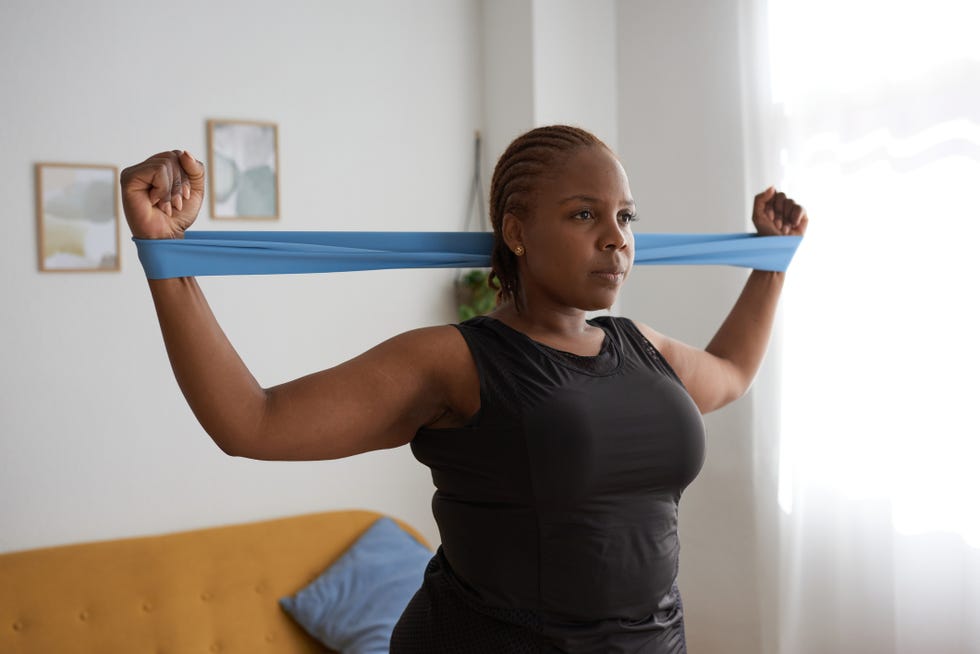
David Espejo//Getty Images
‘The best way to keep bones strong is to do both weight-bearing impact exercises and muscle-strengthening resistance activities,’ Kirsty Carne, a senior osteoporosis specialist nurse, told GH. She recommends progressive muscle resistance training: ‘It’s the best type of muscle-strengthening exercise for your bones. It involves using weights or resistance bands to build up the work your muscles do over time. You do this by gradually increasing the weight you lift, in a slow and controlled way. As you train, you’ll find the movements get easier as your muscles get stronger.’
Why we stoop
Age, however, may not be the only factor here. A lifetime spent sitting a desk may also be contributing to my decline. Curling over a computer could be causing me to stoop. It’s not a great look for the summer (or any other season, truth be told) and it’s not brilliant for my health, either – forcing my centre of gravity forwards and increasing the possibility of falls as well as neck pain and even headaches. This, however, is something I can absolutely do something about. There’s plenty of time to learn how to stand taller and stronger this summer, and these are the exercises that will make a difference.
Tai chi standing posture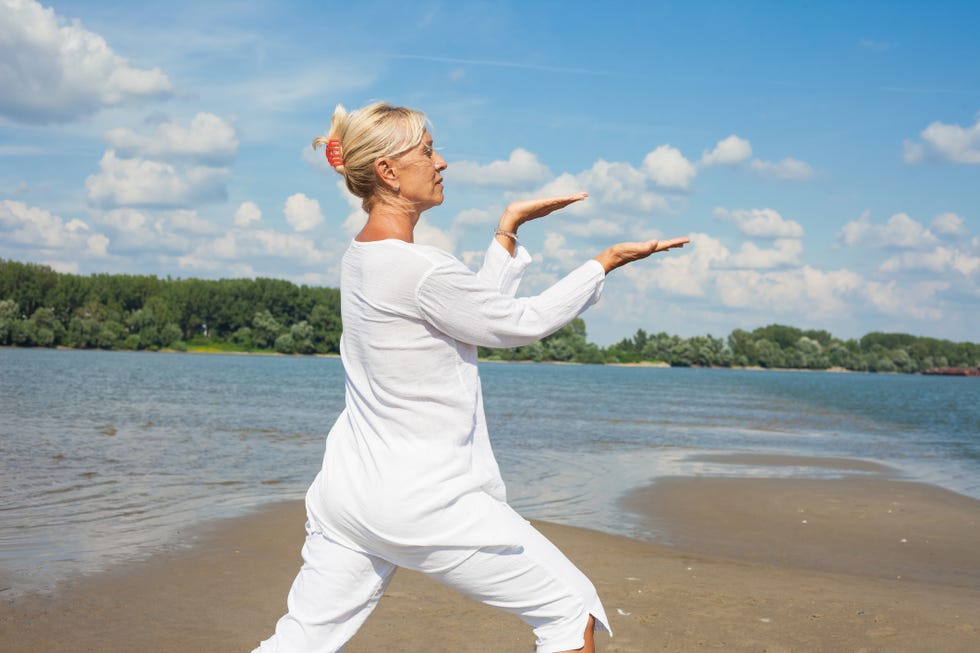
meteo021//Getty Images
If you want to strengthen the muscles that help you with standing, the NHS recommends you try practising the ‘tai chi’ standing posture:
Place your feet hip-width apart and stand with ‘soft knees’ (knee joints slightly unlocked).Now imagine your feet as footprints in the sand; concentrate on spreading your weight through the whole foot (and equally on both sides) so that the footprint is equally deep throughout. Remember to keep your knees softNow lengthen through your spine as if someone is suspending you by a string from the top of your head.Remain tall but relax your back and trunk muscles. You may feel that this is quite hard work for your leg muscles.Keep your breathing relaxed.Chin tucks
Physiotherapist Sam Bhide recommends this exercise for a curved back or stooped posture. ‘Lie on your back or sit tall,’ she explains. ‘Gently draw your chin straight backwards, as if making a double chin, without tilting your head up or down. This strengthens the deep neck flexors that fight forward head posture. Hold for 5 seconds, repeat 10 times every day.’
Wall angels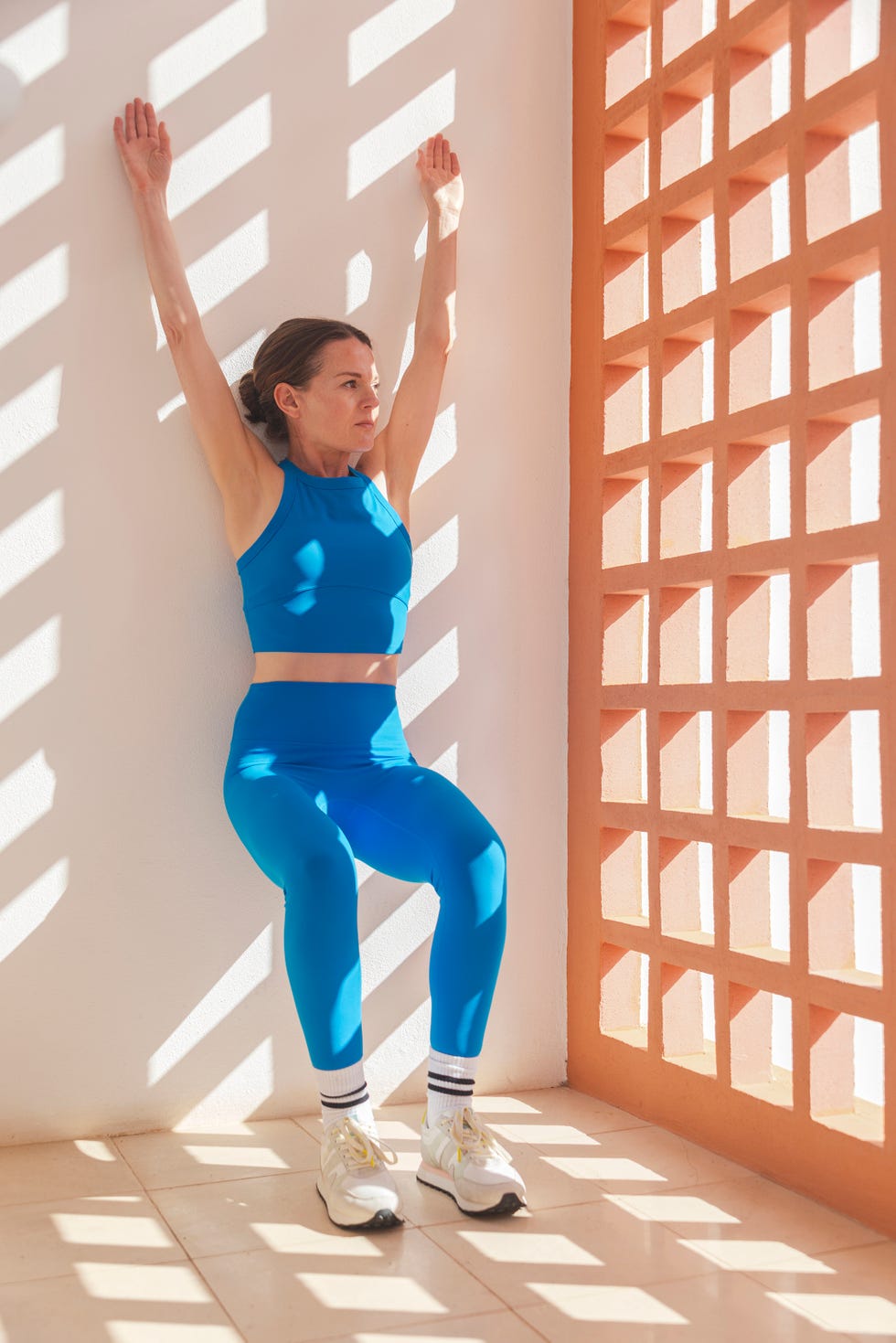
Rob Wilkinson//Getty Images
Stand with your back flat against a wall (heels, bottom, shoulders and head touching), says Sam. ‘Raise your arms so that your upper arms are right angles to your torso, and your forearms point directly up to the ceiling at right angles to them (you will look like a fork, pressed against a wall). Press your elbows and the backs of your hands against the wall. Slowly slide your arms up into a “Y” shape while trying to keep your back, head, wrists and elbows glued to the wall. Do 10 slow repetitions.’
Thoracic extensions
‘Lie on your back with a foam roller (or rolled towel) positioned horizontally just below your shoulder blades,’ says Sam. ‘Support your head with your hands. Gently allow your upper back to extend (arch) backward over the roller. This mobilises the stiff upper spine that’s often associated with slouching. Hold the stretch for 20 seconds. NB: do not attempt this if you have an osteoporotic spine.’