A few times a week during marathon training, you could find me in the corner of my local gym jumping in place vigorously for 60 seconds at a time. It sounds a little ridiculous and, at the time, I was highly aware of how unconventional the move might have looked to other gym-goers.
I learned this move from my cross-country, when I first started running 5Ks. As he’d walk the team through post-run exercises, he’d nickname this one ‘jumping beans’ – and he said that the move would make us stronger, faster and capable of running long distances without getting injured.
I often think of this plyometrics-based move as exclusively helpful for shorter distances, but there are a few unique ways that these types of exercises build speed and resilience for longer races like marathons, too.
‘Jumping beans’, better known as pogo hops, get my calves burning (in a good way) and raise my heart rate, but not enough to completely break a sweat.
When I returned to running post-marathon, I ran about three times a week without doing this move (or any other plyometrics) and I immediately noticed extra soreness and tightness in my calves. Once I added the move back into my routine before strength sessions and runs, the calf soreness disappeared.
So, steal these moves for yourself and watch them pay off in your next marathon build.
How plyometrics build durability and strength
Durability in distance running, also referred to as physiological resilience, relies heavily on racking up easy miles. However, plyometrics and strength training also play an important role.
Specifically, research shows that hopping can help you to run faster. A 2023 study published in Scientific Reports examined 34 amateur runners with a daily hopping regimen over the course of six weeks. The researchers found that simply bouncing on both feet, much like pogo hops, was shown to increase running economy, or how fast you can run using a given amount of oxygen. Along with running economy, the researchers also believe that hopping can decrease tendon stiffness, which allows for more explosiveness and less ground contact time in every step.
A 2024 meta-analysis published in Sports Medicine also backs up the benefits of plyometrics for improving running economy. This meta-analysis examined 31 studies covering running economy effects from different strength training methods, including high loads (lifting heavier weights for a lower number of reps), plyometric training (explosive exercises) and submaximal load training that focuses on lifting lighter weights for a higher number of reps. Some of the studies also included combined strength training methods, as well as isometric training, which relies on contracting a specific muscle or group of muscles held in one position.
For endurance-based runners like marathoners, the researchers found that plyometric training is the way to go, because it allows for greater energy storage distributed over a longer timeframe, Cristian Llanos-Lagos, PhD(c), researcher in sports sciences at Universidad Pablo de Olavide in Spain, previously told Runner’s World. He explains that plyometric training increases tendon elongation, which likely influences overall energy storage. This allows you to keep performing until the end of a long run or race.
‘Plyometrics help you to become a durable runner by improving your muscle-tendon unit to absorb impact and rapidly produce force more efficiently,’ says Anh Bui, DPT, CSCS, USATF-certified running coach at Run Resiliently Physical Therapy. This helps you to develop a more efficient spring in your step to store energy when you land and, as a result, have more explosive energy to push off the ground when you take off, adds Bui. ‘Over the course of 26.2 miles, this can help you to become fatigue-resistant and reduce your risk of overuse injury.’
Plyometrics also reduce your overall ground contact time, which, in turn, not only reduces your risk of injury, but also improves your stride, says Bui. ‘A longer ground contact time can indicate overstriding, which can cause heavy braking forces on the shins, knees and hips,’ she notes.
In addition, Bui says that plyometrics are highly effective in improving bone density. ‘The rapid, explosive movements create high ground reaction forces that stimulate bone remodelling and growth,’ she explains. ‘This is important for all runners, but especially for runners with a history of bone stress injuries or osteopenia.’
Jonah Rosner, MS, CSCS, a sports scientist, performance coach and the founder of Marathon Science, recommends doing pogo hops 24 hours before or after a quality run, one to two times per week. ‘You can get pretty great adaptations from small volumes, especially in runners who are not used to the stimulus,’ he says.
One-minute moves to add to your training plan
During marathon training, I typically did pogo hops three to four times a week before strength workouts and runs. Specifically, I would do two sets of 60-second efforts with a 30- to 60-second rest in between to shake out my calves. The key is to keep your legs fairly straight with a slight knee bend for soft landings.
Another move that I did regularly when I started running is skaters, which has you moving side-to-side and helps to shore up weaker muscles.
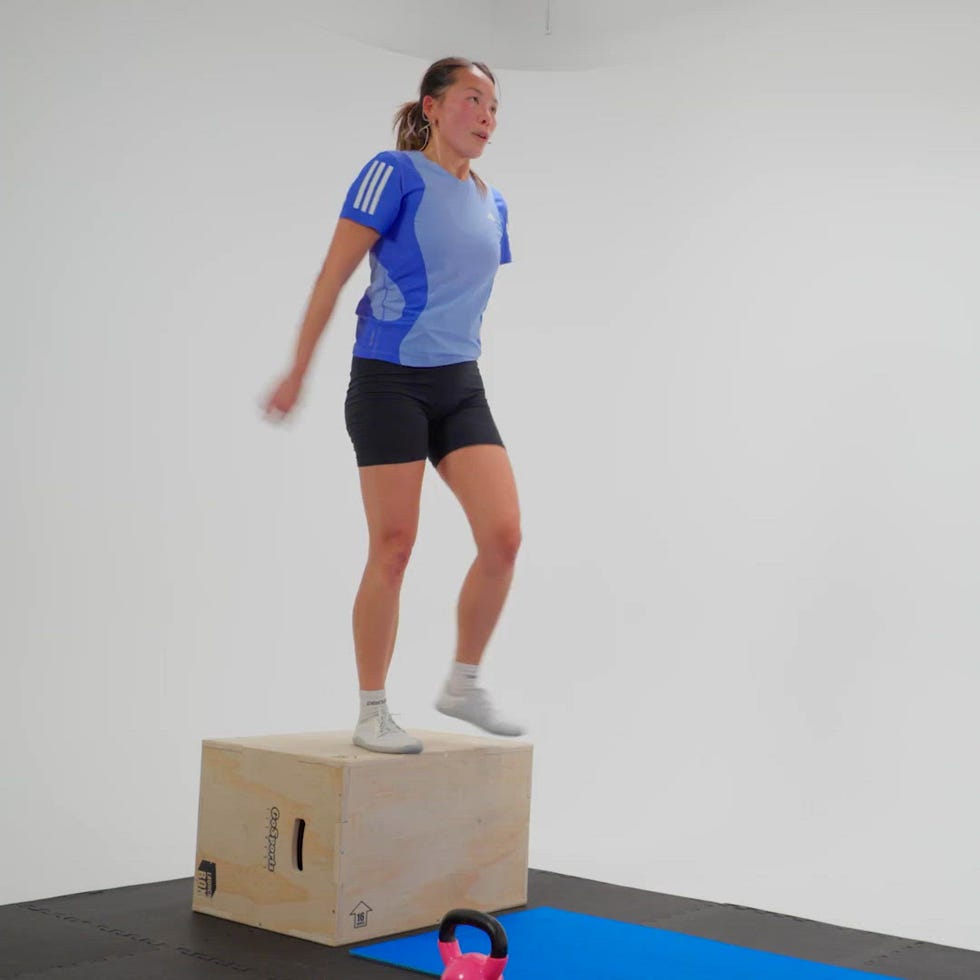
Here’s how to do pogo hops, skaters and a third move, depth drop, which targets a stronger landing to improve stability and power.
Pogo hopsSkatersDepth drop