
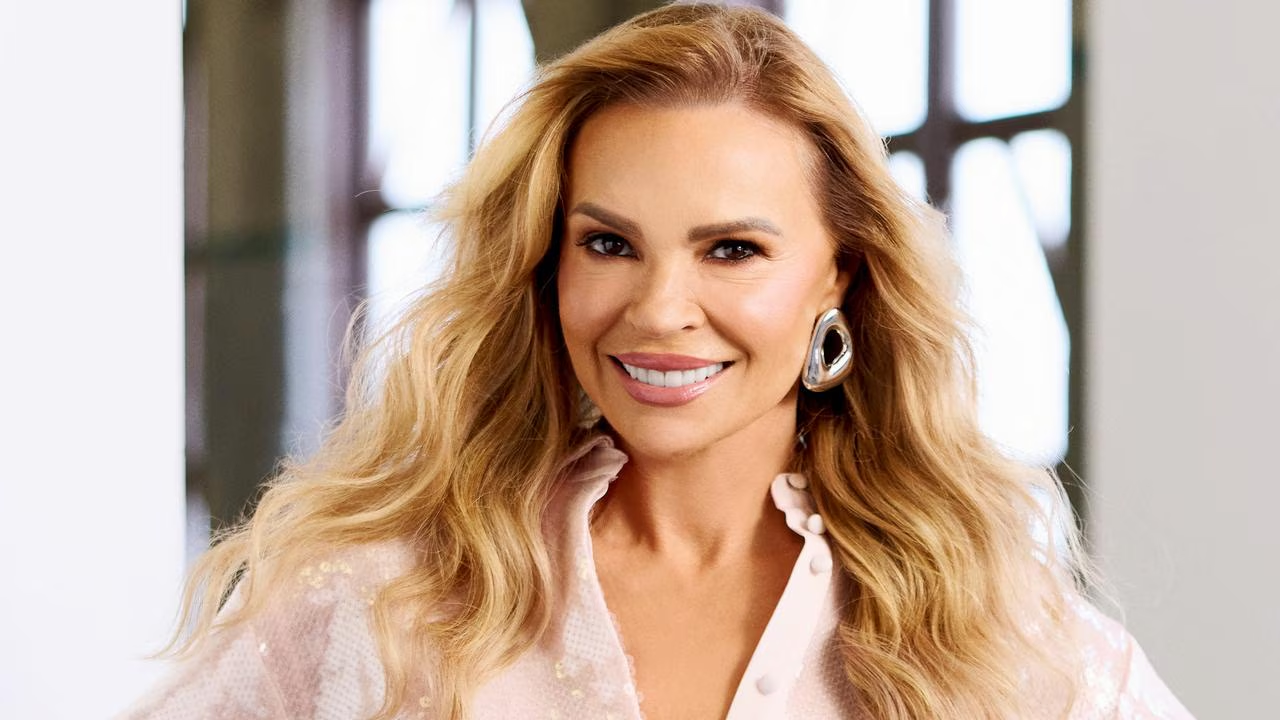
Gold Logie winner Sonia Kruger said she’s looking seriously at her own life after seeing close family members diagnosed with dementia.
The former professional dancer and host of The Voice and Dancing With the Stars said she has began to pay more attention to new research about preventative measures and the lifestyle changes she can make now after seeing first-hand the toll it can take on elderly loved ones.
“When you watch people that you love lose aspects of their memory and their independence and connection with the world, it does change the way you think about aging,” the 61-year-old Kruger said.
“It’s in everybody’s mind probably past the age of 50. You start to look at your own lifestyle and we have a desire for longevity … but nobody wants to lose independence. It’s a natural drive for us to remain independent for as long as we can,” she said.
Kruger is speaking out in support of news.com.au and The Australian’s Think Again dementia campaign.
According to the Australian Institute of Health and Welfare’s Dementia in Australia report released last year, 43 per cent of the dementia burden in Australia can be attributed to six modifiable risk factors: being overweight or obese, physical inactivity, high blood sugar, high blood pressure in midlife, smoking and impaired kidney function.
“I’m trying to eat the right things,” Kruger said.
“I stick to a Mediterranean diet and exercise regularly, consistently. A couple of times a week I’ll do strength training, and then I’ll dance as much as I possibly can. I like to play tennis and social connections are important too.
“It’s not necessarily just catching up with friends, it could be people that you’re working with or just talking to the barista every day if you’re going to get coffee.
“It’s important to stop your world from becoming smaller and smaller. I think if anybody has had experience with a loved one with dementia, you do notice that their world starts to become smaller.”
Kruger was also particularly taken by a 2003 breakthrough study in the New England Journal of Medicine that suggested frequent dancing significantly lowered the risk of dementia, outperforming other physical activities and cognitive tasks such as reading or doing crossword puzzles.
Chilling sign that led to killer diagnosis
Moment family secret finally came out
Louis’ List: 580 adventures in one short life
As a former professional dancer who did an Arts degree majoring in Leisure, Sport, and Tourism, she said it made “a lot of sense because it combines so many things”.
“It combines learning choreography, balance, having to engage your brain in a number of different ways while you’re moving your body,” she said.
“Because it fires up those multiple neural pathways, that’s where the level of effectiveness comes into it, rather than just doing a repetitive movement over and over again.”
Senior Research Fellow at the School of Psychology at the University of New South Wales Dr Craig Sinclair said it’s becoming clearer that “the connection between music and rhythm and movement is seeming to be very beneficial for people living with a range of neurodegenerative conditions”.
“Music is shown to be effective on its own, but there does seem to be something special about music that is participated in,” Dr Sinclair, who specialises in dementia research said.
“When a person is singing along or clapping along or dancing in some way, it does seem to show higher overall activation in the brain and higher connectivity between different brain areas. That’s why it is now more and more used as a therapy.”
Dr Sinclair cites examples of older dementia sufferers who struggle with short-term memory loss but can still sing along when they are played a song they knew when they were much younger and Parkinson’s disease sufferers who “can walk if they’re walking to the beat of a song, but they can’t walk of their own volition”. Dancing, he agrees, makes “perfect sense” as a preventative factor.
“Anything that we’re doing as people age to keep cognitive stimulation high and to move in a way that is safe and beneficial for cardiovascular health is also going to be helping to prevent neurodegeneration,” he said.
Kruger said she has found the aged care and health system “complicated”, especially with family living in a different state. She has now tailored the Strictly You fitness program she started eight years ago before any family members were diagnosed with dementia to incorporate the benefits of dancing.
“If you can do a five or 10-minute little piece of choreography at home every day – like doing Wordle or doing a crossword or doing Duolingo – according to the research they could help reduce your risk going forward.”
She said with Australian’s rapidly ageing population she’d like to see process of negotiating the aged care system simplified and welcomes campaigns such as Think Again that can raise awareness about early dementia prevention and “create that momentum we need for people to start putting this on the top of the priority list”.
“The more conversations that people can have about it, the better we will be at finding ways to manage and hopefully slow down the progress,” she said