
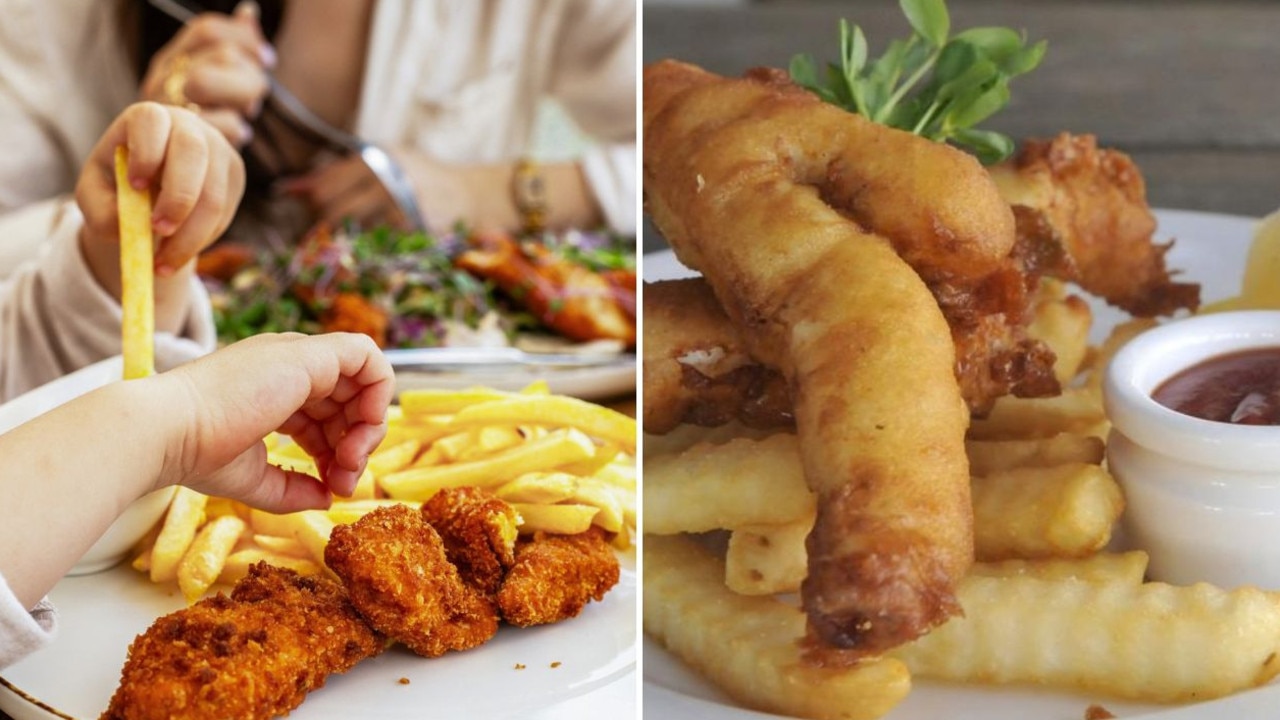
An in-depth audit of Sydney kids’ menus has validated a familiar frustration that many Aussie parents battle.
Comedian Sean Szeps opened up 125 menus across the city in pubs, restaurants, cafes and RSLs with one simple question in mind.
Be the first to know when news breaks. Download our new app
How many options include vegetables? Sadly, less than half.

The father of twins led the investigation in a nation-first as part of his new Nova’s podcast, The Parenting Police.
The findings might shock you – but if you’re a parent of a nuggets-obsessed toddler, it might also fail to surprise you.
“We’ve decided as a culture that our children can’t do better or shouldn’t do better than fish and chips. I think that’s a huge issue,” Mr Szeps told news.com.au.
After combing through all of the menus, he put his findings into a spreadsheet, with the data showing 82 per cent shared a default option: chips.
53 per cent of menus didn’t offer up any vegetables at all.
“You go to a Thai restaurant, you go to a Russian restaurant, the adults are eating the food of those countries, and then the kids are having nuggets and chips,” he pointed out.
The data also shifted depending on the suburb he was dining at.
“If you live in the Northern Beaches, 43 per cent of those menus have real vegetables listed on the kids’ menus. If you go to Western Sydney, that number drops to just 9 per cent,” he said.
Mr Szeps theorised that perhaps budget was the hidden motive behind the deep-fried debacle.
He thought “it must be way more expensive for these restaurant teams to actually be putting the vegetables onto people’s plates, but it’s not actually the case.”
“Oftentimes, the vegetable restaurants, the price was a lot cheaper.”
No-veg venues averaged at a cost of $13.60 per kids’ meal. Veg-present menus averaged at $13.31.
One establishment in Darling Harbour charges parents $25 for their kids’ menu items, which features no vegetables.
An executive chef at a bistro in Petersham commented on the podcast’s Instagram post, offering food waste as a potential contributor to the veggie-less menus.
“I did an experiment for the previous 18 months. Every kids’ party I included chopped vegetables (carrots, celery, capsicum and a dip – avocado or hummus) with a fruit platter, nuggies, chips and pizza. 90 per cent of the time the veggies were wasted,” he explained.
“Every time I put out fresh-cut fruit, though, [it] evaporates instantly. So I just bulk out the fruit and took off the veggies (I hate food waste); the platters came back clean.”
Mr Szeps did find establishments willing to risk an untouched plate, with just six of the menus having zero chips on offer.
Some places went a step further than offering steamed broccoli and carrot, with seasoning and taste incorporated.
“I was stumbling across not just vegetables but green beans with garlic. And that was definitely exciting to me,” he recalled.
The Field at Easts Rugby in Rose Bay was an honourable mention, offering “A Lil Healthier” section featuring grilled chicken or grilled fish for kids at $14 a meal, alongside the usual nuggets and chips.
All come with the choice of salad or mash and veg.
Another in Newtown, Thai Pothong, offers kids’ portions of culturally rich meals for a reasonable price of $15.
“All three of their kids’ meals, surprisingly, are Thai food. There were no chips on the menu. That kind of jumped out to me,” he said.
To Mr Szeps, the solution isn’t drastic, and his research isn’t to pry nuggets from your toddler’s iron grip.
“What if every time they went out, they always got broccoli or what if every time they went out, they had a side salad? Over the course of a generation, you would hope that the story would change,” he proposed.
“Many parents want nothing more than for their kids to be great eaters.”
According to Sydney child nutritionist Gina Urlich, eating habits when families dine out can impact fussiness.
“If every time a child goes to a restaurant they’re presented with nuggets and chips, we’re reinforcing familiarity with those foods while missing opportunities to introduce something new,” she told news.com.au.
Too much exposure can impact the nutritional requirements youngsters need to meet in order to be healthy.
“Their brains are developing, their bones are growing, their immune systems are maturing, and they need a broad spectrum of nutrients to support that development. Yet when we take them out for a meal, we’re often presented with some of the least nutritionally diverse options on the entire menu,” Ms Urlich said.
She acknowledges that for some children fussy eating can be due to a sensory challenge, but there’s plenty of support available to combat it.
Otherwise, we need to offer them the correct plate or risk doing them a “disservice”.
“If we assume they won’t eat vegetables, seafood, different cuisines or more complex flavours, we stop offering them those experiences… for many children, expanding their palate starts with simply giving them the opportunity,” she said.
She encourages parents to “broaden children’s food experiences” and “look beyond the children’s menu” by considering a communal approach by ordering dishes for the table to share.
“We don’t need to assume children only enjoy bland food. Model the behaviour you want to see,” she said.