



While runner’s knee gets plenty of attention, another common injury can cause knee pain in new and experienced runners alike. Iliotibial band syndrome, also called IT band syndrome (ITBS), typically causes pain on the outside of the knee.
In The Runner’s World Guide to Common Running Injuries, an exclusive program hosted by Winnie Yu, PT, DPT, CSCS, our medical experts explain what contributes to ITBS, how to address your symptoms, and how to safely return to running.
What You’ll Learn
In The Runner’s World Guide to Common Running Injuries: IT Band Syndrome, we’ll teach you:
Underlying causes of IT band syndrome, what it feels like, and how it differs from other knee painStretching and strengthening exercises that target the areas around the IT bandHow acting early can keep a mild case of ITBS from turning chronicHow to return to running gradually and reduce the risk of further pain Watch VideoGo DeeperUnderstand the Injury
The iliotibial band is a thick strip of connective tissue that runs from the outside of your hip down to the outside of the knee. “[It helps] stabilize both the hip and the knee during our running gait,” explains John Vasudevan, MD. “But sometimes there is too much friction where that IT band is rubbing over the outside of the knee.”
Several factors may contribute to ITBS. For some runners, there’s a structural reason. For example, a leg-length discrepancy can result from a previous fracture or be related to scoliosis in the spine, causing an imbalance between the hips and therefore the lower legs.
Most commonly, though, ITBS involves a combination of training load and mechanics.
Underlying causes of ITBS:Weak glute musclesPelvic imbalancesTraining issuesFor the vast majority of runners, it actually is more of a mechanical problem.
— John Vasudevan, MDHow Serious Is It?
The severity of your symptoms—and how they respond as you run—can help determine your next steps.
🟢 Green Flag The pain you experience during your run responds to a period of rest and stretchingThe pain might persist to a small degree but doesn’t get actively worse during your run🟡 Yellow Flag Your pain gets worse as your run continuesYour pain begins at an earlier point during each subsequent run🔴 Red Flag You experience swelling of your knee, which isn’t typical of ITBS and may indicate another injury You experience numbness or tingling around the knee or elsewhere in your lower legYou notice significant snapping or a feeling of instability on the outside of the kneeRecover and Return to Running
“Most of my IT band rehab usually involves a lot of glute and hip strengthening,” says Yu. “These are the major hip stabilizers that can really help reduce some of the strain that’s being placed onto that IT band.”
If you’re experiencing ITBS, Yu recommends performing the following exercises daily or at least three to four times per week.
Dynamic Glute Stretch in 90-90
How to do it
Start in a 90-90 position with hands placed in front of youMove slowly into a hinge positionReturn to the starting position Repeat for 8–10 repsThen switch sides
Modification
Shorten the angle of the knees to about 45 degrees
Hip Switches
How to do it
Start with both hands behind you, your knees bent to about 90 degrees, and your feet slightly wider than hip-width apartSlowly rotate both knees down to the side, aiming to touch both knees to the groundRepeat for 8–10 reps per side
Modification
If one side feels more challenging than the other, return to neutral and focus on slow, controlled motions toward that restricted direction
Progression
Do the same exercise as described above, but lift your hands off the ground and hold them out in front of you
Standing Fire Hydrants with Miniband
How to do it
Place a resistance band right above your kneesSit your hips back slightly, keeping a nice flat back positionShift your weight onto one leg as you open the other leg into a fire hydrant positionReturn to starting positionRepeat for 8–10 repsThen switch sides
Modification
Remove the resistance band and perform the movement described above using only your bodyweight
Progression
Do the same exercise as described above, but use a band with more resistance
Curtsy Lunge
How to do it
Stand with your feet hip-width apart Step one foot diagonally behind the other, crossing slightly past your midline, and bending the forward leg into a lunge positionPause, then return to starting positionRepeat 8–10 repsThen switch sides
Progression
Do the same exercise as described above, but add a dumbbell. Hold it on the descending side for more of a challenge or on the opposite side for added stability
Lateral Lunge
How to do it
Stand with feet wider than hip-width apart in a straddle stance Feet can be pointed straight ahead or slightly externally rotatedShift weight to right side, descend forward into a slight hinge position, and pauseRepeat 8–10 repsThen switch sides
Progression
Do the same exercise as described above, but add a dumbbell and hold it vertically in front of your chest
❌ Common recovery mistakes:Foam rolling directly on the IT band rather than along the outer quad muscleTaking a brief break from running before immediately returning to previous mileage rather than making a gradual returnStay Healthy and Run Stronger
Many of the exercises used during your rehab program can be part of your prehab program. “Doing adequate hip mobility and hip strengthening exercises within your routine not only helps to make the outer muscles of the hip and knee stronger but also helps reduce your risk of developing IT band syndrome as you build up your training,” explains Yu.
Once these exercises feel comfortable, you can add more targeted, lower-body strengthening exercises into your training routine.
Recovery tools to integrate into your routine:Ready to build a stronger, more resilient running routine?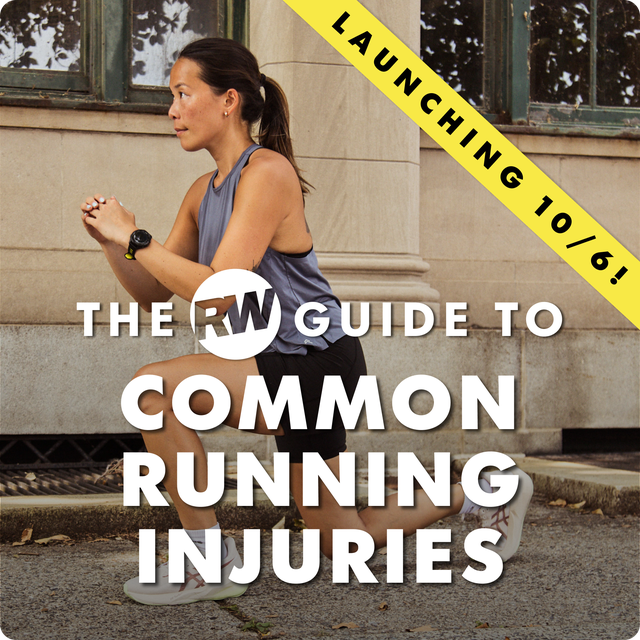
Whether you’re beginning to run or you’re training for that next marathon, the Runner’s World Guide to Common Running Injuries will help you spend less time sidelined and more time doing what you love. You’ll learn how to recognize the signs of common running injuries, understand their causes, and determine when you can safely modify your training versus when it’s time to seek medical care. This holistic program is available exclusively to Runner’s World+ members and launches on October 6!

Kristen Wagner joined the Runner’s World and Bicycling team as a senior health & fitness editor in November 2024 with a decade of magazine editorial experience. In her role, she prioritizes content that supports the brands’ marquee video programs and works closely with members on exclusive Train With opportunities. Since joining the team, Kristen has caught the bug for running! She completed her first 5K and looks forward to accomplishing longer race distances. Passionate about all things wellness, Kristen enjoys Pilates and long walks with her dog, Koda.
LinkedIn