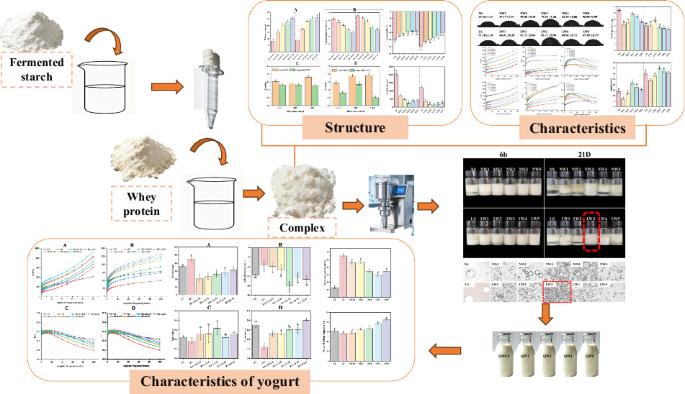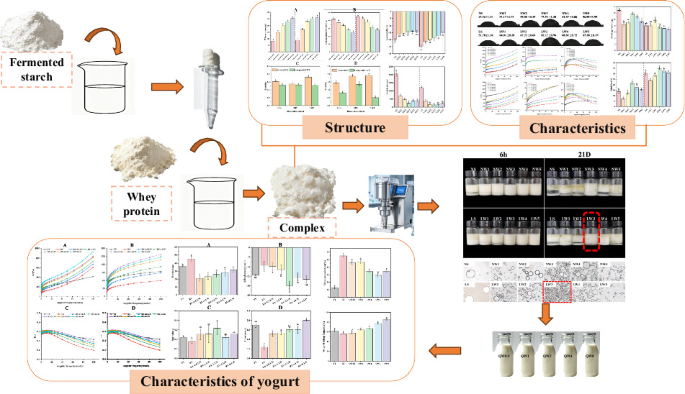
Starch-protein composites are promising fat replacers, yet stable structures and desirable interfacial functions remain difficult to attain for high-quality low-fat foods. Herein, native and fermented quinoa starch-whey protein composite fat replacers were prepared by anti-solvent precipitation at starch-protein mass ratios from 1:0 to 1:0.5, followed by characterizations of particle size, zeta potential, contact angle, emulsifying capacity and rheological behavior. At 1:0.2, fermented starch complexes possessed higher complexation efficiency (84.99%) than native counterparts (74.48%). Under the optimal ratio of 1:0.3, fermented complexes displayed smaller particle size (134.01 nm vs. 250.40 nm), larger contact angle (82.17° vs. 74.25°), better emulsification and denser microstructure. FTIR and dissociation tests verified stronger hydrogen bonds, hydrophobic and electrostatic interactions, alongside greater zeta potential changes, confirming improved structural stability. Optimized complexes were incorporated into reduced-fat milk at 0.5–8% (w/w) to manufacture yogurt. The 4% addition of fermented composites yielded yogurt with the maximum water-holding capacity (85.18%), minimized whey separation, and texture and rheology most similar to full-fat yogurt. This work proves fermentation tailors starch surface features and interfacial complexation to boost fat-replacing performance, providing a clean-label route for premium reduced-fat fermented dairy products.