
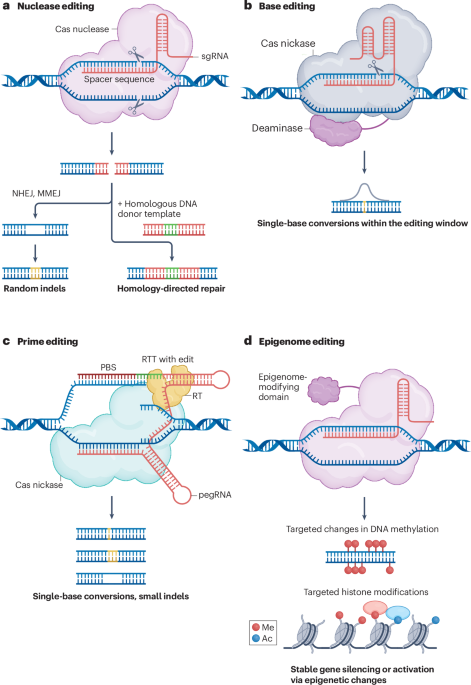
Zheng, Y. et al. Precise genome-editing in human diseases: mechanisms, strategies and applications. Signal. Transduct. Target. Ther. 9, 47 (2024).
Adli, M. The CRISPR tool kit for genome editing and beyond. Nat. Commun. 9, 1911 (2018).
Pixley, K. V. et al. Genome-edited crops for improved food security of smallholder farmers. Nat. Genet. 54, 364–367 (2022).
Jinek, M. et al. A programmable dual-RNA-guided DNA endonuclease in adaptive bacterial immunity. Science 337, 816–821 (2012).
Chavez, M., Chen, X., Finn, P. B. & Qi, L. S. Advances in CRISPR therapeutics. Nat. Rev. Nephrol. 19, 9–22 (2023).
Chen, P. J. & Liu, D. R. Prime editing for precise and highly versatile genome manipulation. Nat. Rev. Genet. 24, 161–177 (2023).
Villiger, L. et al. CRISPR technologies for genome, epigenome and transcriptome editing. Nat. Rev. Mol. Cell Biol. 25, 464–487 (2024).
Porto, E. M., Komor, A. C., Slaymaker, I. M. & Yeo, G. W. Base editing: advances and therapeutic opportunities. Nat. Rev. Drug. Discov. 19, 839–859 (2020).
Urnov, F. D., Rebar, E. J., Holmes, M. C., Zhang, H. S. & Gregory, P. D. Genome editing with engineered zinc finger nucleases. Nat. Rev. Genet. 11, 636–646 (2010).
Joung, J. K. & Sander, J. D. TALENs: a widely applicable technology for targeted genome editing. Nat. Rev. Mol. Cell Biol. 14, 49–55 (2013).
Pacesa, M., Pelea, O. & Jinek, M. Past, present, and future of CRISPR genome editing technologies. Cell 187, 1076–1100 (2024).
Winter, J., Shirguppe, S. & Perez-Pinera, P. Protein engineering technologies for development of next-generation genome editors. Curr. Opin. Biomed. Eng. 28, 100514 (2023).
Hu, J. H. et al. Evolved Cas9 variants with broad PAM compatibility and high DNA specificity. Nature 556, 57–63 (2018).
Yoon, P. H. et al. Structure-guided discovery of ancestral CRISPR–Cas13 ribonucleases. Science 385, 538–543 (2024).
Altae-Tran, H. et al. Uncovering the functional diversity of rare CRISPR–Cas systems with deep terascale clustering. Science 382, eadi1910 (2023).
Wang, Z. et al. Robust enzyme discovery and engineering with deep learning using CataPro. Nat. Commun. 16, 2736 (2025).
Senior, A. W. et al. Improved protein structure prediction using potentials from deep learning. Nature 577, 706–710 (2020).
Jumper, J. et al. Highly accurate protein structure prediction with AlphaFold. Nature 596, 583–589 (2021).
Abramson, J. et al. Accurate structure prediction of biomolecular interactions with AlphaFold 3. Nature 630, 493–500 (2024).
Baek, M. et al. Accurate prediction of protein structures and interactions using a three-track neural network. Science 373, 871–876 (2021).
Simon, E., Swanson, K. & Zou, J. Language models for biological research: a primer. Nat. Methods 21, 1422–1429 (2024).
Nambiar, T. S., Baudrier, L., Billon, P. & Ciccia, A. CRISPR-based genome editing through the lens of DNA repair. Mol. Cell 82, 348–388 (2022).
Li, T. et al. CRISPR/Cas9 therapeutics: progress and prospects. Signal. Transduct. Target. Ther. 8, 36 (2023).
Zetsche, B. et al. Cpf1 is a single RNA-guided endonuclease of a class 2 CRISPR–Cas system. Cell 163, 759–771 (2015).
Badon, I. W., Oh, Y., Kim, H. J. & Lee, S. H. Recent application of CRISPR–Cas12 and OMEGA system for genome editing. Mol. Ther. 32, 32–43 (2024).
Hino, T. et al. An AsCas12f-based compact genome-editing tool derived by deep mutational scanning and structural analysis. Cell 186, 4920–4935.e23 (2023).
Abudayyeh, O. O. et al. C2c2 is a single-component programmable RNA-guided RNA-targeting CRISPR effector. Science 353, aaf5573 (2016).
Altae-Tran, H. et al. The widespread IS200/IS605 transposon family encodes diverse programmable RNA-guided endonucleases. Science 374, 57–65 (2021).
Marquart, K. F. et al. Effective genome editing with an enhanced ISDra2 TnpB system and deep learning-predicted omegaRNAs. Nat. Methods 21, 2084–2093 (2024).
Karvelis, T. et al. Transposon-associated TnpB is a programmable RNA-guided DNA endonuclease. Nature 599, 692–696 (2021).
Kannan, S. et al. Evolution-guided protein design of IscB for persistent epigenome editing in vivo. Nat. Biotechnol. https://doi.org/10.1038/s41587-025-02655-3 (2025).
Xu, C. et al. Conversion of IscB and Cas9 into RNA-guided RNA editors. Cell 188, 5847–5861.e11 (2025).
Enache, O. M. et al. Cas9 activates the p53 pathway and selects for p53-inactivating mutations. Nat. Genet. 52, 662–668 (2020).
Kosicki, M., Tomberg, K. & Bradley, A. Repair of double-strand breaks induced by CRISPR–Cas9 leads to large deletions and complex rearrangements. Nat. Biotechnol. 36, 765–771 (2018).
Leibowitz, M. L. et al. Chromothripsis as an on-target consequence of CRISPR–Cas9 genome editing. Nat. Genet. 53, 895–905 (2021).
Komor, A. C., Kim, Y. B., Packer, M. S., Zuris, J. A. & Liu, D. R. Programmable editing of a target base in genomic DNA without double-stranded DNA cleavage. Nature 533, 420–424 (2016).
Gaudelli, N. M. et al. Programmable base editing of A*T to G*C in genomic DNA without DNA cleavage. Nature 551, 464–471 (2017).
Xu, F. et al. Breaking genetic shackles: the advance of base editing in genetic disorder treatment. Front. Pharmacol. 15, 1364135 (2024).
Davies, K., Philippidis, A. & Barrangou, R. Five years of progress in CRISPR clinical trials (2019–2024). CRISPR J. 7, 227–230 (2024).
Musunuru, K. et al. Patient-specific in vivo gene editing to treat a rare genetic disease. N. Engl. J. Med. 392, 2235–2243 (2025).
Grunewald, J. et al. Transcriptome-wide off-target RNA editing induced by CRISPR-guided DNA base editors. Nature 569, 433–437 (2019).
Anzalone, A. V. et al. Search-and-replace genome editing without double-strand breaks or donor DNA. Nature 576, 149–157 (2019).
Anzalone, A. V. et al. Programmable deletion, replacement, integration and inversion of large DNA sequences with twin prime editing. Nat. Biotechnol. 40, 731–740 (2022).
Yarnall, M. T. N. et al. Drag-and-drop genome insertion of large sequences without double-strand DNA cleavage using CRISPR-directed integrases. Nat. Biotechnol. 41, 500–512 (2023).
Pandey, S. et al. Efficient site-specific integration of large genes in mammalian cells via continuously evolved recombinases and prime editing. Nat. Biomed. Eng. 9, 22–39 (2025).
Doman, J. L., Sousa, A. A., Randolph, P. B., Chen, P. J. & Liu, D. R. Designing and executing prime editing experiments in mammalian cells. Nat. Protoc. 17, 2431–2468 (2022).
Chen, P. J. et al. Enhanced prime editing systems by manipulating cellular determinants of editing outcomes. Cell 184, 5635–5652.e29 (2021).
Doman, J. L. et al. Phage-assisted evolution and protein engineering yield compact, efficient prime editors. Cell 186, 3983–4002.e26 (2023).
Yan, J. et al. Improving prime editing with an endogenous small RNA-binding protein. Nature 628, 639–647 (2024).
Nelson, J. W. et al. Engineered pegRNAs improve prime editing efficiency. Nat. Biotechnol. 40, 402–410 (2022).
Li, X. et al. Highly efficient prime editing by introducing same-sense mutations in pegRNA or stabilizing its structure. Nat. Commun. 13, 1669 (2022).
Fei, J. et al. Mismatch prime editing gRNA increased efficiency and reduced indels. Nat. Commun. 16, 139 (2025).
Gilbert, L. A. et al. Genome-scale CRISPR-mediated control of gene repression and activation. Cell 159, 647–661 (2014).
Gilbert, L. ukeA. et al. CRISPR-mediated modular RNA-guided regulation of transcription in eukaryotes. Cell 154, 442–451 (2013).
Chavez, A. et al. Highly efficient Cas9-mediated transcriptional programming. Nat. Methods 12, 326–328 (2015).
Nunez, J. K. et al. Genome-wide programmable transcriptional memory by CRISPR-based epigenome editing. Cell 184, 2503–2519.e17 (2021).
Hilton, I. B. et al. Epigenome editing by a CRISPR–Cas9-based acetyltransferase activates genes from promoters and enhancers. Nat. Biotechnol. 33, 510–517 (2015).
Li, J. et al. Programmable human histone phosphorylation and gene activation using a CRISPR/Cas9-based chromatin kinase. Nat. Commun. 12, 896 (2021).
Konstantakos, V., Nentidis, A., Krithara, A. & Paliouras, G. CRISPR–Cas9 gRNA efficiency prediction: an overview of predictive tools and the role of deep learning. Nucleic Acids Res. 50, 3616–3637 (2022).
Sherkatghanad, Z., Abdar, M., Charlier, J. & Makarenkov, V. Using traditional machine learning and deep learning methods for on- and off-target prediction in CRISPR/Cas9: a review. Brief. Bioinform. 24, bbad131 (2023).
Dixit, S., Kumar, A., Srinivasan, K., Vincent, P. & Ramu Krishnan, N. Advancing genome editing with artificial intelligence: opportunities, challenges, and future directions. Front. Bioeng. Biotechnol. 11, 1335901 (2023).
Chari, R., Mali, P., Moosburner, M. & Church, G. M. Unraveling CRISPR–Cas9 genome engineering parameters via a library-on-library approach. Nat. Methods 12, 823–826 (2015).
Kim, H. K. et al. In vivo high-throughput profiling of CRISPR–Cpf1 activity. Nat. Methods 14, 153–159 (2017).
Zhang, G., Luo, Y., Dai, X. & Dai, Z. Benchmarking deep learning methods for predicting CRISPR/Cas9 sgRNA on- and off-target activities. Brief. Bioinform. 24, bbad333 (2023).
Kim, H. K. et al. Deep learning improves prediction of CRISPR–Cpf1 guide RNA activity. Nat. Biotechnol. 36, 239–241 (2018).
Kim, H. K. et al. SpCas9 activity prediction by DeepSpCas9, a deep learning-based model with high generalization performance. Sci. Adv. 5, eaax9249 (2019).
Chuai, G. et al. DeepCRISPR: optimized CRISPR guide RNA design by deep learning. Genome Biol. 19, 80 (2018).
Xiang, X. et al. Enhancing CRISPR–Cas9 gRNA efficiency prediction by data integration and deep learning. Nat. Commun. 12, 3238 (2021).
Li, C., Zou, Q., Li, J. & Feng, H. Prediction of CRISPR–Cas9 on-target activity based on a hybrid neural network. Comput. Struct. Biotechnol. J. 27, 2098–2106 (2025).
Hou, Y. et al. Leveraging protein language models for cross-variant CRISPR/Cas9 sgRNA activity prediction. Bioinformatics 41, btaf385 (2025).
Lin, Z. et al. Evolutionary-scale prediction of atomic-level protein structure with a language model. Science 379, 1123–1130 (2023).
Elkayam, S., Tziony, I. & Orenstein, Y. DeepCRISTL: deep transfer learning to predict CRISPR/Cas9 on-target editing efficiency in specific cellular contexts. Bioinformatics 40, btae481 (2024).
Liu, Q., Cheng, X., Liu, G., Li, B. & Liu, X. Deep learning improves the ability of sgRNA off-target propensity prediction. BMC Bioinforma. 21, 51 (2020).
Chen, Q. et al. Genome-wide CRISPR off-target prediction and optimization using RNA–DNA interaction fingerprints. Nat. Commun. 14, 7521 (2023).
Ozden, F. & Minary, P. Learning to quantify uncertainty in off-target activity for CRISPR guide RNAs. Nucleic Acids Res. 52, e87 (2024).
Tahsin, A. et al. CRISPR-Embedding: CRISPR/Cas9 off-target activity prediction using DNA k-mer embedding. Computational Struct. Biotechnol. Rep. 2, 100043 (2025).
Du, W. et al. A versatile CRISPR/Cas9 system off-target prediction tool using language model. Commun. Biol. 8, 882 (2025).
Cheng, X. et al. Modeling CRISPR–Cas13d on-target and off-target effects using machine learning approaches. Nat. Commun. 14, 752 (2023).
Wessels, H. H. et al. Prediction of on-target and off-target activity of CRISPR–Cas13d guide RNAs using deep learning. Nat. Biotechnol. 42, 628–637 (2024).
Shen, M. W. et al. Predictable and precise template-free CRISPR editing of pathogenic variants. Nature 563, 646–651 (2018).
Chen, W. et al. Massively parallel profiling and predictive modeling of the outcomes of CRISPR/Cas9-mediated double-strand break repair. Nucleic Acids Res. 47, 7989–8003 (2019).
Allen, F. et al. Predicting the mutations generated by repair of Cas9-induced double-strand breaks. Nat. Biotechnol. 37, 64–72 (2019).
Leenay, R. T. et al. Large dataset enables prediction of repair after CRISPR–Cas9 editing in primary T cells. Nat. Biotechnol. 37, 1034–1037 (2019).
Naert, T. et al. Precise, predictable genome integrations by deep-learning-assisted design of microhomology-based templates. Nat. Biotechnol. https://doi.org/10.1038/s41587-025-02771-0 (2025).
Huang, T. P., Newby, G. A. & Liu, D. R. Precision genome editing using cytosine and adenine base editors in mammalian cells. Nat. Protoc. 16, 1089–1128 (2021).
Arbab, M. et al. Determinants of base editing outcomes from target library analysis and machine learning. Cell 182, 463–480.e30 (2020).
Song, M. et al. Sequence-specific prediction of the efficiencies of adenine and cytosine base editors. Nat. Biotechnol. 38, 1037–1043 (2020).
Marquart, K. F. et al. Predicting base editing outcomes with an attention-based deep learning algorithm trained on high-throughput target library screens. Nat. Commun. 12, 5114 (2021).
Koblan, L. W. et al. Efficient C*G-to-G*C base editors developed using CRISPRi screens, target-library analysis, and machine learning. Nat. Biotechnol. 39, 1414–1425 (2021).
Kim, N. et al. Deep learning models to predict the editing efficiencies and outcomes of diverse base editors. Nat. Biotechnol. 42, 484–497 (2024).
Zhou, X. et al. Comprehensive evaluation and prediction of editing outcomes for near-PAMless adenine and cytosine base editors. Commun. Biol. 7, 1389 (2024).
Walton, R. T., Christie, K. A., Whittaker, M. N. & Kleinstiver, B. P. Unconstrained genome targeting with near-PAMless engineered CRISPR–Cas9 variants. Science 368, 290–296 (2020).
Yuan, T. et al. Deep learning models incorporating endogenous factors beyond DNA sequences improve the prediction accuracy of base editing outcomes. Cell Discov. 10, 20 (2024).
Zhang, C. et al. Prediction of base editor off-targets by deep learning. Nat. Commun. 14, 5358 (2023).
Kim, H. K. et al. Predicting the efficiency of prime editing guide RNAs in human cells. Nat. Biotechnol. 39, 198–206 (2021).
Li, Y., Chen, J., Tsai, S. Q. & Cheng, Y. Easy-Prime: a machine learning-based prime editor design tool. Genome Biol. 22, 235 (2021).
Mathis, N. et al. Predicting prime editing efficiency and product purity by deep learning. Nat. Biotechnol. 41, 1151–1159 (2023).
Yu, G. et al. Prediction of efficiencies for diverse prime editing systems in multiple cell types. Cell 186, 2256–2272 e2223 (2023).
Mathis, N. et al. Machine learning prediction of prime editing efficiency across diverse chromatin contexts. Nat. Biotechnol. 43, 712–719 (2025).
Koeppel, J. et al. Prediction of prime editing insertion efficiencies using sequence features and DNA repair determinants. Nat. Biotechnol. 41, 1446–1456 (2023).
Liu, F. et al. Design of prime-editing guide RNAs with deep transfer learning. Nat. Mach. Intell. 5, 1261 (2023).
Alipanahi, R., Safari, L. & Khanteymoori, A. DTMP-prime: a deep transformer-based model for predicting prime editing efficiency and pegRNA activity. Mol. Ther. Nucleic Acids 35, 102370 (2024).
Janssen, S. M. & Lorincz, M. C. Interplay between chromatin marks in development and disease. Nat. Rev. Genet. 23, 137–153 (2022).
McCutcheon, S. R., Rohm, D., Iglesias, N. & Gersbach, C. A. Epigenome editing technologies for discovery and medicine. Nat. Biotechnol. 42, 1199–1217 (2024).
Yang, Q. et al. EpiCas-DL: predicting sgRNA activity for CRISPR-mediated epigenome editing by deep learning. Comput. Struct. Biotechnol. J. 21, 202–211 (2023).
Mu, W. et al. Machine learning methods for predicting guide RNA effects in CRISPR epigenome editing experiments. Preprint at bioRxiv https://doi.org/10.1101/2024.04.18.590188 (2024).
Consortium, E. P. An integrated encyclopedia of DNA elements in the human genome. Nature 489, 57–74 (2012).
Batra, S. S. et al. Predicting the effect of CRISPR–Cas9-based epigenome editing. Preprint at bioRxiv https://doi.org/10.1101/2023.10.03.560674 (2025).
Zhao, F. et al. A strategy for Cas13 miniaturization based on the structure and AlphaFold. Nat. Commun. 14, 5545 (2023).
Pan, L. et al. Optimization of CRISPR/Cas12f1 guide RNAs using AlphaFold3 for enhanced nucleic acid detection. Microchemical J. 212, 113194 (2025).
Leman, J. K. et al. Macromolecular modeling and design in Rosetta: recent methods and frameworks. Nat. Methods 17, 665–680 (2020).
Jurtz, V. et al. NetMHCpan-4.0: improved peptide–MHC class I interaction predictions integrating eluted ligand and peptide binding affinity data. J. Immunol. 199, 3360–3368 (2017).
Raghavan, R. et al. Rational engineering of minimally immunogenic nucleases for gene therapy. Nat. Commun. 16, 105 (2025).
Watson, J. L. et al. De novo design of protein structure and function with RFdiffusion. Nature 620, 1089–1100 (2023).
Park, J. C. et al. AI-generated MLH1 small binder improves prime editing efficiency. Cell 188, 5831–5846.e21 (2025).
Ruffolo, J. A. & Madani, A. Designing proteins with language models. Nat. Biotechnol. 42, 200–202 (2024).
He, Y. et al. Protein language models-assisted optimization of a uracil-N-glycosylase variant enables programmable T-to-G and T-to-C base editing. Mol. Cell 84, 1257–1270.e6 (2024).
Perrotta, R. M. et al. Machine learning and directed evolution of base editing enzymes. Preprint at bioRxiv https://doi.org/10.1101/2024.05.17.594556 (2024).
Silverstein, R. A. et al. Custom CRISPR–Cas9 PAM variants via scalable engineering and machine learning. Nature 643, 539–550 (2025).
Chen, K. et al. Lung and liver editing by lipid nanoparticle delivery of a stable CRISPR–Cas9 ribonucleoprotein. Nat. Biotechnol. 43, 1445–1457 (2025).
Wang, Y. et al. Directed evolution: methodologies and applications. Chem. Rev. 121, 12384–12444 (2021).
Wittmann, B. J., Johnston, K. E., Wu, Z. & Arnold, F. H. Advances in machine learning for directed evolution. Curr. Opin. Struct. Biol. 69, 11–18 (2021).
Jiang, K. et al. Rapid in silico directed evolution by a protein language model with EVOLVEpro. Science 387, eadr6006 (2025).
Raftopoulou, O. & Barrangou, R. Mining microbial organisms to discover and characterize novel CRISPR–Cas systems. Curr. Opin. Biomed. Eng. 27, 100469 (2023).
Faure, G. et al. TIGR-Tas: a family of modular RNA-guided DNA-targeting systems in prokaryotes and their viruses. Science 388, eadv9789 (2025).
Saito, M. et al. Fanzor is a eukaryotic programmable RNA-guided endonuclease. Nature 620, 660–668 (2023).
Jiang, K. et al. Programmable RNA-guided DNA endonucleases are widespread in eukaryotes and their viruses. Sci. Adv. 9, eadk0171 (2023).
Huang, J. et al. Discovery of deaminase functions by structure-based protein clustering. Cell 186, 3182–3195.e14 (2023).
Xu, K. et al. Structure-guided discovery of highly efficient cytidine deaminases with sequence-context independence. Nat. Biomed. Eng. 9, 93–108 (2025).
Li, W. et al. Discovering CRISPR–Cas system with self-processing pre-crRNA capability by foundation models. Nat. Commun. 15, 10024 (2024).
Nguyen, E. et al. Sequence modeling and design from molecular to genome scale with EVO. Science 386, eado9336 (2024).
Nijkamp, E., Ruffolo, J. A., Weinstein, E. N., Naik, N. & Madani, A. ProGen2: exploring the boundaries of protein language models. Cell Syst. 14, 968–978.e3 (2023).
Ruffolo, J. A. et al. Design of highly functional genome editors by modelling CRISPR–Cas sequences. Nature 645, 518–525 (2025).
Nammi, B. et al. CasGen: a regularized generative model for CRISPR cas protein design with classification and margin-based optimization. Preprint at bioRxiv https://doi.org/10.1101/2025.02.28.640911 (2025).
Jiang, J. et al. A review of transformer models in drug discovery and beyond. J. Pharm. Anal. 15, 101081 (2025).
Chen, Y. et al. All-RNA-mediated targeted gene integration in mammalian cells with rationally engineered R2 retrotransposons. Cell 187, 4674–4689.e18 (2024).
Fell, C. W. et al. Reprogramming site-specific retrotransposon activity to new DNA sites. Nature 642, 1080–1089 (2025).
Witte, I. P. et al. Programmable gene insertion in human cells with a laboratory-evolved CRISPR-associated transposase. Science 388, eadt5199 (2025).
Durrant, M. G. et al. Bridge RNAs direct programmable recombination of target and donor DNA. Nature 630, 984–993 (2024).
Perry, N. T. et al. Megabase-scale human genome rearrangement with programmable bridge recombinases. Science https://doi.org/10.1126/science.adz0276 (2025).
Rood, J. E., Hupalowska, A. & Regev, A. Toward a foundation model of causal cell and tissue biology with a perturbation cell and tissue atlas. Cell 187, 4520–4545 (2024).
Bunne, C. et al. How to build the virtual cell with artificial intelligence: priorities and opportunities. Cell 187, 7045–7063 (2024).
Roohani, Y. H. et al. Virtual cell challenge: toward a turing test for the virtual cell. Cell 188, 3370–3374 (2025).
Cui, H. et al. Towards multimodal foundation models in molecular cell biology. Nature 640, 623–633 (2025).
Qu, Y. et al. CRISPR-GPT for agentic automation of gene-editing experiments. Nat. Biomed. Eng. https://doi.org/10.1038/s41551-025-01463-z (2025).
Huang, K. et al. Biomni: a general-purpose biomedical AI agent. Preprint at bioRxiv https://doi.org/10.1101/2025.05.30.656746 (2025).
Canty, R. B. et al. Science acceleration and accessibility with self-driving labs. Nat. Commun. 16, 3856 (2025).
Frangoul, H. et al. CRISPR–Cas9 gene editing for sickle cell disease and beta-thalassemia. N. Engl. J. Med. 384, 252–260 (2021).
Raguram, A., Banskota, S. & Liu, D. R. Therapeutic in vivo delivery of gene editing agents. Cell 185, 2806–2827 (2022).
Tan, F., Dong, Y., Qi, J., Yu, W. & Chai, R. Artificial intelligence-based approaches for AAV vector engineering. Adv. Sci. 12, e2411062 (2025).
Laxmi, B., Devi, P. U. M., Thanjavur, N. & Buddolla, V. The applications of artificial intelligence (AI)-driven tools in virus-like particles (VLPs) research. Curr. Microbiol. 81, 234 (2024).
Cui, H. et al. LUMI-lab: a foundation model-driven autonomous platform enabling discovery of new ionizable lipid designs for mRNA delivery. Preprint at bioRxiv https://doi.org/10.1101/2025.02.14.638383 (2025).
Wang, W. et al. Artificial intelligence-driven rational design of ionizable lipids for mRNA delivery. Nat. Commun. 15, 10804 (2024).
Witten, J. et al. Artificial intelligence-guided design of lipid nanoparticles for pulmonary gene therapy. Nat. Biotechnol. 43, 1790–1799 (2025).
Xu, Y. et al. AGILE platform: a deep learning powered approach to accelerate LNP development for mRNA delivery. Nat. Commun. 15, 6305 (2024).
Dorsey, P. J., Lau, C. L., Chang, T. C., Doerschuk, P. C. & D’Addio, S. M. Review of machine learning for lipid nanoparticle formulation and process development. J. Pharm. Sci. 113, 3413–3433 (2024).
Li, B. et al. Combinatorial design of nanoparticles for pulmonary mRNA delivery and genome editing. Nat. Biotechnol. 41, 1410–1415 (2023).
Zhang, H. et al. Algorithm for optimized mRNA design improves stability and immunogenicity. Nature 621, 396–403 (2023).
Chu, Y. et al. A 5\Prime; UTR language model for decoding untranslated regions of mRNA and function predictions. Nat. Mach. Intell. 6, 449–460 (2024).
Morrow, A. K. et al. ML-driven design of 3′ UTRs for mRNA stability. Preprint at bioRxiv https://doi.org/10.1101/2024.10.07.616676 (2024).
Castillo-Hair, S. et al. Optimizing 5′ UTRs for mRNA-delivered gene editing using deep learning. Nat. Commun. 15, 5284 (2024).
Mao, D. et al. AI-MARRVEL—a knowledge-driven AI system for diagnosing mendelian disorders. NEJM AI https://doi.org/10.1056/aioa2300009 (2024).
Avsec, Ž. et al. AlphaGenome: advancing regulatory variant effect prediction with a unified DNA sequence model. Preprint at bioRxiv https://doi.org/10.1101/2025.06.25.661532 (2025).
Birgmeier, J. et al. AMELIE speeds mendelian diagnosis by matching patient phenotype and genotype to primary literature. Sci. Transl. Med. 12, eaau9113 (2020).
Duong, D. & Solomon, B. D. Artificial intelligence in clinical genetics. Eur. J. Hum. Genet. 33, 281–288 (2025).
Teodoro, D., Naderi, N., Yazdani, A., Zhang, B. & Bornet, A. A scoping review of artificial intelligence applications in clinical trial risk assessment. NPJ Digit. Med. 8, 486 (2025).
Berman, H. M. et al. The Protein Data Bank. Nucleic Acids Res. 28, 235–242 (2000).
Burley, S. K. et al. Updated resources for exploring experimentally-determined PDB structures and computed structure models at the RCSB Protein Data Bank. Nucleic Acids Res. 53, D564–D574 (2025).
Abolhasani, M. & Kumacheva, E. The rise of self-driving labs in chemical and materials sciences. Nat. Synth. 2, 483–492 (2023).
Szymanski, N. J. et al. An autonomous laboratory for the accelerated synthesis of novel materials. Nature 624, 86–91 (2023).
Greener, J. G., Kandathil, S. M., Moffat, L. & Jones, D. T. A guide to machine learning for biologists. Nat. Rev. Mol. Cell Biol. 23, 40–55 (2022).
Eraslan, G., Avsec, Z., Gagneur, J. & Theis, F. J. Deep learning: new computational modelling techniques for genomics. Nat. Rev. Genet. 20, 389–403 (2019).
LeCun, Y., Bengio, Y. & Hinton, G. Deep learning. Nature 521, 436–444 (2015).
Bommasani, R. et al. On the opportunities and risks of foundation models. Preprint at https://doi.org/10.48550/arXiv.2108.07258 (2021).
Sengar, S. S., Hasan, A. B., Kumar, S. & Carroll, F. Generative artificial intelligence: a systematic review and applications. Multimed. Tools Appl. 84, 23661–23700 (2025).
Hayes, T. et al. Simulating 500 million years of evolution with a language model. Science 387, 850–858 (2025).
Bock, C. et al. High-content CRISPR screening. Nat. Rev. Methods Primers 2, 9 (2022).
Baysoy, A., Bai, Z., Satija, R. & Fan, R. The technological landscape and applications of single-cell multi-omics. Nat. Rev. Mol. Cell Biol. 24, 695–713 (2023).
Dixit, A. et al. Perturb-Seq: dissecting molecular circuits with scalable single-cell RNA profiling of pooled genetic screens. Cell 167, 1853–1866.e17 (2016).
Jaitin, D. A. et al. Dissecting immune circuits by linking CRISPR-pooled screens with single-cell RNA-seq. Cell 167, 1883–1896.e15 (2016).
Datlinger, P. et al. Pooled CRISPR screening with single-cell transcriptome readout. Nat. Methods 14, 297–301 (2017).
Roohani, Y., Huang, K. & Leskovec, J. Predicting transcriptional outcomes of novel multigene perturbations with GEARS. Nat. Biotechnol. 42, 927–935 (2024).
Yu, H., Qian, W., Song, Y. & Welch, J. D. PerturbNet predicts single-cell responses to unseen chemical and genetic perturbations. Mol. Syst. Biol. 21, 960–982 (2025).
Toneyan, S. & Koo, P. K. Interpreting cis-regulatory interactions from large-scale deep neural networks. Nat. Genet. 56, 2517–2527 (2024).
Xing, H. & Yau, C. GPerturb: Gaussian process modelling of single-cell perturbation data. Nat. Commun. 16, 5423 (2025).
Cui, H. et al. scGPT: toward building a foundation model for single-cell multi-omics using generative AI. Nat. Methods 21, 1470–1480 (2024).
Theodoris, C. V. et al. Transfer learning enables predictions in network biology. Nature 618, 616–624 (2023).
Adduri, A. K. et al. Predicting cellular responses to perturbation across diverse contexts with State. Preprint at bioRxiv https://doi.org/10.1101/2025.06.26.661135 (2025).
Hao, M. et al. Large-scale foundation model on single-cell transcriptomics. Nat. Methods 21, 1481–1491 (2024).
Zeng, Y. et al. CellFM: a large-scale foundation model pre-trained on transcriptomics of 100 million human cells. Nat. Commun. 16, 4679 (2025).
Dhainaut, M. et al. Spatial CRISPR genomics identifies regulators of the tumor microenvironment. Cell 185, 1223–1239.e20 (2022).
Baysoy, A. et al. Spatially resolved in vivo CRISPR screen sequencing via perturb-DBiT. Preprint at bioRxiv https://doi.org/10.1101/2024.11.18.624106 (2024).
Saunders, R. A. et al. Perturb-Multimodal: A platform for pooled genetic screens with imaging and sequencing in intact mammalian tissue. Cell 188, 4790–4809.e22 (2025).
Binan, L. et al. Simultaneous CRISPR screening and spatial transcriptomics reveal intracellular, intercellular, and functional transcriptional circuits. Cell 188, 2141–2158.e18 (2025).
Megas, S. et al. Celcomen: spatial causal disentanglement for single-cell and tissue perturbation modeling. Preprint at https://doi.org/10.48550/arXiv.2409.05804 (2024).
Li, Y., Stanojevic, S. & Garmire, L. X. Emerging artificial intelligence applications in spatial transcriptomics analysis. Comput. Struct. Biotechnol. J. 20, 2895–2908 (2022).