

When she’s not busy writing books, presenting the successful podcast The Rest Is Money or helping crack cases on Crimewatch, you might well find journalist and presenter Steph McGovern, 44, sweating it out on a VersaClimber. In fact, she felt such an affinity with this gym machine that she recently partnered with her personal trainer David Fairlamb to set up a new business, ClimbAhub, offering disco-themed VersaClimber classes.
‘I’ve had terrific success using the VersaClimber machine at my gym in North Shields,’ Fairlamb told Northern Insight. ‘It’s proved to be one of the most popular classes that I have… and one of the people who enjoyed attending was Steph McGovern. She always made a beeline for the VersaClimber classes because she immediately saw the benefits of using it.’
Below, we explore why workouts on a VersaClimber are so effective – and what to do instead if you don’t have access to a machine.
What is a VersaClimber?
A vertical climbing machine designed to replicate the motion of climbing a ladder, a VersaClimber works your upper and lower body simultaneously, improving cardiovascular fitness, muscular endurance and calorie burn.
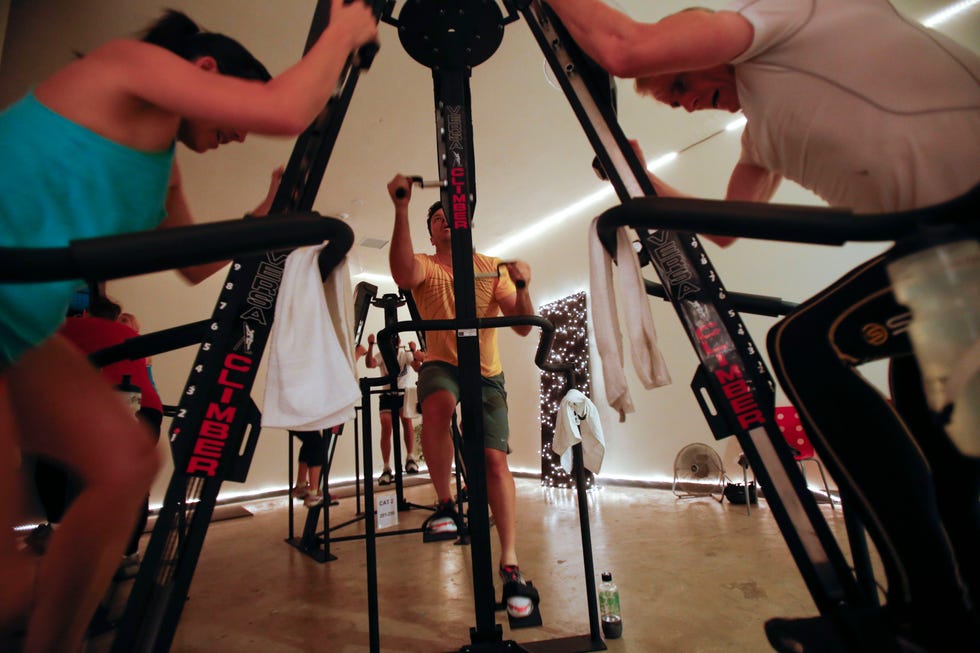 Michael Robinson Chavez//Getty Images
A full-body workout, the VersaClimber machine mimics the motion of ladder climbing
Why is it an effective workout?
‘The VersaClimber works because it never lets half your body switch off,’ says personal trainer Michael Baah. While that might sound alarming, it’s not as scary as it sounds – it simply means your body remains engaged throughout.
‘It burns significantly more calories per minute than a treadmill at the same perceived effort, but the movement is low-impact, so your joints are not taking a pounding while that happens,’ adds Baah. ‘You also finish standing tall rather than hunched – after years of seeing clients improve their posture from this machine alone, that is not a small thing.’
Workouts can also be easily adapted for fitness level, says Baah.
‘Beginners can start gently and feel the benefit immediately; athletes can crank resistance and build serious power,’ he notes. ‘I use it with clients who are managing mild injuries because the movement is controlled and upright, which is far easier on the body than floor work or anything high-impact – and I also adapt it for clients in cancer recovery, where maintaining strength and cardiovascular health matters enormously and the body needs to be treated carefully.’
But, Baah cautions, ‘if your shoulder or hip mobility is very restricted, spend a few sessions getting comfortable before pushing intensity’.
Beginner VersaClimber workout
Once you feel comfortable, aim for 10-15 minutes on the machine, advises Baah. Start with 30-45 seconds of work followed by 60-90 seconds of rest, at an effort level of around 5-6/10.
‘Once that feels manageable, extend to 20-30 minutes and increase resistance gradually,’ he adds, ensuring you put ‘posture before pace – the moment your form goes, your results go with it’.
Mistakes to avoid
Speaking of mistakes to avoid, says Baah, the main ones are: leaning forward, pulling only with your arms, and going too heavy too soon. If you fall into any of these three traps, ‘you take the work away from the large muscles that should be driving it and dump it onto your back and shoulders instead,’ he says.
‘Keep the balls of your feet fully on the pedals – if your heels lift, you lose power and eventually rhythm,’ he adds.
VersaClimber alternatives
If your gym doesn’t have a VersaClimber, Baah highlights several other workouts that can elicit similar effects.
‘A stair climber with active arm movement is the closest substitute, and step-ups combined with overhead resistance band pulls also replicate the push-pull pattern well,’ he notes. ‘Outdoors, hill repeats or climbing steps while pumping your arms will give you very similar aerobic and endurance results. The movement pattern is the point; the [VersaClimber] machine just makes it cleaner.’
One of our most frequently asked questions here at Women’s Health? How to build muscle and burn fat at the same time. So, we asked superstar trainer Oyinda Okunowo exactly how to do it. In this 4-week plan – created exclusively for Women’s Health COLLECTIVE members – you’ll get the workouts and nutrition guidance needed to help you on your way to better body composition. Tap the link below to unlock 14 days of free access to Oyinda’s plan and start training today.

Hannah Bradfield is a Senior Health and Fitness Writer for Women’s Health UK. An NCTJ-accredited journalist, Hannah graduated from Loughborough University with a BA in English and Sport Science and an MA in Media and Cultural Analysis. She has been covering sports, health and fitness for the last five years and has created content for outlets including BBC Sport, BBC Sounds, Runner’s World and Stylist. She especially enjoys interviewing those working within the community to improve access to sport, exercise and wellness. Hannah is a 2024 John Schofield Trust Fellow and was also named a 2022 Rising Star in Journalism by The Printing Charity. A keen runner, Hannah was firmly a sprinter growing up (also dabbling in long jump) but has since transitioned to longer-distance running. While 10K is her favoured race distance, she loves running or volunteering at parkrun every Saturday, followed, of course, by pastries. She’s always looking for fun new runs and races to do and brunch spots to try.