
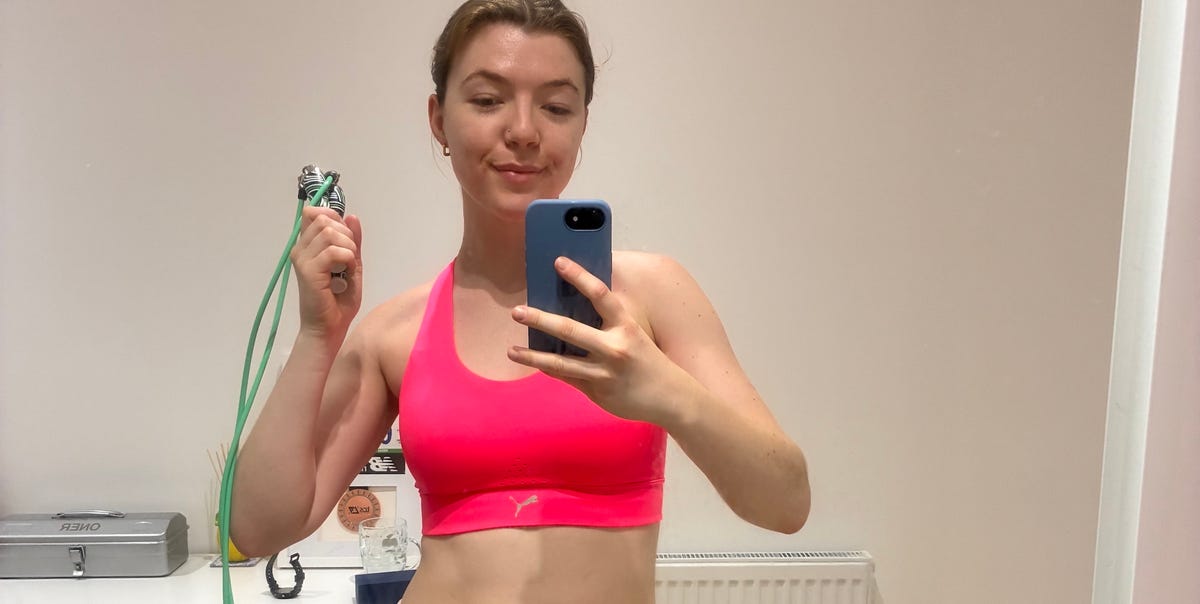
After experiencing somewhat of a motivation slump following my first marathon a couple of months ago, I recently started craving some structure in my fitness routine.
I was ready for a challenge, but a specific kind: one that could provide novelty without completely decimating my summer social calendar.
So, when Crossrope reached out asking if I wanted to try one of their weighted skipping ropes, I jumped (no pun intended) at the chance and decided to commit for 30 days. Particularly because a personal trainer had recently told me about the benefits of skipping for runners.
Hannah’s weighted skipping plan
Seeing as my skipping CV was… limited, I eased into the challenge with eight rounds of 30 seconds on/30 seconds off, upon the advice of personal trainer and strength and conditioning specialist Eryn Barber. I also used Crossrope’s entry-level weighted rope, which weighs 1/4 lb.
While that might sound light, the first session was humbling. Who knew you could get DOMS in your feet?
It strengthened my feet
If the pain had persisted, I would’ve stopped and sought medical advice, but it didn’t, so the initial soreness was likely due to the fact that skipping was working muscles I’d previously neglected, aka, the intrinsic muscles of the foot, often referred to as the ‘deep foot muscles’.
‘As well as being a full-body workout, skipping develops ankle stiffness [despite the term, this is a good thing and refers to your ankle’s ability to act like a spring] and conditions the foot and ankle – both of which can benefit your running,’ Barber says.
It helped maintain my stamina and leg strength
Sure enough, while my running and strength training had been quite sporadic post-marathon, on the runs I completed during the skipping challenge, my legs felt strong and my stamina surprisingly solid despite the lack of overall training volume.
I gradually progressed my sessions from 8 × 30 seconds on/30 seconds off to 8 × 45 seconds on/off, then 8 × 60 seconds on/off, before eventually reaching 60 seconds on/30 seconds off. Without really thinking about it, I was doing at least a 12-minute workout every day.
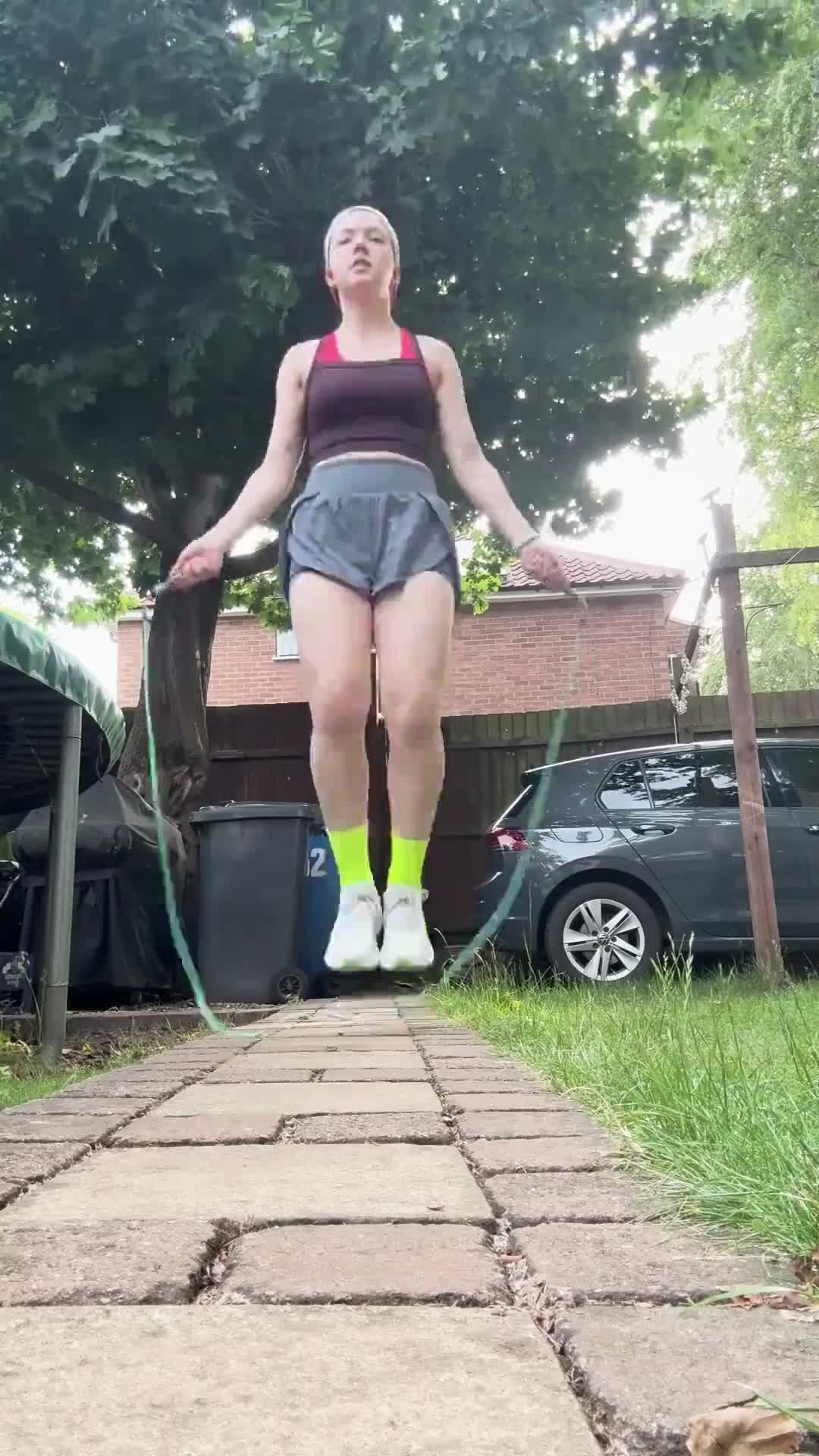
Hannah deep in concentration during a weighted skipping interval
Yes, there were times when I had to squeeze it in just before bed or get it done quickly before heading out, but that was the benefit of such a minimal-equipment workout. As per the image at the top of this article, there’s nothing to say you can’t skip in your pyjamas.
I automatically habit-stacked
Because skipping became ingrained in my daily routine, I also habit-stacked without much thought.
I started warming up with simple strength exercises such as calf and tib raises, both of which Barber recommends for prepping muscles and tendons for the impact of skipping. I also stretched afterwards, taking some time for mindfulness exercises if skipping at night.
It helped my knee stiffness
One of the most surprising effects of the challenge on my body, however, was on my right knee, which had felt stiff throughout and after my marathon training – even when my training load reduced.
After 30 days of weighted skipping, though, the stiffness seemed to have eased considerably. While it’s impossible to know whether the skipping itself was solely responsible, it’s plausible that the extra strength demands on my calves, quadriceps and hamstrings – which all help support the knee joint – may have played a role.
Is (weighted) skipping better than running for cardio fitness?
So could it be better than running for cardio fitness?
‘Skipping – particularly weighted skipping – can quickly increase your heart rate and generate a higher heart rate response per minute than steady-state running,’ says Barber. ‘It provides a combination of aerobic and anaerobic conditioning as well as coordination work.’
One often-cited study concluded that 10 minutes of vigorous skipping rivals 30 minutes of jogging. How accurate is that comparison?
‘In studies, 10 minutes of skipping often matches the calorie burn and cardiovascular load of running at about 5-6 mph (8-10 km/h): a comfortable, moderate jog,’ says Barber. ‘But variables like rope speed, technique, body weight and fitness level can change the comparison dramatically and weighted skipping makes the gap even larger due to increased upper-body demand.’
Technique tips
Before the challenge, Barber advised me on how to get the most out of my skipping. Here are a few of the tips I took on board.
‘Aim for small, quick jumps – this helps to conserve energy and reduces the impact on joints.’‘Try to land softly on the balls of your feet with a slight bend in the knees – this helps to absorb the shock and protect the ankles and knees.’ ‘The rotation of the rope should come from your wrists moving and not your shoulders to prevent shoulder fatigue.’ ‘Start by skipping for a shorter period of time and gradually increase this as you get used to the weighted rope.’
Starting conservatively is key, adds Barber, as ‘weighted ropes will fatigue your upper body a lot quicker than a normal rope’ and ‘you should try to maintain a consistent pace that elevates your heart rate, but not so fast that you struggle to maintain a rhythm and fatigue quickly.’
As for how often you should skip? Due to its high-impact nature, Barber recommends beginning with two to three sessions a week before slowly increasing frequency should you wish.
The verdict
While I probably won’t continue to skip every day, I’ll certainly be using it to support my running going forward.
If it continues to help keep my knee stiffness at bay, train forgotten foot muscles and build strength in my legs, it’s a no-brainer.
One of our most frequently asked questions here at Women’s Health? How to build muscle and burn fat at the same time. So, we asked superstar trainer Oyinda Okunowo exactly how to do it. In this 4-week plan – created exclusively for Women’s Health COLLECTIVE members – you’ll get the workouts and nutrition guidance needed to help you on your way to better body composition. Tap the link below to unlock 14 days of free access to Oyinda’s plan and start training today.

Hannah Bradfield is a Senior Health and Fitness Writer for Women’s Health UK. An NCTJ-accredited journalist, Hannah graduated from Loughborough University with a BA in English and Sport Science and an MA in Media and Cultural Analysis. She has been covering sports, health and fitness for the last five years and has created content for outlets including BBC Sport, BBC Sounds, Runner’s World and Stylist. She especially enjoys interviewing those working within the community to improve access to sport, exercise and wellness. Hannah is a 2024 John Schofield Trust Fellow and was also named a 2022 Rising Star in Journalism by The Printing Charity. A keen runner, Hannah was firmly a sprinter growing up (also dabbling in long jump) but has since transitioned to longer-distance running. While 10K is her favoured race distance, she loves running or volunteering at parkrun every Saturday, followed, of course, by pastries. She’s always looking for fun new runs and races to do and brunch spots to try.