

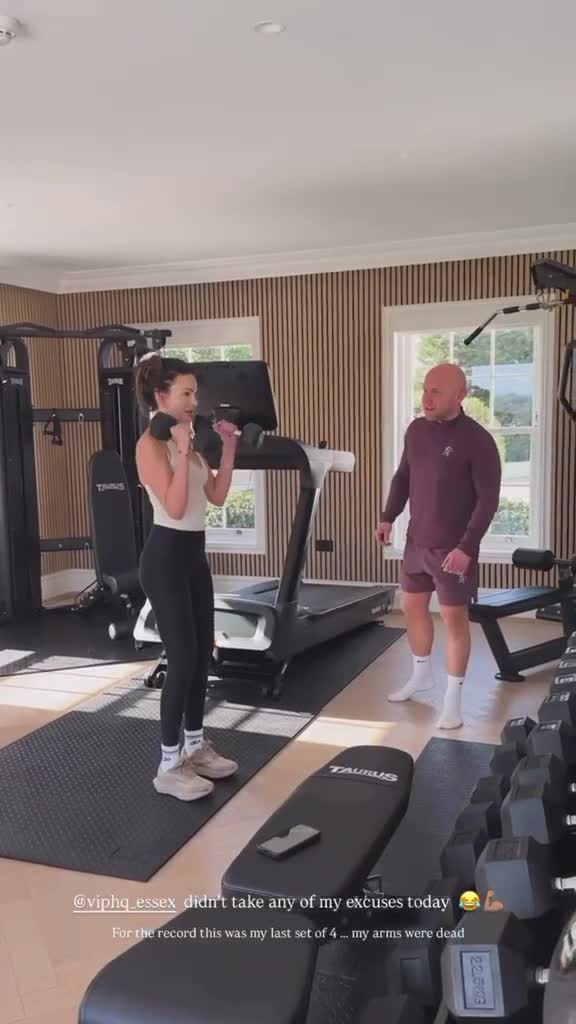
Shortly after giving birth to baby Palma 18 months ago, Michelle Keegan overhauled her fitness routine. Working with coach Danny-Lee Finch, The Blame star introduced one key change: progressive weight training. ‘Progressive weight training – which means weight training that always challenges her more than the previous session, by lifting heavier or performing more reps – has completely transformed Michelle’s physique,’ Lee-Finch tells Women’s Health.
‘She’s become noticeably leaner, significantly stronger and has built more definition [meaning her muscles have become more visible, by increasing her muscle mass and lowering body fat]. Her training had become repetitive and motivation had naturally dipped, but by tracking improvements, constantly adapting the programme and making sure there’s always a new challenge to work towards, she’s constantly progressing.’
Instagram @michkeegan
Better still, her results come from just two-three hours per week. ‘We train just two to three times per week, for an hour at a time,’ Lee-Finch shares. Keegan, 39, and husband Mark Wright have also implemented a simple new routine to account for baby Palma. ‘Rather than training together, they now take it in turns, so one of them looks after Palma while the other trains. It works brilliantly for their family and has allowed them to stay committed to their fitness despite the demands of parenthood,’ Lee-Finch adds.
When we ask Lee-Finch what makes his workouts so effective, there’s a clear focus: ‘We mainly use isolation exercises which target individual muscle groups, to allow us to really focus on developing specific areas, and each workout focuses on specific muscles to maximise results,’ he explains. For example, one workout will train her legs, another will train her upper body – a concept known as workout splits.

@michkeegan//Instagram
How he structures each session is deliberate, too. ‘Each workout starts with heavier weights to stimulate strength and muscle growth while Michelle has the most energy, before reducing the load and incorporating drop sets – a technique where you lift a heavy weight until you cannot do another repetition, then immediately reduce the weight and keep lifting without resting – to fully fatigue her muscles. It comes back to that progressive overload. We want to leave every workout knowing we’ve pushed as hard as we could and made use of every minute in that hour.’

Marc Piasecki//Getty Images
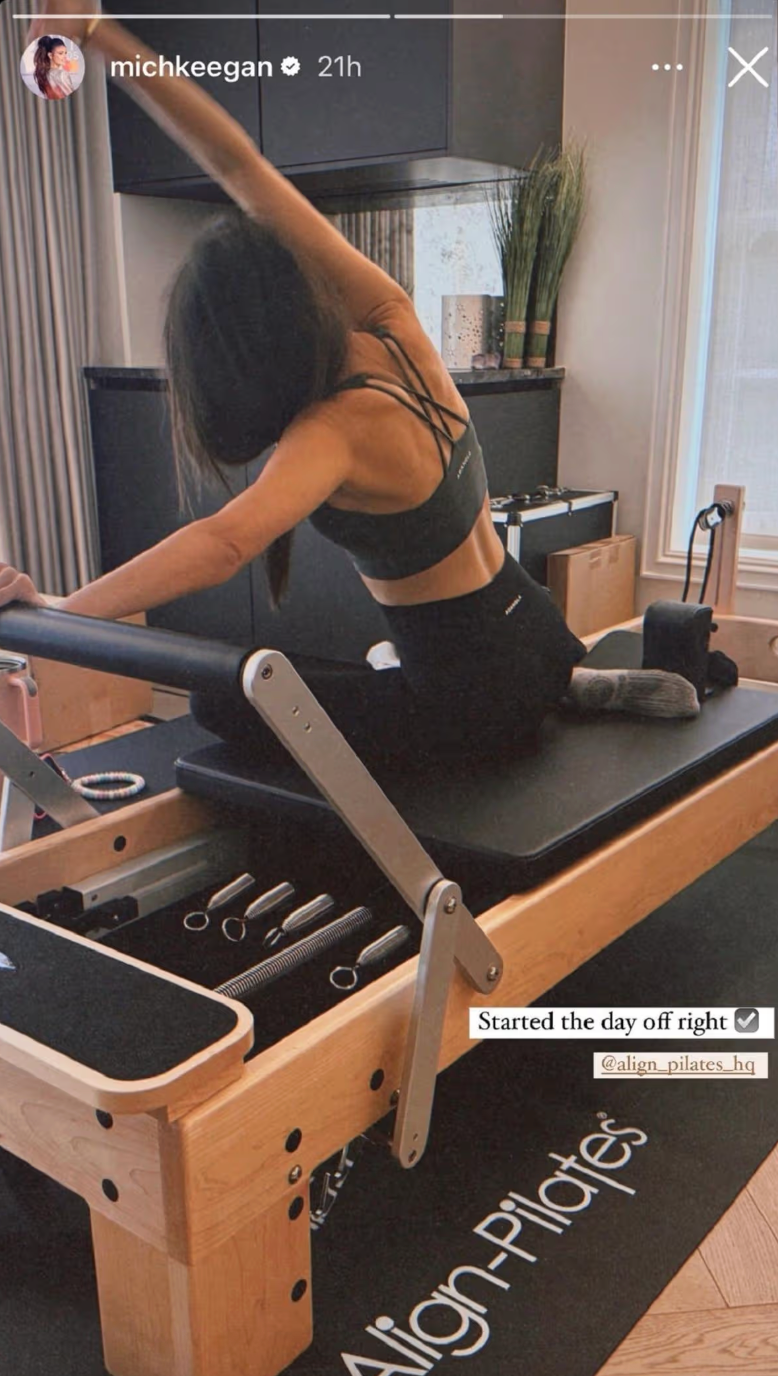
Every session finishes with punches on a boxing pad. ‘It’s a great way to improve fitness, coordination and leave the session on a high,’ Lee-Finch says. ‘Outside of our PT sessions, she regularly attends reformer Pilates, which complements her strength work perfectly by improving mobility, core strength and overall movement.’ Below, find the exact 7-move lower-body strength workout she does weekly.
 @michkeegan//Instagram
Michelle regularly attends reformer Pilates alongside weight training
Michelle Keegan’s lower-body workoutWarm up:Incline treadmill walk: 6 minutes (8-12% incline, steady pace)Mini band glute bridges: 2 x 15 repsReformer footwork: 2 x 15 repsReformer single-leg presses: 2 x 12 reps each legReformer scooter lunges: 2 x 12 reps each legMain workout:Finisher:Boxing pad: 4 rounds x 2 minsHow often to do the workout
Lee-Finch recommends doing the workout once a week, alongside one upper-body and one full-body session.

As Women’s Health UK’s fitness director and a qualified Pilates and yoga instructor, Bridie Wilkins has been passionately reporting on exercise, health and nutrition since the start of her decade-long career in journalism.
After earning a first-class degree in journalism and NCTJ accreditation, she secured her first role at Look Magazine, where she launched the magazine’s health and fitness column, Look Fit, before going on to become Health and Fitness writer at HELLO!
Since, she has written for Stylist, Glamour, Cosmopolitan, Marie Claire, Elle, The Metro, Runner’s World and Red. Today, she oversees all fitness content across Women’s Health online and in print, spearheading leading cross-platform franchises, such as ‘Fit At Any Age’, which showcases the women proving that age is no barrier to exercise.
She has also represented the brand on BBC Radio London, plus various podcasts and Substacks – all with the aim to encourage more women to exercise and show them how. Outside of work, find her trying the latest Pilates studio, testing her VO2 max for fun (TY, Oura), or posting workouts on Instagram.