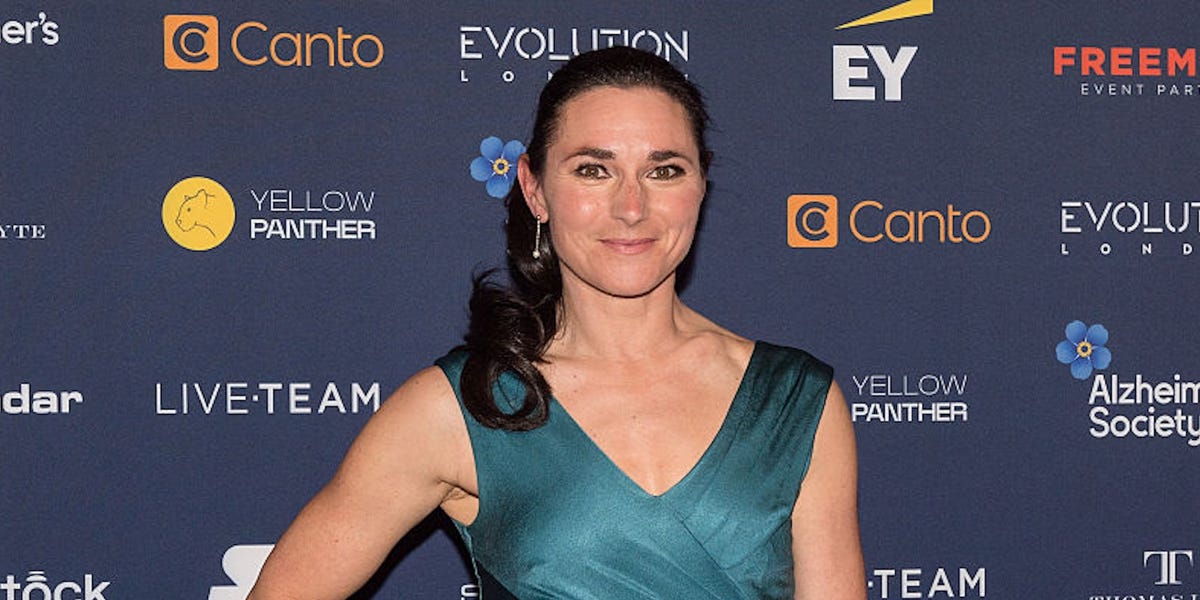
It’s 9.45 am on a Monday in September, and Dame Sarah Storey is about to enter her first full day of rehearsal for the 24th series of Strictly Come Dancing.
‘This morning, we’re going through some of the fundamentals and then the film crew capture my reaction to the details of my first routine being shared with me,’ she tells WH.
‘I haven’t found out my first musical style yet. We won’t know far in advance – every week I’ll get that surprise of what I’m doing immediately next,’ she says.
Not having a plan of action is new for the cyclist and swimmer, who – with 19 gold medals, 29 World Champion titles, six British national track championship titles and 75 world records to her name – is one of the most decorated Paralympic athletes of all time and the most successful British Paralympian.
‘I’ve spent the last 20 years doing my own training and designing my own programmes, but 1789921210 I’m not…[in] control of what happens,’ she acknowledges.
‘This is where psychological skills come in, though,’ she says, without missing a beat. ‘You have to be adaptable and keep an open mind.’
What she is more certain of, though, is that the rehearsals will be rigorous.
‘My educated guess [is that] training takes around seven or eight hours in the day, if you’ve got that much time around work,’ she says.
‘The breakdown is a mixture of a warm up and cool down at either end of the day, learning the steps, doing the actual routine, and learning other dance styles to [support the current choreography].’
Sarah’s pre-Strictly training approach
Since Sarah announced her withdrawal from professional racing in July, she’s committed to a training routine that will keep her fit for the long-term – a combination of cycling, running, strength training and Pilates.
Being capable enough for Strictly is therefore an added benefit, and she didn’t really ramp up her training after joining the dance competition line up.
‘[My routine is] for life,’ she reflects. ‘Without knowing anything about dance training, I decided if I could be physically fit, mobile and strong, then that would put me in a good spot for what’s to come.’
Her weekly routine
Sarah’s training usually ends up taking between six and 12 hours a week, and comprises:
2-3 bike rides – usually 1 hour 30 minutes to 1 hour 45 minutes if she’s commuting home from work, though they can extend up to 3 hours.2-3 runs – 30 minutes to an hour. ‘I either do that on the treadmill in the gym or go out on the trails near my home,’ she says. 3-4 Pilates sessions – ‘It depends on how much time I have, but these are around 15-20 minutes done little and often and can be a sort of cardio session.’2 strength sessions – ‘These are focused around specific exercises and they take about 20 minutes,’ she shares.
In particular, she’s been building up strength around her ankle, which she broke nearly two years ago while training for Dancing on Ice in December 2024.
‘It was a double fracture-dislocation – one of the worst ankle injuries you could have,’ she reveals. ‘To prepare for the rigours of the dance training, I wanted a solid rehab and prehab programme, to make sure that those ligaments are ready and strong.’
Her workout routine is robust, but one type of exercise she’s scaled back recently is HIIT.
‘I’ve found I can’t do so many of those short, really high-intensity workouts,’ she says. ‘Perimenopause has really affected HIIT. So you’re better off focusing on one or two of those a week at most.’
Why consistency is important
‘I’ve focused on regularity of training rather than trying to do anything too heroic or reach [my usual] hours as a professional athlete,’ she says.
‘It very much depends on work and life and kids,’ she continues. ‘Everything has to be very manageable around a “normal” life, otherwise it’s not sustainable.’
For that reason, her movement is sometimes broken up into shorter chunks, but she makes sure to do something every day.
‘I make sure to do at least half an hour of something, even if it’s just a quick walk to clear my head if I’ve had a busy week.’
The areas and exercises she’s focused onCore strength
Sarah’s core strength is solid. ‘It’s going to really help me – I’ll be able to contribute during the lifts,’ she says.
Dead bugs
‘I do dead bugs and different balances with weights – the maximum I use is a 10kg kettlebell, just enough to strengthen the abs in a lengthened position,’ she adds. ‘I also do banded glute bridges.’
Reformer Pilates leg circles
‘In Pilates, we have our feet in the straps and you pull your legs out to the side and do circles, taking your feet down to the foot bar together, keeping your hips down and your back down,’ she continues.
When she doesn’t have a reformer machine to hand, Sarah will do those circles with a foam roller while wearing ankle weights.
Ankle and hip strength
Sarah’s worked hard to build strong ankles and develop good mobility through her legs.
‘I think that will help with any of the high kicks or the general mobility that you have to have as a dancer,’ she anticipates. ‘You wouldn’t know that I’d had an ankle injury less than two years ago.’
She also does deep squats where she pushes her knees out with her elbows to improve the movement in her hips.
Calf raises
Sarah does a lot of controlled calf raises with weights.
‘Straight leg calf raises, bent knee calf raises, sumo squats with a heel raise,’ she reels off.
Standing knee raise to leg extension
‘You stand on a step with the kettlebell on the floor, you hook your foot into the handle of the kettlebell, you lift your knee up to 90 degrees and then you straighten your leg. Then as you lower your leg, don’t put the kettlebell down,’ Sarah explains.
‘It’s good for running, and for hip flexor strength,’ she shares. ‘Although I’ve discovered that that’s not so good for the jive – I’m going to need to learn to point my toes!’
Balance
‘I have good balance because I’ve had to be [stable] on my right leg when my left was broken,’ she says.
‘I have also worked really hard to regain balance on my left leg because when you break your ankle, all of the nerves and ligaments are completely destroyed.’
One of our most frequently asked questions here at Women’s Health? How to build muscle and burn fat at the same time. So, we asked superstar trainer Oyinda Okunowo exactly how to do it. In this 4-week plan – created exclusively for Women’s Health COLLECTIVE members – you’ll get the workouts and nutrition guidance needed to help you on your way to better body composition. Tap the link below to unlock 14 days of free access to Oyinda’s plan and start training today.