

It’s a buzz word. Push your trolley down any supermarket aisle and you’ll be bombarded by labels boasting about levels of it. You can sip it in shakes, nibble it in bars, shake in powders. But do you know how much protein you really need on a daily basis, or how to get it?
Proteins are known as ‘the building blocks of life’, explains British Heart Foundation senior dietitian Tracy Parker. Once eaten, they break down into amino acids needed to fix damaged cells and build new tissue. Your body can’t make all nine of these vital amino acids, so you really do need to get enough through the foods you eat. This is a little simpler for those who eat meat, since animal protein contains all nine, but trickier for vegetarians since only a few plant-based foods – including soy protein, quinoa and the meat alternative Quorn – are considered ‘complete’.

O2O CREATIVE//Getty Images
Still, in the UK, the Reference Nutrient Intake (RNI) is set at 0.75 g of protein per kilogram bodyweight per day in adults. So an adult weighing 75kg will need around 56g a day, which doesn’t sound too daunting. The British Heart Foundation suggests that the protein portion of every meal should fit roughly into the palm of your hand.
Here’s where it gets a little more complicated, though. People over 65 are advised to eat quite a bit more – about 1g to 1.2g of protein per kg of bodyweight per day, meaning that if you weigh 75kg, you’d need around 75g to 90g a day.
Why? Boosting your protein intake is vital to combat age-related muscle loss (sarcopenia). It’s also essential for preserving bone mass – a particular problem for women, as the first decade following menopause is a critical period of accelerated bone loss.
Important, then. But not easy. ‘I was just making a note of [my protein intake] and realising that I am really falling short, and I actually try quite hard,’ shares wellness expert Liz Earle in a new video. To top up her levels, she makes a shake with a scoop of protein powder and some Greek yogurt – both easy ways to boost protein fast.
She also keeps cottage cheese in the fridge – an excellent source, as 100g delivers around 11 to 12g protein. Still, she points out, ‘I’ve been jotting down some ideas here for the week and you’ve really got to try quite hard.’ Grab a cheese sandwich for lunch, and you’re likely only to get 20g of protein, while one egg is only 6 or 7g.
 Claudia Totir//Getty Images
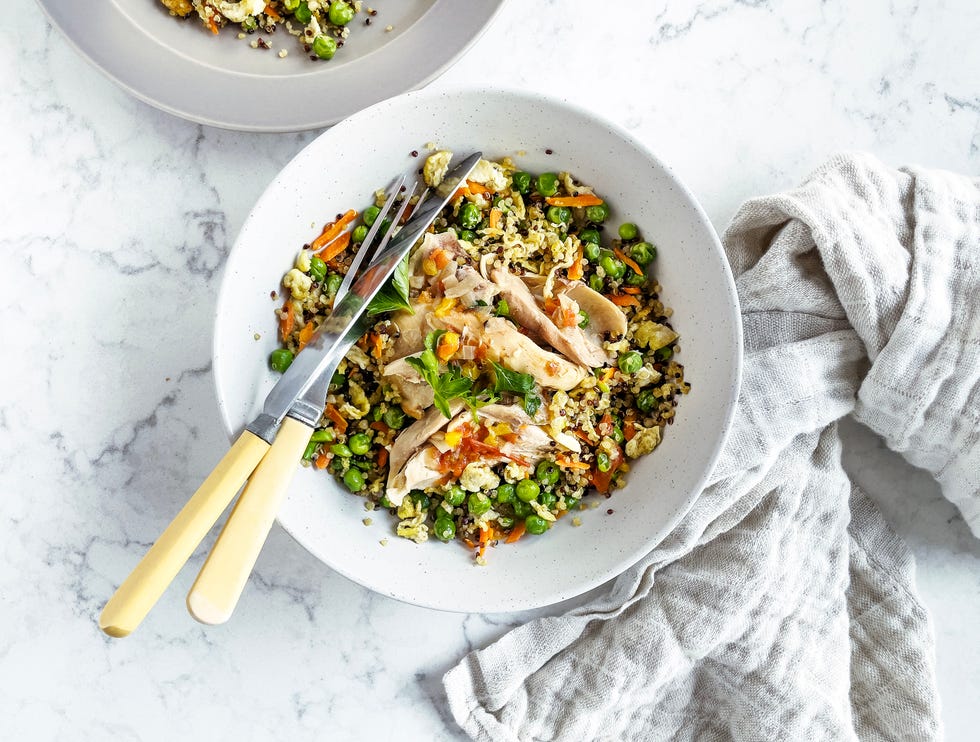
Bowl of quinoa salad with chicken and vegetables.
The challenge is compounded for Liz, who typically eats only two meals a day (brunch and supper), meaning she needs to get 45g of protein into each. Here are some simple ways she manages it…
The 40g breakfast
300g Greek yoghurt, some walnuts, plus a scoop of protein powder (the GHI’s top pick is Optimum Nutrition Gold Standard Whey, since each serving contains an impressive 24g of protein and our panellists were big fans of the silky smooth texture).
The 42g brunch or lunch
Three large eggs, 100g smoked salmon, an avocado salad and some pumpkin seeds.
The 50g supper
A skinless cooked chicken breast will automatically take you to around 50g protein, while a cod fillet will give you around 30g. Add salad and sides of your choice.