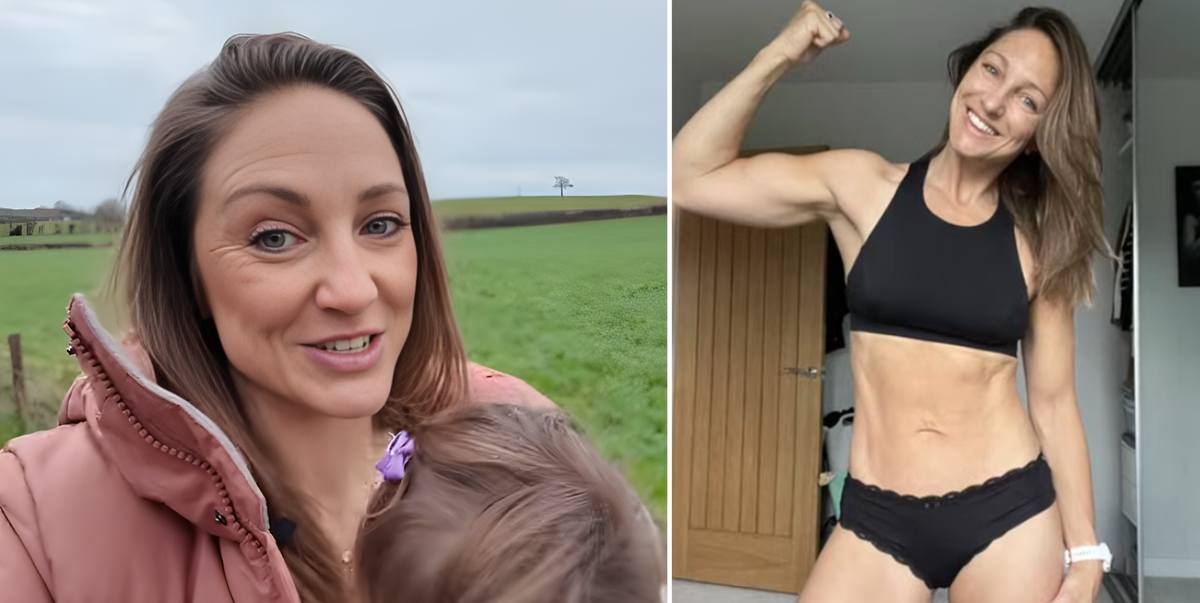
It’s easy to assume you need hours of cardio or a workout that leaves you drenched in sweat for it to ‘count’ – especially if fat loss is your goal. But weight-loss coach, Founder of Body Smart, and busy mum Stacey Jones says that mindset misses the point. ‘Walking gives you huge reward for not that much effort in terms of time or intensity level,’ she explains.
In fact, it was walking that helped Jones lose 50lbs (22.7kg) of body fat during her 30s. Here are the seven techniques she says made the biggest difference.
1. Stop obsessing over 10,000 steps
Referencing the widely cited 10,000-steps-a-day target – which originated as part of a pedometer marketing campaign – Jones says she prefers to aim for 8,000 steps instead.
‘The research actually shows that 8,000 steps cuts your risk of dying early by 15%. And for the average woman with 30 to 50lbs (14kg to 23kg) to lose, 8,000 steps is still around a 400-calorie burn per day,’ she explains.
On paper, the 2,000-step gap between 8,000 and 10,000 may not sound like much. In practice, it can be the difference between consistency and frustration. ‘I just follow my daily routine and about 80% of the time I’ll hit 9,000 without having to try that hard,’ says Jones. ‘But if I aim for 10,000, there are just too many days where I’m not hitting my goal.’
Start with your current daily count to work out your target number.
Rather than jumping straight to 8,000, Jones recommends working from your baseline. Add around 25% to your current daily average and build from there.
‘Building that little extra into your routine in a realistic way is much more conducive to consistency,’ she says.
She also suggests thinking in weekly averages rather than rigid daily targets. ‘If you can’t hit 8k every single day, then what about 56k over the week? Chipping away makes it happen without feeling like another big task you need to factor in.’
Hourly movement reminders on her watch help keep her accountable. ‘It’s like a little nudge as the day goes on,’ she says. ‘Even with a desk job, it helps me get my steps in.’
2. Walk after meals
Jones explains that going for a stroll after eating helps you stay in a calorie deficit (burning more calories than you take in) if fat loss is your goal. Walking helps stabilise your blood sugar, because your muscles use some of the glucose in the food you’ve eaten to help you move.
‘That means there’s less sugar floating around in your bloodstream,’ Jones says. ‘So you’re not having those blood sugar peaks and crashes which leave you with wild cravings.’ This absence of cravings and subsequent snacking means it’s easier to stay in the calorie deficit necessary for fat loss.
Jones adds that post-meal walking also lowers the hormone ghrelin, which makes you feel hungry, and improves digestion by stimulating movement in your gut, making sleep easier.
Good sleep, in turn, reduces ghrelin and increases leptin (the hormone signalling to your brain that you’re full) and resets your cortisol, regulating your appetite and making overeating less likely, says Jones.
Stacey Jones//YouTube
3. Take a morning walk
A walk shortly after waking exposes you to morning light, regulating your circadian rhythm. ‘Getting your circadian rhythm back on track is [important] when it comes to weight loss,’ Jones says, ‘because when it’s out of sync from late nights, too much stress or too much screen time, your body starts pumping out cortisol.’
High cortisol’s adverse effects mustn’t be ignored. ‘It makes you crave sugar. It messes with your sleep, your hunger, your energy levels,’ Jones warns. Walking lowers cortisol, decreasing appetite and making it easier to stay in a calorie deficit.
A walk also helps you stay calmer throughout the day. ‘It’s as much a mindset hack as a practical one,’ says Jones. ‘You’re getting natural light and fresh air. Your mind clears. You feel ready to handle the day instead of reacting from the moment you wake up, helping you to make better food choices.’
And of course, it adds to your step count. ‘If you start your day with three or four thousand steps already ticked off, it suddenly feels a lot more doable to hit your overall daily goal,’ says Jones.
4. Use the Japanese interval walking method
Japanese walking is simple but highly effective: you walk for three minutes at a steady pace, three minutes at a fast pace, and repeat that pattern for 30 minutes. ‘It’s interval training but walking,’ explains Jones. ‘Japanese scientists found that it can raise your cardio fitness by 10%, make your legs up to 17% stronger, and drop your blood pressure by around 10 points, all in five months in just 30 minutes a day.’
When it comes to fat loss, compared to a steady-state walk, research shows that moving at vary paces means you’re going to burn around 20% more calories in the same time. Jones suggests that the Japanese method uses 30% more: ‘So if you’re about 190lb (86kg) woman, you’ll burn about 150 calories in half an hour on a regular-paced walk, but if you do this Japanese method, you’ll burn about 200.’
5. Add inclines
Walking on an incline burns up to 70% more calories, because now you’re lifting your body against gravity, suggests Jones. One study backs her up, finding that a 5% incline increased energy expenditure by 52% and a 10% incline 113% compared with flat walking. ‘This is largely because there’s more muscle engagement, especially in your calves, your glutes, and your hamstrings,’ says Jones.
In weight-loss terms, your body uses more energy per minute than it does walking on flat ground, even at the same speed and distance. ‘So,’ Jones continues, ‘for a 190lb (86kg) woman doing a 30-minute walk, flat terrain burns around 150 calories. A 5% incline at the same speed burns around 195 calories and a 10% incline 250 calories.’
6. Add weight
Adding extra load – through, say, wearing a weighted vest – is an easy way to burn some extra calories, because moving more weight through space takes more energy. Research confirms this, with one study showing that metabolic cost – energy expenditure – increases with vest load.
‘Wearing a vest that’s 10% of your body weight will add 10 to 15% more calories than walking the same distance unweighted,’ Jones says.
7. Make walking part of your NEAT exercise
Non-exercise activity thermogenesis, or NEAT, simply refers to the energy used to carry out any daily activity that isn’t formal exercise (eg, running, resistance training) or sleeping.
Many of these activities involve walking, adding to your total energy expenditure. ‘[Examples include] housework, running around after your kids, taking the dog out or completing errands,’ explains Jones. It’s an easy way to get extra movement in without consciously trying.
‘Make a drink, walk over and speak to a colleague instead of messaging them. Use the furthest away bathroom possible,’ Jones suggests. ‘Clear your inbox while you pace the room. If you’re at home, deal with some laundry or put away things upstairs. Park further away. Just get moving.’
Related Stories