
Bowles, S. & Gintis, H. A cooperative species: human reciprocity and its evolution. (Princeton Univ. Press, 2011).
Tomasello, M. Why We Cooperate (MIT, 2009).
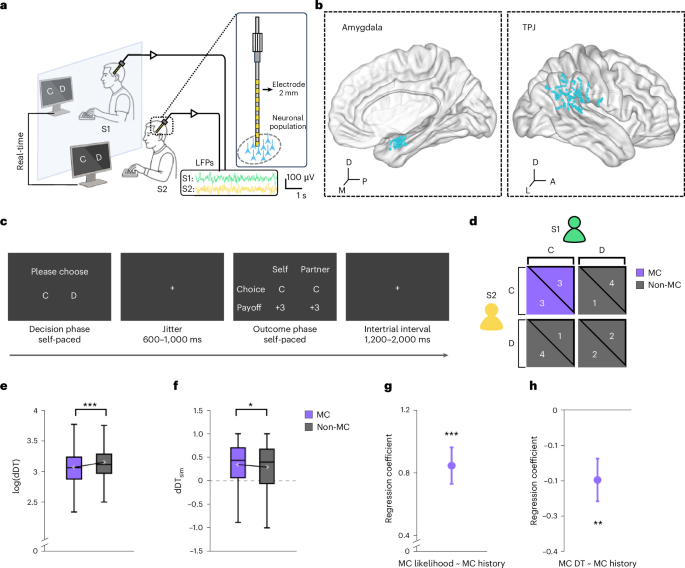
Wang, J. et al. Simultaneous intracranial recordings of interacting brains reveal neurocognitive dynamics of human cooperation. Nat. Neurosci. 28, 161–173 (2025).
Balliet, D. & Lindström, B. Inferences about interdependence shape cooperation. Trends Cogn. Sci. 27, 583–595 (2023).
Nash, J. F. The bargaining problem. Econometrica 18, 155–162 (1950).
Axelrod, R. & Hamilton, W. D. The evolution of cooperation. Science 211, 1390–1396 (1981).
Dawes, R. M. Social dilemmas. Annu. Rev. Psychol. 31, 169–193 https://doi.org/10.1146/annurev.ps.31.020180.001125 (1980).
Frith, C. D. & Frith, U. The neural basis of mentalizing. Neuron 50, 531–534 (2006).
Fehr, E. & Camerer, C. F. Social neuroeconomics: the neural circuitry of social preferences. Trends Cogn. Sci. 11, 419–427 (2007).
Tomasello, M., Carpenter, M., Call, J., Behne, T. & Moll, H. Understanding and sharing intentions: the origins of cultural cognition. Behav. Brain Sci. 28, 675–691 (2005).
Yoshida, W., Dolan, R. J. & Friston, K. J. Game theory of mind. PLoS Comput. Biol. 4, e1000254 (2008).
Utz, S. Self-construal and cooperation: Is the interdependent self more cooperative than the independent self?. Self Identity 3, 177–190 (2004).
Moeller, S. et al. Human and macaque pairs employ different coordination strategies in a transparent decision game. eLife 12, e81641 (2023).
Tomasello, M., Melis, A. P., Tennie, C., Wyman, E. & Herrmann, E. Two key steps in the evolution of human cooperation: the interdependence hypothesis. Curr. Anthropol. 53, 673–692 (2012).
Rilling, J. K. et al. A neural basis for social cooperation. Neuron 35, 395–405 (2002).
Liu, Y. et al. Oxytocin modulates social value representations in the amygdala. Nat. Neurosci. 22, 633–641 (2019).
Gangopadhyay, P., Chawla, M., Dal Monte, O. & Chang, S. W. Prefrontal–amygdala circuits in social decision-making. Nat. Neurosci. 24, 5–18 (2021).
Kingsbury, L. et al. Correlated neural activity and encoding of behavior across brains of socially interacting animals. Cell 178, 429–446 (2019).
Zhang, W. & Yartsev, M. M. Correlated neural activity across the brains of socially interacting bats. Cell 178, 413–428 (2019).
Premack, D. & Woodruff, G. Does the chimpanzee have a theory of mind?. Behav. Brain Sci. 1, 515–526 (1978).
Frith, C. & Frith, U. Theory of mind. Curr. Biol. 15, R644–R645 (2005).
Suzuki, S., Niki, K., Fujisaki, S. & Akiyama, E. Neural basis of conditional cooperation. Soc. Cogn. Affect. Neurosci. 6, 338–347 (2011).
Veissière, S. P., Constant, A., Ramstead, M. J., Friston, K. J. & Kirmayer, L. J. Thinking through other minds: a variational approach to cognition and culture. Behav. Brain Sci. 43, e90 (2020).
Wu, H., Liu, X., Hagan, C. C. & Mobbs, D. Mentalizing during social InterAction: a four component model. Cortex 126, 242–252 (2020).
Báez-Mendoza, R., Mastrobattista, E. P., Wang, A. J. & Williams, Z. M. Social agent identity cells in the prefrontal cortex of interacting groups of primates. Science 374, eabb4149 (2021).
Tulving, E. Episodic and semantic memory. Organization of Memory 1, 1 (1972).
Manning, J. R., Polyn, S. M., Baltuch, G. H., Litt, B. & Kahana, M. J. Oscillatory patterns in temporal lobe reveal context reinstatement during memory search. Proc. Natl Acad. Sci. USA 108, 12893–12897 (2011).
Kriegeskorte, N., Mur, M. & Bandettini, P. A. Representational similarity analysis—connecting the branches of systems neuroscience. Front. Systems Neurosci. 2, 249 (2008).
Chen, J. et al. Shared memories reveal shared structure in neural activity across individuals. Nat. Neurosci. 20, 115–125 (2017).
Feng, C., Yan, X., Huang, W., Han, S. & Ma, Y. Neural representations of the multidimensional self in the cortical midline structures. Neuroimage 183, 291–299 (2018).
Parvizi, J. & Kastner, S. Promises and limitations of human intracranial electroencephalography. Nat. Neurosci. 21, 474–483 (2018).
Foster, B. L., Rangarajan, V., Shirer, W. R. & Parvizi, J. Intrinsic and task-dependent coupling of neuronal population activity in human parietal cortex. Neuron 86, 578–590 (2015).
Pacheco Estefan, D. et al. Coordinated representational reinstatement in the human hippocampus and lateral temporal cortex during episodic memory retrieval. Nat. Commun. 10, 2255 (2019).
Ten Oever, S., Sack, A. T., Oehrn, C. R. & Axmacher, N. An engram of intentionally forgotten information. Nat. Commun. 12, 6443 (2021).
Yang, J., Zhang, H., Ni, J., De Dreu, C. K. & Ma, Y. Within-group synchronization in the prefrontal cortex associates with intergroup conflict. Nat. Neurosci. 23, 754–760 (2020).
Dikker, S. et al. Brain-to-brain synchrony tracks real-world dynamic group interactions in the classroom. Curr. Biol. 27, 1375–1380 (2017).
Grabenhorst, F., Báez-Mendoza, R., Genest, W., Deco, G. & Schultz, W. Primate amygdala neurons simulate decision processes of social partners. Cell 177, 986–998 (2019).
Haroush, K. & Williams, Z. M. Neuronal prediction of opponent’s behavior during cooperative social interchange in primates. Cell 160, 1233–1245 (2015).
Koster-Hale, J. & Saxe, R. Theory of mind: a neural prediction problem. Neuron 79, 836–848 (2013).
Canolty, R. T. & Knight, R. T. The functional role of cross-frequency coupling. Trends Cogn. Sci. 14, 506–515 (2010).
Tan, H. et al. Intracranial EEG signals disentangle multi-areal neural dynamics of vicarious pain perception. Nat. Commun. 15, 5203 (2024).
Seidenbecher, T., Laxmi, T. R., Stork, O. & Pape, H. C. Amygdalar and hippocampal theta rhythm synchronization during fear memory retrieval. Science 301, 846–850 (2003).
Karalis, N. et al. 4-Hz oscillations synchronize prefrontal–amygdala circuits during fear behavior. Nat. Neurosci. 19, 605–612 (2016).
Moreau, Q., Adel, L., Douglas, C., Ranjbaran, G. & Dumas, G. A neurodynamic model of inter-brain coupling in the gamma band. J. Neurophysiol. 128, 1085–1090 (2022).
Hsu, M., Bhatt, M., Adolphs, R., Tranel, D. & Camerer, C. F. Neural systems responding to degrees of uncertainty in human decision-making. Science 310, 1680–1683 (2005).
Stolyarova, A. et al. Contributions of anterior cingulate cortex and basolateral amygdala to decision confidence and learning under uncertainty. Nat. Commun. 10, 4704 (2019).
Likhtik, E., Stujenske, J. M., Topiwala, A. M., Harris, A. Z. & Gordon, J. A. Prefrontal entrainment of amygdala activity signals safety in learned fear and innate anxiety. Nat. Neurosci. 17, 106–113 (2014).
Gründemann, J. et al. Amygdala ensembles encode behavioral states. Science 364, eaav8736 (2019).
Gore, F. et al. Neural representations of unconditioned stimuli in basolateral amygdala mediate innate and learned responses. Cell 162, 134–145 (2015).
Rand, D. G., Greene, J. D. & Nowak, M. A. Spontaneous giving and calculated greed. Nature 489, 427–430 (2012).
Xie, W., Bainbridge, W. A., Inati, S. K., Baker, C. I. & Zaghloul, K. A. Memorability of words in arbitrary verbal associations modulates memory retrieval in the anterior temporal lobe. Nat. Human Behav. 4, 937–948 (2020).
Stangl, M. et al. Boundary-anchored neural mechanisms of location-encoding for self and others. Nature 589, 420–425 (2021).
Stieger, J. R. et al. Cross-regional coordination of activity in the human brain during autobiographical self-referential processing. Proc. Natl Acad. Sci. USA 121, e2316021121 (2024).
Lopez-Persem, A. et al. Four core properties of the human brain valuation system demonstrated in intracranial signals. Nat. Neurosci. 23, 664–675 (2020).
Costa, M. et al. Human hippocampal reactivation of amygdala encoding-related gamma patterns during aversive memory retrieval. Nat. Commun. 16, 6820 (2025).
Pacheco-Estefan, D. et al. Representational dynamics during extinction of fear memories in the human brain.Nat. Commun. 10, 29–48 (2026).
Philippe, R. et al. Neurocomputational mechanisms involved in adaptation to fluctuating intentions of others. Nat. Commun. 15, 3189 (2024).
Babür, B. G., Leong, Y. C., Pan, C. X. & Hackel, L. M. Neural responses to social rejection reflect dissociable learning about relational value and reward. Proc. Natl Acad. Sci. USA 121, e2400022121 (2024).
Lamba, A., Frank, M. J. & FeldmanHall, O. Anxiety impedes adaptive social learning under uncertainty. Psychol. Sci. 31, 592–603 (2020).
Gershman, S. J. Empirical priors for reinforcement learning models. J. Math. Psychol. 71, 1–6 (2016).
Stephan, K. E., Penny, W. D., Daunizeau, J., Moran, R. J. & Friston, K. J. Bayesian model selection for group studies. Neuroimage 46, 1004–1017 (2009).
Stolk, A. et al. Integrated analysis of anatomical and electrophysiological human intracranial data. Nat. Protoc. 13, 1699–1723 (2018).
Fonov, V. et al. Unbiased average age-appropriate atlases for pediatric studies. Neuroimage 54, 313–327 (2011).
Oostenveld, R., Fries, P., Maris, E. & Schoffelen, J. M. FieldTrip: open source software for advanced analysis of MEG, EEG, and invasive electrophysiological data. Comput. Intell. Neurosci. 2011, 156869 (2011).
Fischl, B. FreeSurfer. Neuroimage 62, 774–781 (2012).
Ashburner, J. & Friston, K. J. Unified segmentation. Neuroimage 26, 839–851 (2005).
Parish, G. M., Michelmann, S. & Hanslmayr, S. How should I re-reference my intracranial EEG data? In Intracranial EEG: A Guide for Cognitive Neuroscientists (ed. Axmacher, N.) 451–473 (Springer International Publishing, 2023).
Laquitaine, M. et al. Optimal level of human intracranial theta activity for behavioral switching in the subthalamo-medio-prefrontal circuit. Nat. Commun. 15, 7827 (2024).
Cohen, M. X. Analyzing Neural Time Series Data: Theory and Practice (MIT, 2014).
Bijanzadeh, M. et al. Decoding naturalistic affective behaviour from spectro-spatial features in multiday human iEEG. Nat. Human Behav. 6, 823–836 (2022).
Hülsemann, M. J., Naumann, E. & Rasch, B. Quantification of phase-amplitude coupling in neuronal oscillations: comparison of phase-locking value, mean vector length, modulation index, and generalized-linear-modeling cross-frequency-coupling. Front. Neurosci. 13, 573 (2019).
Davis, M. H. A Multidimensional Approach to Individual Differences in Empathy (Univ. Texas at Austin, 1980).
Murphy, R. O., Ackermann, K. A. & Handgraaf, M. J. Measuring social value orientation. Judgm. Decis. Mak. 6, 771–781 (2011).
Freeston, M. H., Rhéaume, J., Letarte, H., Dugas, M. J. & Ladouceur, R. Why do people worry? Personal. Individ. Differ. 17, 791–802 (1994).