
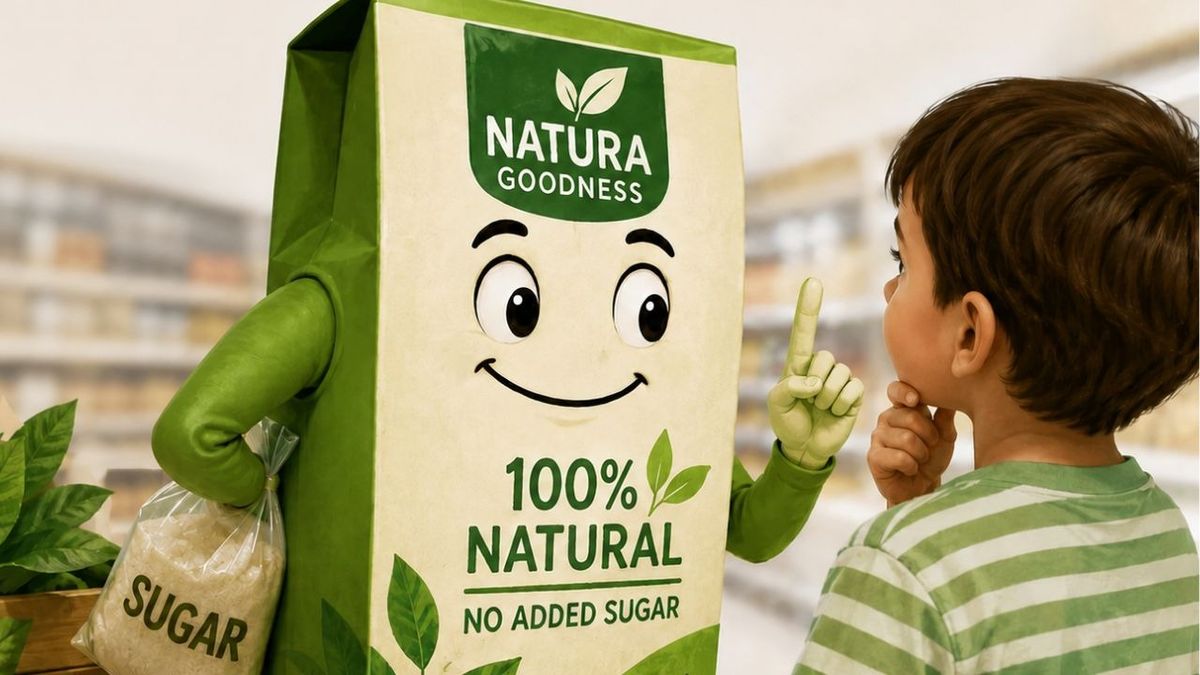
When the Food Safety and Standards Authority of India (FSSAI) recently asked The Whole Truth to drop the phrase “No Added Sugar” from parts of its packaging, it brought to mind an unlikely cultural reference: Johnny Johnny Yes Papa. The rhyme begins with a simple question, “Eating sugar?”, followed by an equally confident denial, “No Papa.” Only when the follow-up arrives, “Telling lies?”, does the performance begin to crack. Much like the world of health food marketing, where products marketed as “clean”, “natural”, or “better-for-you”, often rely on carefully constructed claims that can appear healthier than they really are.
For decades, Indian parents were told a malted drink would make their child grow “taller, stronger and sharper.” Another brand claimed its nutritional drink could help children grow twice as fast. A breakfast cereal campaign suggested that eating low-fat foods in the morning was associated with staying slimmer, without citing supporting evidence. A cooking oil positioned itself as heart-friendly and capable of reducing cholesterol. Each of these brands, at various points in time, came under the scanner of the FSSAI for making unsubstantiated health claims. And yet, for years, these messages shaped how millions of families shopped.
The vocabulary has since evolved, but the underlying dynamic has not. Today’s packaging speaks in cleaner, safer language. “Multigrain.” “No added sugar.” “Natural.” “Made with millets.” “Immunity-boosting.” These claims appear in bold on biscuit packs, protein bars, breakfast cereals, and packaged juices, asking consumers to believe they are making a responsible choice.
While The Whole Truth modified and withdrew some of these claims and replaced “No Added Sugar” on certain products with “Sweetened with Dates”, the debate over health marketing is no longer limited to legacy packaged-food giants; even brands positioning themselves as cleaner and more transparent alternatives are being tested on where exactly the line lies between consumer-friendly communication and potentially misleading health claims.
The more useful question, however, is what the back label says.
What the front label doesn’t tell you
Nutritionist Kinita Kadakia Patel, a metabolic and body transformation specialist with over two decades of experience, has watched this pattern become common practice across the packaged food industry. “Many products, when flipped to read the fine print of the ingredient list or nutrition value table, have a significant amount of added sugars, syrups, refined flours, completely negating the health benefits and making the product unhealthy,” she says.
The front label is designed to capture attention and build trust. “For instance, the front- of a packaged food product may have claims such as “low-fat”, “high-protein”, “multigrain”, “natural”, “no palm oil”, “baked, not fired”, etc… which are designed to immediately capture consumers attention and build trust, leading them to assume the product is healthy and suitable for them,” Patel notes.
What they rarely do is prompt a consumer to turn the pack over. This gap between the front and the back of a product is not incidental. It is, in many cases, the point.
A 2024 study titled Fifty Shades of Food Advertising, published by the Nutrition Advocacy in Public Interest (NAPi), analysed 50 food and beverage advertisements and found that not a single one disclosed the amounts of sugar, salt, or fat in the product. Nearly half the ads featured Bollywood and sports celebrities, and emotional appeals around romance, aspiration, and belonging appeared in 22 of the 50 advertisements examined.
The brands that appear in these advertisements are not selling nutrition as much as they are selling reassurance. Anxieties differ by audience. For parents with young children, it is height and immunity. For adults managing weight, it is low-fat or low-calorie. For those wary of processed food, it is “natural” or “Ayurvedic.” Each claim is targeted, and the targeting is deliberate.
Ravi Putrevu, Co-founder and CEO of NatFirst, parent company of TruthIn, a product-rating platform that has analysed over 75,000 currently sold packaged food products in India, identifies a pattern his platform consistently surfaces across categories. “Brands emphasise one positive aspect, like ‘high fibre,’ ‘made with millets,’ or ‘no added preservatives,’ while the overall product may still be high in added sugar, sodium, or saturated fats,” he says.
Putrevu continues that it is not limited to specific categories, but widespread across the packaged food ecosystem. “However, categories like breakfast foods, beverages, and products positioned for children tend to combine strong marketing for products with noticeable nutritional and ingredient concerns more frequently.”
The scale of the problem is visible in compliance data. A 2025-26 audit by LabelBlind Solutions, an AI-led digital food labelling platform, analysed 5,058 labelling claims across 18 food categories and found that 33.6% were either non-compliant or lacked adequate substantiation under FSSAI regulations, ASCI guidelines, and the Consumer Protection Act, 2019. Among everyday staples, the numbers are sharper: 80% of health claims on honey, 65.5% on ghee, 54.3% on tea, and 52.9% on edible oils failed compliance checks.
The celebrity endorsement amplifies the trust gap
Beyond the label, brands have a second line of persuasion: the celebrity who appears alongside the product. When a cricketer or a Bollywood actor endorses a product marketed as healthy, some of their credibility transfers to the claim. The celebrity, however, has no obligation to verify the nutrition science behind what they endorse.
Harish Bijoor, brand strategy consultant and founder of Harish Bijoor Consults Inc., puts it, “There is most certainly a very thin line that divides persuasive storytelling and manipulation. Marketers need to be careful not to tread into the terrain of manipulative stunts. Unfortunately, most marketers bite into this tendency.”
The consequences of this tendency surfaced clearly in January 2023, when ASCI directed a biscuit brand to withdraw its campaign featuring Amitabh Bachchan, which claimed the biscuit carried “the power of milk and wheat flour.” The product in question contained 27 grams of sugar per 100 grams, along with added artificial flavour and inverted sugar syrup. The gap between the front-facing claim, the celebrity, and the actual nutritional content is what regulators flag as one of the most damaging patterns in food advertising, because it removes the consumer’s ability to make an informed choice.
Beyond celebrity endorsements, digital marketing and influencer content have extended the same logic into social media, where audiences tend to trust the messenger as much as the message.
Kadakia Patel notes, “Beyond bold claims on the label, the industry also amplifies these perceptions through digital marketing and influencer endorsements, where “healthy” products are seamlessly integrated into aspirational lifestyles.”
Further, she points out, while the industry has played a significant role in making health a mainstream conversation and is constantly increasing access to diverse food options, it has also blurred the line between genuine healthy food products and strategic marketing tricks, which do not convey the complete facts.
Bijoor sees a long-term commercial risk in this approach that the industry has not fully reckoned with. “The demand for healthy products is going to explode exponentially in the years to come. Only true blue healthy products need to position themselves correctly in this space. If not, the very term ‘healthy’ is going to attain a rather negative connotation.”
Responsible marketing, in his view, requires brands to lead with what a product genuinely is, rather than what it aspires to sound like.
What consumers can do, and why it matters
For consumers navigating this landscape, the advice is consistent: read the back of the pack. Kadakia Patel is direct about this. “The key lies in looking beyond the front label, focusing on the fine print mentioned on the back on the product and educating themselves on how to read and better understand the Nutrition Value Table, so that they can make an informed decision of what to consume based on their health goals.”
In practice, that means checking total sugar content, not just whether sugar has been “added.” It means reading the ingredient list in order, since ingredients are listed from highest to lowest quantity. A product whose first three ingredients are refined flour, sugar, and hydrogenated oil is not a health product, regardless of what the front of the pack says.
Putrevu says, “The use of ‘clean label’ cues, whether claims or visuals, creates a perception of healthfulness even when the nutritional profile does not fully support it,” he says.
“One common example is the use of ingredients like dates, date powder, or fruit concentrates, where brands claim “no added sugar.” While this may be technically compliant with the current regulations, these ingredients still contribute to the overall sugar content of the product. Such practices operate within regulatory definitions but can create a misleading perception amongst consumers,” Putrevu shares.
Platforms that translate label information into simple, comparable formats, he argues, can play a role in closing that gap, which is the premise behind TruthIn’s barcode-scanning model.
The fact that consumer education has become a necessary defence against food marketing says something about how far the industry has drifted from straightforward communication. India’s packaged food market is estimated at over $100 billion, with the health and wellness segment growing at double-digit rates annually. The economic incentive to use health language is strong. The regulatory incentive to verify it has not kept pace.
But even when consumers learn to question labels, another problem remains: who ensures that brands are actually held accountable?
In part two, we will dive into the regulatory gaps and how de-influencing and health-conscious consumers are shaping the stage for an ethical ground in marketing practices.