

Miranda Hart has been busy making us laugh for decades, but in recent years, she’s revealed how her health deteriorated after wrapping her hugely popular sitcom Miranda in 2015.
Following years of searching for answers, in 2020, Miranda was diagnosed with reactivated Lyme disease – the expected root cause of her myalgic encephalomyelitis/chronic fatigue syndrome (ME/CFS), which she’d already received a diagnosis for.
And with movement having always been an integral part of her life, Miranda has discussed how being ‘housebound and bedbound’ by chronic illness was made even more difficult by not being able to exercise and spend time in nature.
‘It feels like such an inherent part of who I am. I love that movement, that energy, the connection with team sports,’ she revealed on Elizabeth Day’s How To Fail podcast, when discussing her talents as a youngster in lacrosse, tennis and sprinting. ‘I just wanted to be a professional athlete.’
How Miranda used movement to rebuild trust in her body
‘I’ve always loved the Great Outdoors – it’s the most wonderful playground, isn’t it?’ Miranda said on Woman’s Hour last year. ‘When I became ill and was bedbound and housebound on and off for many years, suddenly my beautiful playground that brought me peace and regulation and excitement was no longer there, so I now have an even deeper respect and love for it because I lost it for a few years.’
During this time, Miranda said she turned to visualising herself exercising after reading some ‘extraordinary research’ on how it can help the body. She thinks it did help in her case.
Walking
But it was walking that Miranda says really helped her heal and build ‘a sort of mind-body connection of me trusting my own body again’.
‘It was really walking and getting out in my mum’s garden and just taking very small steps – literally and metaphorically – that really did help my fatigue-based illness,’ she told Woman’s Hour.
Miranda added that walking barefoot on the grass also helped her to regulate her nervous system. And while she wasn’t yet ready for ‘cardio power walks’ then, doing slow-paced, 20-minute walks around a field – where she discovered something new every day – helped calm her ‘busy mind’.
Research has suggested that barefoot walking can have both cognitive and physiological benefits. One narrative review noted that barefoot walking ‘offers additional sensory input, which is beneficial for balance and gait stability’ and is ‘linked with improving attention and working memory’.
And while power walking is great for cardiovascular fitness, slower-paced walking also has a range of benefits, especially when combined with the mindfulness of being out in nature.
Indeed, one study found that mindful walking (which involved participants paying attention to their body’s movements and the environment around them) outdoors – both in nature and urban environments – improved mood and sleep quality.
Cycling
Recently, Miranda has also shared on social media that she’s been cycling, too.
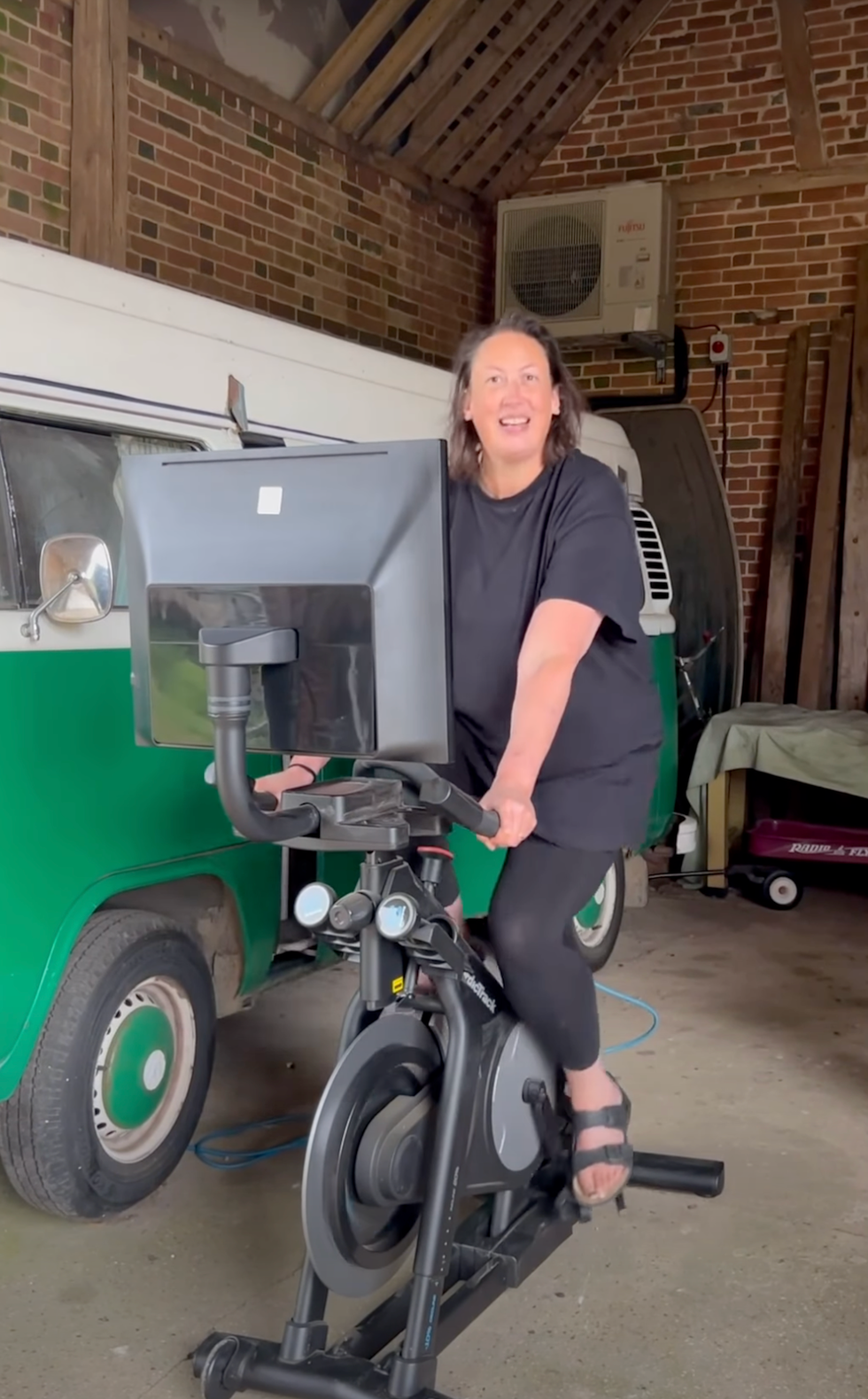 Instagram / @realmirandahart
Miranda recently revealed she’s also been using cycling for recovery
‘Exercising after long-term chronic illness has been quite the thing. I missed exercise so much. Me and my body love it. That’s not sarcastic – many people assume I don’t like it but [I] love sport. The bike has been great for the next stage of recovery,’ she wrote on Instagram.
Low-impact and incredibly effective for cardio fitness, studies have found cycling to be hugely beneficial for different areas of health.
In one study, researchers found that amateur cyclists’ immune systems appeared not to have aged.
Another study found that people who cycled to work had a 47% lower risk of death from any cause compared with non-active commuters, while this paper found that women who performed highly on maximal cycling tests had a significantly lower risk of developing dementia.
And as Miranda herself might put it, compared with a lot of other workouts, cycling can be Such Fun!
One of our most frequently asked questions here at Women’s Health? How to build muscle and burn fat at the same time. So, we asked superstar trainer Oyinda Okunowo exactly how to do it. In this 4-week plan – created exclusively for Women’s Health COLLECTIVE members – you’ll get the workouts and nutrition guidance needed to help you on your way to better body composition. Tap the link below to unlock 14 days of free access to Oyinda’s plan and start training today.

Hannah Bradfield is a Senior Health and Fitness Writer for Women’s Health UK. An NCTJ-accredited journalist, Hannah graduated from Loughborough University with a BA in English and Sport Science and an MA in Media and Cultural Analysis. She has been covering sports, health and fitness for the last five years and has created content for outlets including BBC Sport, BBC Sounds, Runner’s World and Stylist. She especially enjoys interviewing those working within the community to improve access to sport, exercise and wellness. Hannah is a 2024 John Schofield Trust Fellow and was also named a 2022 Rising Star in Journalism by The Printing Charity. A keen runner, Hannah was firmly a sprinter growing up (also dabbling in long jump) but has since transitioned to longer-distance running. While 10K is her favoured race distance, she loves running or volunteering at parkrun every Saturday, followed, of course, by pastries. She’s always looking for fun new runs and races to do and brunch spots to try.