
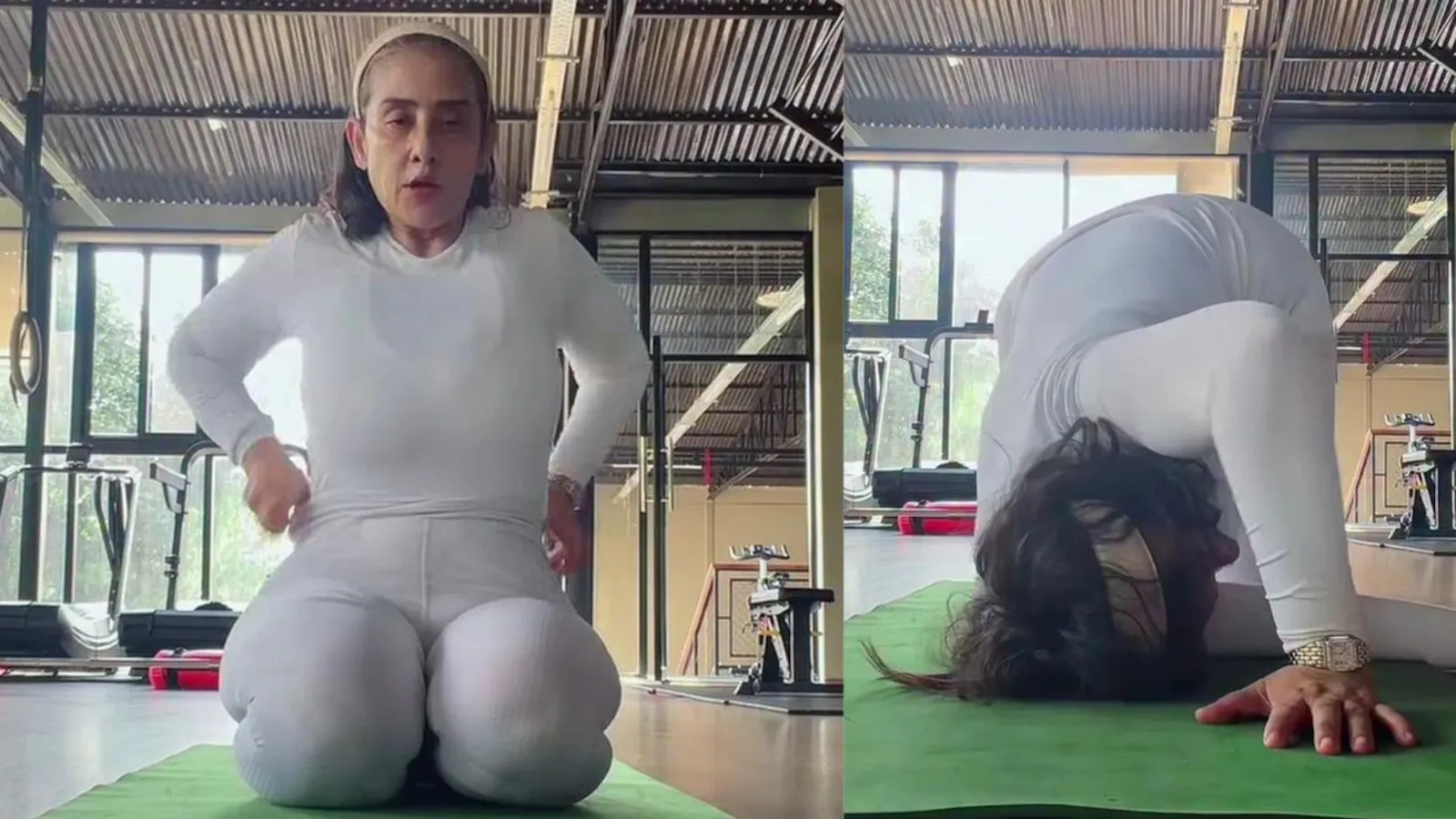
At 56, Manisha Koirala continues to prioritise fitness, and her workout routine shows why staying active is about much more than simply building muscle. The actor recently shared a glimpse of her exercise session on Instagram, combining yoga-based mobility exercises with strength training. Her routine focused on improving flexibility, mobility, balance and muscular strength, all of which can become increasingly important with age. Manisha began her workout with a series of yoga stretches before moving on to strength-training exercises. She started with the classic cat-cow pose, a gentle movement that takes the spine through flexion and extension and can help improve spinal mobility. She then performed the thread-the-needle stretch, which works on rotation through the upper back and can help ease stiffness around the shoulders, neck and upper back. She followed these movements with lunging stretches to work on lower-body mobility before transitioning to strength training.
Manisha Koirala’s Strength Training Routine
The actor began the strength-training portion of her workout with lunges while holding small dumbbells. Lunges engage several major lower-body muscles, including the quadriceps, hamstrings and glutes. They also require the body to maintain stability, making them useful for working on balance and coordination. She then performed lateral leg movements with dumbbells, targeting the muscles around the outer thighs and hips. The workout continued with leg raises and leg circles while lying on a mat, adding controlled movements that engage the core and lower-body muscles. Her workout highlights an important principle of healthy ageing: mobility deserves as much attention as strength.
Why Mobility Becomes Important As We Age
As we get older, muscle mass, joint flexibility, balance and coordination can gradually decline, particularly when physical activity is limited. Reduced mobility can make simple everyday movements, such as climbing stairs, bending down, walking or getting up from a chair, more difficult.
“Mobility exercises typically combine controlled movement, flexibility and joint stability. Simple activities such as shoulder circles, hip rotations, ankle movements, thoracic spine rotations and gentle dynamic stretches can help keep joints moving through their available range,” says Dr Dharam Pandey, Physiotherapy, ShardaCare – Healthcity.
According to the expert, movements such as cat-cow exercises, bodyweight squats, lunges and controlled leg raises can also support mobility when performed correctly.
Mobility And Strength Training Go Hand In Hand
Mobility should not be viewed as an alternative to strength training. For adults in their 50s and beyond, combining the two can help support overall physical function. “Strong muscles provide support to the joints, while good mobility allows the body to move efficiently. Balance-focused exercises are also useful because they can improve stability and body awareness and may help reduce the risk of falls,” explains Dr Pandey.
This is where a routine like Manisha Koirala’s can offer a useful takeaway. Strength exercises help maintain muscle function, while mobility exercises allow the joints and body to move through their available range more comfortably.
How Much Mobility Exercise Do You Need?
You do not necessarily need a long or intense workout to work on mobility. According to Dr Pandey, even 10-15 minutes of mobility exercises a day can be beneficial when done consistently. “Mobility exercises should be adapted to an individual’s fitness level, joint health and previous injuries. Movements should be slow and controlled rather than forced, and pain should not be ignored,” he says.
The focus should therefore be on controlled movement rather than trying to push the body into a deeper stretch. Someone with an existing joint problem, injury or significant stiffness should ideally seek professional guidance before starting a new exercise routine. Manisha Koirala’s workout is a reminder that fitness as we age is not only about lifting heavier weights or doing more repetitions. Maintaining mobility, balance, flexibility and strength can help support movement and independence in everyday life. A combination of mobility exercises, strength training and cardiovascular activity, adapted to individual ability, can make fitness more sustainable as we grow older. The goal is not simply to look fit, but to keep the body strong, mobile and confident enough to handle everyday movements with ease.
Disclaimer: This content including advice provides generic information only. It is in no way a substitute for a qualified medical opinion. Always consult a specialist or your own doctor for more information. NDTV does not claim responsibility for this information.