
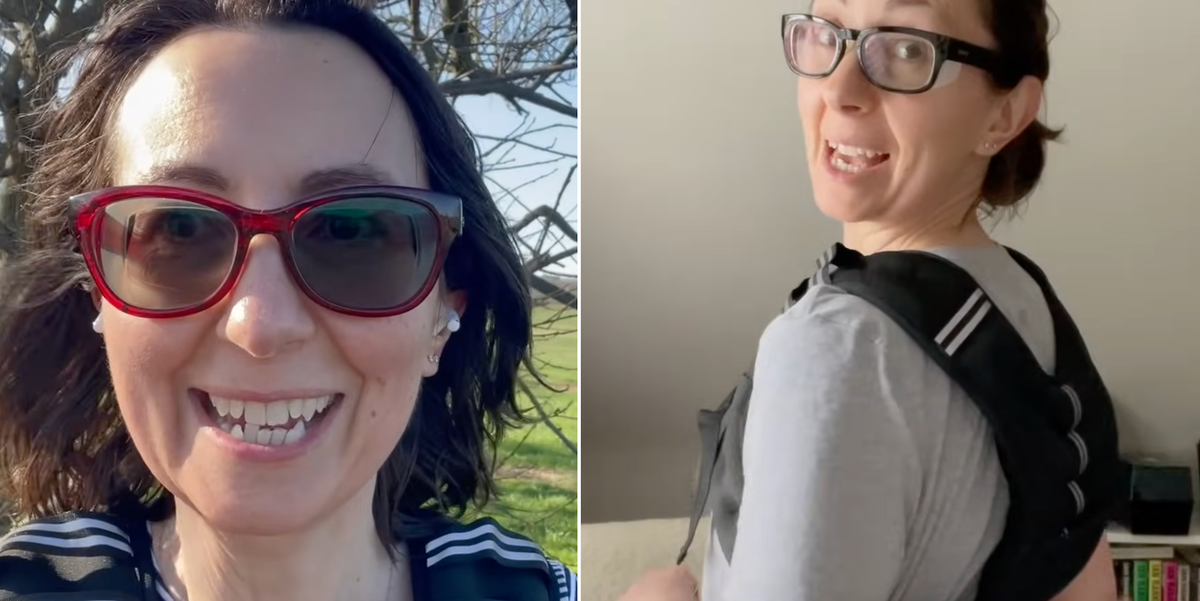
Praised for being an easy way to elevate a walk or workout, weighted vests have become hugely popular in recent years. But have we really stopped to consider whether they are as much of a fitness miracle as the marketing claims?
That was the goal of health coach, YouTuber and retired NHS doctor Dr Ruth Machin as she set out to wear a 5.4kg (12lb) vest for 30 days.
The weighted vest experiment results
To make the experiment as controlled as possible, Dr Machin kept her normal exercise and nutrition habits the same. That meant continuing with her three weekly Peloton cycling workouts, two weekly resistance training sessions and five weekly walks (around 4k each); she only wore the vest during her walks.
‘Because I like science, I wanted to keep everything else constant. So, I changed nothing except for the vest,’ noted Dr Machin in the video documenting her experiment.
Before starting the experiment and upon completion, she recorded her body weight, BMI, waist circumference – a measurement that’s often seen as a key marker of longevity – and thigh circumference. While weight loss wasn’t her goal, Dr Machin lost around half a pound by the end, which she calls ‘pretty negligible’. A result that did surprise her, however, was a 2cm reduction in waist circumference.
Another notable finding? Her legs felt stronger.
‘What surprised me this morning, having struggled a little bit on my bike in the last couple of weeks, I felt really good – my legs felt really strong and it was a really tough ride,’ Dr Machin said of a particularly successful Peloton session.
‘Mid-April, something clicked and I started to feel some real benefits from it [the vest]. My legs definitely felt stronger,’ she added in her post-experiment debrief.
However, by the end of the experiment, Dr Machin said that she had begun to experience some discomfort.
‘I found it really digging into the trapezius – the muscle that goes from the lower neck to the top of your shoulders – and causing some strain on the back of my neck… making the walk less enjoyable,’ she explained.
While she noted that some of the discomfort could have been due to her scoliosis and/or the design of this specific vest, Dr Machin urged viewers never to push through if experiencing any pain. ‘It’s not worth getting injured.’
The research into weighted vests
Alongside the experiment, Dr Machin also reviewed the existing scientific research on weighted vests, and drew the following conclusions.
1. Context is often missed
While there appears to be ‘some evidence that weighted vests can improve bone density, reduce bone turnover and help with muscle strength’, Dr Machin flagged that what’s often overlooked is the fact that research is always context specific.
In other words, she noted, the majority of existing studies compare wearing a vest to doing no exercise at all rather than doing the exercise without the vest. ‘So, what caused the benefit?’ she asked. ‘Was it the vest or was it the movement?’
And actually, one rare study that did compare walking in a weighted vest to walking without, Dr Machin later added, found that it actually made no difference to bone density.
2. There are key evidence gaps
‘There are no studies comparing wearing a vest for walking versus just walking in post-menopausal women,’ she added. Nor, she said, crucially, does there appear to be any studies comparing weighted vests to other forms of resistance exercise.
3. A vest may increase exercise intensity
Dr Machin also highlighted a study that found walking quickly in a light weight was equivalent to walking slower in a heavier weight. ‘This is potentially useful because there’s some people who obviously can’t walk really quickly for medical reasons, and for them, adding a little bit of extra weight could be helpful,’ she noted.
The verdict
All things considered, Dr Machin concluded, weighted vests may be useful in specific contexts. For example, if you can’t do your normal resistance training due to injury and walking is easier (provided you have medical clearance).
As for people who already walk and strength train regularly? She thinks adding a weighted vest is ‘almost a no-brainer, as long as it doesn’t hurt’.
But, added Dr Machin, ‘they’re not, in my opinion, a substitute for resistance exercise with weights – doing a full-body resistance workout, working those big muscle groups is going to be a lot better for building muscle and preserving strength’.
And if you currently don’t do any exercise at all, she advises against jumping straight into a vest. Instead, she recommends, getting ‘used to walking on a regular basis – and by the time you’ve built up to 30-45 minutes, if you’re comfortable, consider adding in a vest’.
One of our most frequently asked questions here at Women’s Health? How to build muscle and burn fat at the same time. So, we asked superstar trainer Oyinda Okunowo exactly how to do it. In this 4-week plan – created exclusively for Women’s Health COLLECTIVE members – you’ll get the workouts and nutrition guidance needed to help you on your way to better body composition. Tap the link below to unlock 14 days of free access to Oyinda’s plan and start training today.
Hannah Bradfield is a Senior Health and Fitness Writer for Women’s Health UK. An NCTJ-accredited journalist, Hannah graduated from Loughborough University with a BA in English and Sport Science and an MA in Media and Cultural Analysis. She has been covering sports, health and fitness for the last five years and has created content for outlets including BBC Sport, BBC Sounds, Runner’s World and Stylist. She especially enjoys interviewing those working within the community to improve access to sport, exercise and wellness. Hannah is a 2024 John Schofield Trust Fellow and was also named a 2022 Rising Star in Journalism by The Printing Charity. A keen runner, Hannah was firmly a sprinter growing up (also dabbling in long jump) but has since transitioned to longer-distance running. While 10K is her favoured race distance, she loves running or volunteering at parkrun every Saturday, followed, of course, by pastries. She’s always looking for fun new runs and races to do and brunch spots to try.