
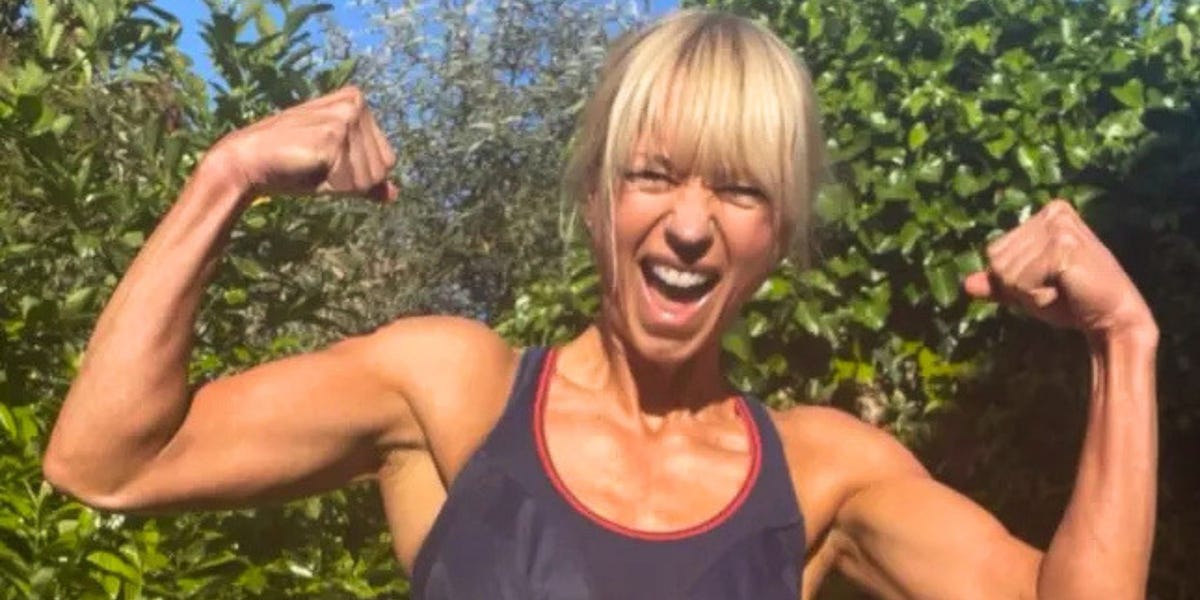
If you’re reading this, chances are you followed Sara Cox’s Children in Need challenge last year – where the 51-year-old broadcaster ran five marathons in five consecutive days. It was an incredible feat of endurance, and a reminder that you can achieve anything you set your mind to. Now, though, after completing a strict course of physiotherapy and a very gradual return to exercise, Cox’s workout routine is about building fitness and strength for both performance and longevity. It’s a balanced, realistic approach that we could all learn from. No marathons necessary.
Sara Cox’s workout routineBlaze
Cox recently shared with Good Housekeeping that she was a member at David Lloyd – ‘the nicest gym I’ve belonged to’. In a separate post on Instagram, she quipped: ‘Traditionally the 3 little words people wanna hear is “I love you” but for me it’s gotta be trainer Saul saying “CARDIO HIT ZERO” during a Blaze class when I’m legging it on the treadmill.’
Blaze is David Lloyd’s signature high-intensity interval training class, combining cardio, strength training and boxing (participants rotate between the three). The 45-55 minute sessions are designed for all levels, but expect energy levels similar to Barry’s Bootcamp.
Across multiple studies, HIIT in women over 50 is consistently linked to better heart fitness (proven by VO₂ max, the max amount of oxygen you can use during exercise), improved mobility and functional capacity, and better fat loss and metabolic health. The key is to combine it with strength training to avoid injury, and to take a progressive approach. Blaze classes are billed as ‘all-levels’, but try a shorter at-home HIIT workout if you’ve never done the style of workout before.
Strength training
In the same interview with Good Housekeeping, Cox revealed that she regularly weight trains. ‘It’s really important for women to do strength training a couple of times a week if they can,’ she said, adding that she ‘goes to the gym a few times a week, even if I’m super busy.’
On her road to recovery post-challenge, she worked with physio Nick Worth and leading sports scientist Professor Greg Whyte. Resistance work was a big part of her return to exercise, but starting small was key. ‘Barely any weight and low reps,’ Cox wrote in a post on Instagram documenting her workout in November 2025. ‘But good to be (kinda) back.’
Research consistently shows that strength training is one of the most effective ways for women in their 50s and beyond to protect health, function and independence. It counteracts sarcopenia (age-related muscle loss), improves bone density, supports hormonal and metabolic health, enhances balance and reduces injury risk. Aim for two-three sessions per week.
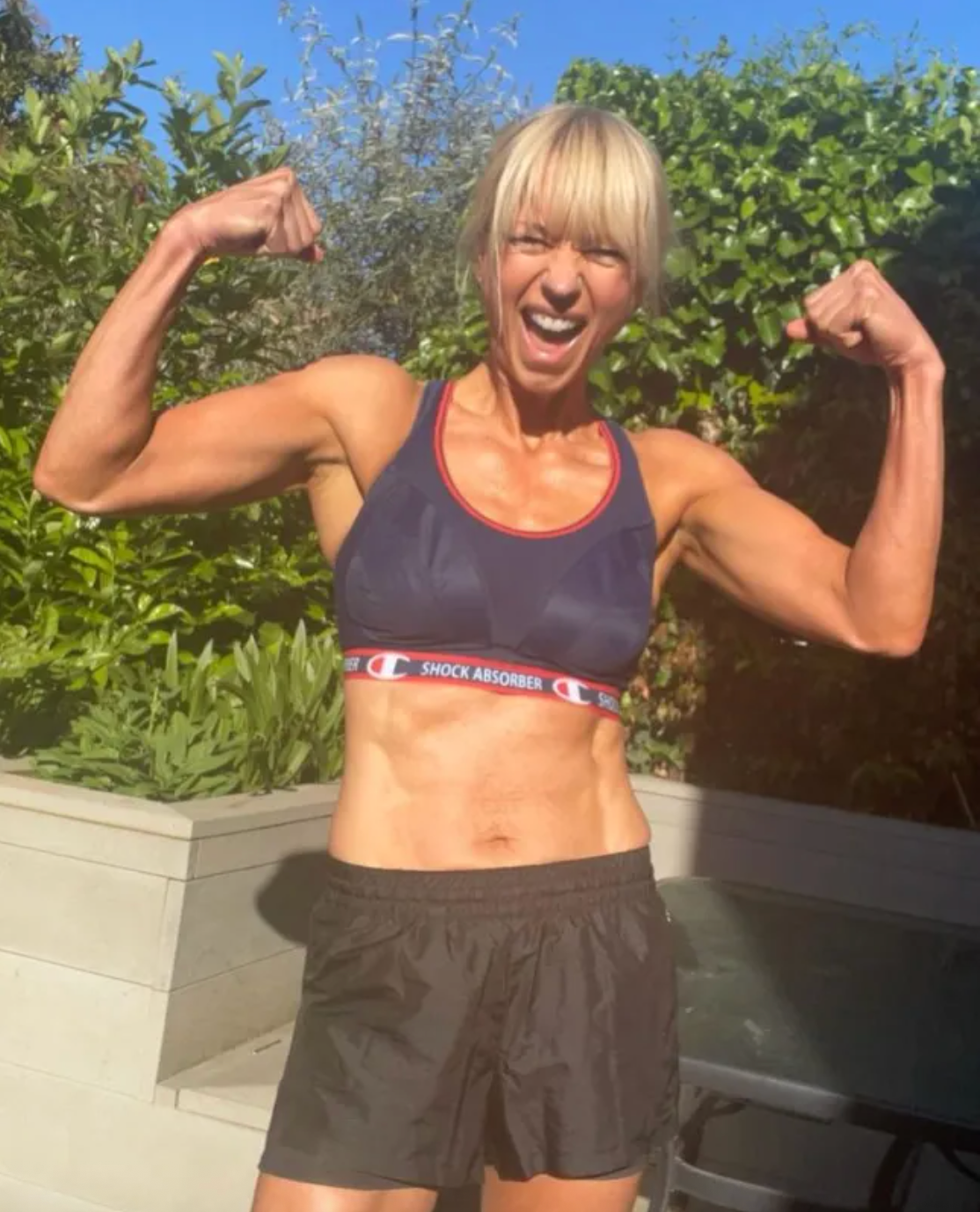 Instagram
Cox gave up alcohol and completed a ten-week training programme in 2022
Dog walking
Daily dog walks are a non-negotiable within Cox’s routine. When asked what she recommends to other women, she answered: ‘Move more! Get out, walk the dog, eat well.’
Dog walking is a form of NEAT exercise. Standing for Non-Exercise Activity Thermogenesis, it’s a form of movement you do that isn’t planned exercise, and makes up significantly more of your TDEE (Total Daily Energy Expenditure – how many calories you burn across each day), compared to the time you spend exercising in a gym or doing a planned workout. NEAT makes up 50% of your TDEE, while a planned workout typically counts for around 10%. Dog walking, like Cox, is a great example. Good Morning Britain host Kate Garraway is also a big advocate of NEAT exercise, with her go-to form being gardening. Other examples include playing with your children, using a standing desk, or washing the car.
Taking the stairs
A second form of NEAT movement for Cox is taking the stairs over the lift or escalator. She told Good Housekeeping she does this specifically at work since ‘we’re on the eighth floor at new Broadcasting House.’ Like dog walking or gardening, it’s about building more movement into your day – without relying on structured workouts.
Horse riding
If you’re one of Cox’s 662k Instagram followers, you’ll know she’s a keen horse rider. She regularly posts videos of her riding, and there’s a solid (and growing) body of research showing that it can be particularly beneficial for women in their 50s and beyond. Some show it enhances both static and dynamic balance, others show it significantly strengthens your core as it requires constant micro-adjustments to stay upright on a moving animal, and one study shows even light-to-moderate riding of 30 minutes counts as meaningful aerobic activity, supporting heart health without the joint impact of other high-intensity cardio. It’s a low-impact, full-body workout that supports critical factors of healthy ageing.
RELATED STORIES
As Women’s Health UK’s fitness director and a qualified Pilates and yoga instructor, Bridie Wilkins has been passionately reporting on exercise, health and nutrition since the start of her decade-long career in journalism.
After earning a first-class degree in journalism and NCTJ accreditation, she secured her first role at Look Magazine, where she launched the magazine’s health and fitness column, Look Fit, before going on to become Health and Fitness writer at HELLO!
Since, she has written for Stylist, Glamour, Cosmopolitan, Marie Claire, Elle, The Metro, Runner’s World and Red. Today, she oversees all fitness content across Women’s Health online and in print, spearheading leading cross-platform franchises, such as ‘Fit At Any Age’, which showcases the women proving that age is no barrier to exercise.
She has also represented the brand on BBC Radio London, plus various podcasts and Substacks – all with the aim to encourage more women to exercise and show them how. Outside of work, find her trying the latest Pilates studio, testing her VO2 max for fun (TY, Oura), or posting workouts on Instagram.